Vedic Astrology
How to Read a Vedic Birth Chart: A Practical Framework for Beginners
Kushal Agarwal · 2 Sept 2026 · 22 min read
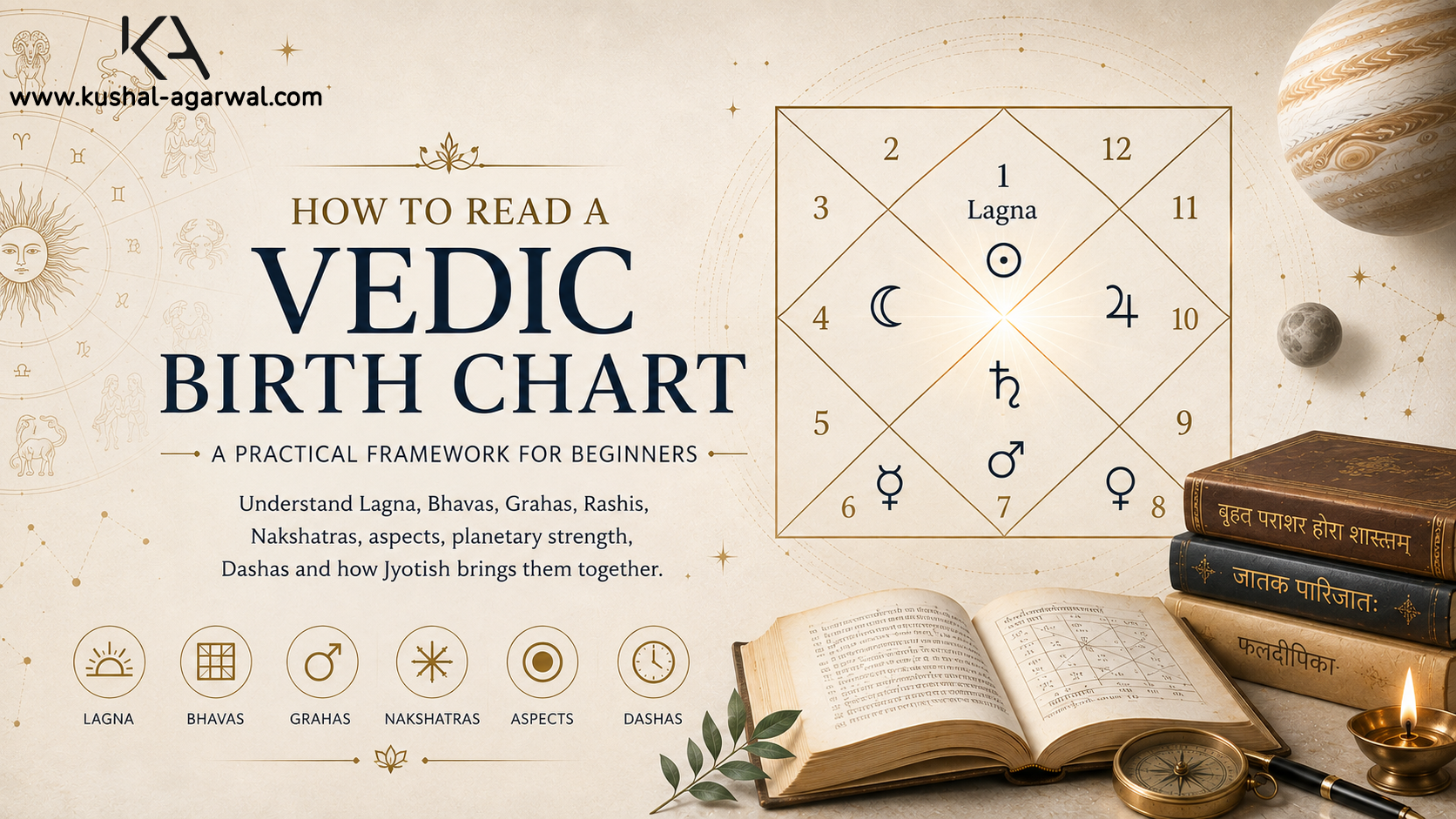
How to Read a Vedic Birth Chart: A Practical Framework for Beginners
The first time someone opens a Vedic birth chart, it can look intimidating.
Twelve houses.
Nine Grahas.
Twelve Rashis.
Nakshatras.
Aspects.
House lordships.
Dashas.
Divisional charts.
Yogas.
And then someone tells you:
"Just look at where Jupiter is."
That is usually where the confusion begins.
Because Jyotish is not really a system of isolated planetary keywords.
A birth chart is a system of relationships.
A planet occupies a house.
That house falls in a sign.
The planet rules particular houses.
It may be associated with another planet.
It may aspect other houses.
It occupies a Nakshatra.
It has a certain degree of strength.
It becomes active during particular periods.
And all of these factors interact.
That is why two people can have the same planet in the same sign and still experience completely different lives.
The purpose of learning Jyotish is therefore not to memorise more and more rules.
It is to learn how to put the rules together.
This article presents a practical framework for doing exactly that.
What Is a Vedic Birth Chart?
A Vedic birth chart, commonly called a Janma Kundali, is a map of the sky calculated for the time and place of birth.
In the classical Jyotish framework, the chart considers the positions of the Grahas in relation to the zodiac, the Lagna and the Bhavas.
The foundational Parashari tradition describes Jyotish through concepts including Grahas, Rashis, Bhavas and Nakshatras. The Brihat Parashara Hora Shastra describes the zodiac as divided into twelve Rashis and refers to the twenty-seven Nakshatras through which the Grahas move. :contentReference[oaicite:1]{index=1}
The chart is therefore not merely a picture.
It is a structured representation of planetary relationships at a particular moment.
The First Rule: Start With the Lagna
If you are learning Jyotish, the Lagna should usually be your starting point.
The Lagna is the sign rising on the eastern horizon at the moment of birth.
It establishes the framework of the horoscope.
Once the Lagna is known, the twelve houses can be arranged from it.
That means the Lagna determines:
Which sign becomes the 1st house.
Which planet rules the 1st house.
Which planets become functional benefics or malefics for that horoscope.
Which signs occupy the other houses.
And therefore, much of the structural logic of the chart.
This is why the same planet can behave very differently for two people with different Ascendants.
Why the Lagna Matters So Much
Suppose Jupiter is in Aries.
That statement alone tells us something about Jupiter's sign placement.
But it does not tell us the complete story.
For one Ascendant, Aries may be the 2nd house.
For another, it may be the 5th.
For another, the 9th.
The house changes.
Jupiter's lordship changes.
Its relationship with the rest of the horoscope changes.
Therefore:
Never interpret a planet's sign placement without knowing the Lagna.
Step 2: Understand the Twelve Bhavas
The next step is to understand the twelve houses.
Each Bhava represents a field of life.
A simplified framework is:
1st — self, body, identity and overall orientation
2nd — wealth, speech, family and accumulated resources
3rd — courage, communication, skills, initiative and siblings
4th — home, mother, emotional foundations, property and inner security
5th — intelligence, creativity, children, learning and Purva Punya
6th — disease, debt, competition, service and obstacles
7th — marriage, partnerships and interaction with others
8th — longevity, transformation, inheritance and hidden matters
9th — Dharma, father, Guru, higher learning and fortune
10th — career, profession, action and public role
11th — gains, networks, ambitions and fulfilment of desires
12th — expenditure, isolation, foreign environments, sleep and liberation
These are starting points.
They are not complete definitions.
The 8th house, for example, cannot be reduced to "death."
The 12th cannot be reduced to "loss."
The 5th cannot be reduced to "children."
Every house contains a much wider range of significations.
A House Is More Than Its Keyword
This is one of the biggest differences between memorising astrology and actually learning it.
If someone tells you:
"10th house = career"
you know almost nothing.
You still need to ask:
Who rules the 10th?
Where is the 10th lord?
Which planets occupy the 10th?
Which planets aspect the 10th?
What is the condition of the 10th lord?
What is happening in the relevant Dasha?
What do the divisional charts say?
Only then does "career" become an astrological interpretation.
The Bhava gives us the field.
The rest of the horoscope tells us how that field is likely to operate.
Step 3: Identify the Bhava Lords
Once you know the Lagna, identify the ruler of every house.
This is one of the most important steps in reading a chart.
For example, if Aries is the Ascendant:
Mars rules the 1st house.
Venus rules the 2nd and 7th.
Mercury rules the 3rd and 6th.
Moon rules the 4th.
Sun rules the 5th.
Jupiter rules the 9th and 12th.
Saturn rules the 10th and 11th.
Now you can begin tracing relationships.
Where is the 10th lord?
Where is the 7th lord?
Where is the 9th lord?
Where is the 5th lord?
Which houses are these planets connecting?
This is where the horoscope starts becoming a network rather than a diagram.
Why House Lordship Is So Important
Consider a simple example.
Suppose the 10th lord is placed in the 2nd house.
Immediately, two areas become connected:
Career.
Wealth, family and speech.
This could manifest through many possibilities.
A career connected with finance.
Income through speech or communication.
Family business.
Professional activity contributing directly to accumulated wealth.
Or something else entirely.
The chart does not give us one automatic answer.
It gives us a relationship that must be interpreted.
Step 4: Look at the Grahas
Now examine the planets.
The nine Grahas traditionally used in Jyotish are:
Sun.
Moon.
Mars.
Mercury.
Jupiter.
Venus.
Saturn.
Rahu.
Ketu.
The first seven are the visible classical Grahas.
Rahu and Ketu are the lunar nodes.
The Grahas represent different principles.
A very simplified starting framework is:
Sun — identity, authority, vitality and leadership
Moon — mind, emotions, memory and receptivity
Mars — energy, courage, competition and action
Mercury — intellect, communication, calculation and commerce
Jupiter — wisdom, knowledge, Dharma and expansion
Venus — relationships, pleasure, aesthetics and values
Saturn — time, discipline, responsibility and structure
Rahu — amplification, desire, unconventional experience and obsession
Ketu — separation, detachment, insight and discontinuity
But these are not rigid definitions.
A planet can express itself differently depending on its context.
Never Stop at "Planet = Keyword"
This is perhaps the single most important lesson for a beginner.
If Jupiter means wisdom, that does not mean:
"Jupiter in the 10th = teacher."
If Venus means relationships, it does not mean:
"Venus in the 7th = perfect marriage."
If Saturn means delay, it does not mean:
"Saturn in the 10th = failed career."
These statements are too simplistic.
A planet has:
Natural significations.
House lordships.
A house placement.
A sign placement.
A Nakshatra.
Associations.
Aspects.
Strength.
And timing.
All of these matter.
Step 5: Examine the Sign
A planet operates through the sign it occupies.
The twelve Rashis are:
Aries.
Taurus.
Gemini.
Cancer.
Leo.
Virgo.
Libra.
Scorpio.
Sagittarius.
Capricorn.
Aquarius.
Pisces.
The sign provides an environment through which the planet expresses itself.
Mars in Aries and Mars in Cancer are not the same Mars.
Jupiter in Sagittarius and Jupiter in Capricorn are not the same Jupiter.
Saturn in Aquarius and Saturn in Aries are not the same Saturn.
Therefore, planet and sign should always be read together.
Sign Is Not House
This distinction confuses many beginners.
A sign and a house are not the same thing.
The sign describes the zodiacal environment.
The house describes the field of life.
If Taurus is rising, Taurus becomes the 1st house.
Gemini becomes the 2nd.
Cancer the 3rd.
And so on.
The sign tells you "what kind."
The house tells you "where."
The planet tells you "what principle is operating."
This is an oversimplification, but it is a useful starting framework.
Step 6: Check Planetary Dignity
Next, examine the condition of the planet.
Is it exalted?
Debilitated?
In its own sign?
In its Moolatrikona?
In a friendly sign?
In an enemy sign?
These conditions modify the planet's capacity to operate.
A planet in a supportive environment may express its significations more easily.
A planet in a difficult environment may struggle or express them differently.
But dignity is still only one factor.
An exalted planet does not automatically give perfect results.
A debilitated planet does not automatically destroy everything it touches.
Context remains essential.
Strength Is Not the Same as Goodness
This is a subtle but crucial distinction.
A planet can be strong and still produce difficult results.
Imagine a strongly placed Mars ruling difficult houses.
Its strength may mean that Mars produces its results very effectively.
That does not necessarily mean those results will always be pleasant.
Likewise, a weak benefic may not be able to deliver all of its promised results despite having a naturally supportive nature.
Therefore, always separate two questions:
How strong is the planet?
and
What does the planet signify in this horoscope?
They are not the same question.
Step 7: Examine Conjunctions
Next, see which planets occupy the same house.
When two or more Grahas are together, they influence one another.
This can create powerful combinations.
For example:
Sun + Mercury.
Mars + Saturn.
Jupiter + Moon.
Venus + Saturn.
The meaning depends on the planets involved, their degrees, house, sign, lordship and strength.
A conjunction is not automatically a Yoga.
Nor is every conjunction necessarily beneficial or harmful.
Again, interpretation comes from context.
Step 8: Examine Drishti
A planet does not influence only the house it occupies.
It also casts Drishti, or aspect.
The classical Parashari framework gives all seven classical Grahas a full 7th aspect, while Mars, Jupiter and Saturn have additional special aspects. Mars aspects the 4th and 8th, Jupiter the 5th and 9th, and Saturn the 3rd and 10th, in addition to their 7th aspects. :contentReference[oaicite:2]{index=2}
This is one of the reasons a horoscope is interconnected.
A planet can influence another house without occupying it.
Drishti Changes the Interpretation
Suppose the 10th house contains no planets.
That does not mean the 10th house is irrelevant.
Ask:
Who rules the 10th?
Where is the 10th lord?
Which planets aspect the 10th?
What is the condition of the 10th lord?
Which Dasha is operating?
Suddenly the "empty" 10th house is anything but empty.
This is why beginners should never ignore an unoccupied house.
Step 9: Examine the Nakshatra
Once the basic structure is understood, move deeper.
The zodiac is divided into 27 Nakshatras in the classical framework. :contentReference[oaicite:3]{index=3}
Each Graha occupies a Nakshatra.
The Nakshatra can provide another layer of interpretation.
For example, two people may both have Venus in Taurus.
But if their Venus occupies different Nakshatras, the finer expression can differ.
This is one reason Nakshatra analysis becomes increasingly important as the student moves beyond basic chart reading.
Why Nakshatra Should Not Be Your First Step
Nakshatras are powerful.
But beginners sometimes start with them too early.
They learn:
Planet.
Nakshatra.
Pada.
Deity.
Symbol.
And then attempt to predict.
This creates information overload.
Start with the architecture.
Lagna.
Houses.
Lords.
Planets.
Signs.
Then aspects.
Then Nakshatras.
Then strength and timing.
A good astrologer needs depth.
But depth without structure becomes confusion.
Step 10: Look for Relationships Between Houses
Now begin asking the most interesting questions.
Which houses are connected?
Suppose:
5th lord → 10th house.
Education or intelligence becomes connected with career.
Suppose:
9th lord → 5th house.
Dharma and higher knowledge become connected with intelligence and creativity.
Suppose:
2nd lord → 11th house.
Accumulated wealth becomes connected with gains.
Suppose:
7th lord → 10th house.
Partnership becomes connected with profession.
These are not predictions yet.
They are structural relationships.
Prediction comes after timing and corroboration.
Step 11: Identify Yogas
Once the basic structure is understood, you can begin examining Yogas.
Yoga means a combination or relationship.
Jyotish contains many different types of Yogas.
Raj Yogas.
Dhana Yogas.
Dharma-Karma relationships.
Viparita Raja Yogas.
Neecha Bhanga.
And many others.
But this is another area where beginners often make mistakes.
They discover one Yoga on a website and immediately declare:
"You will become extremely wealthy."
That is not enough.
A Yoga must be evaluated in the context of the complete horoscope.
A Yoga Is Not a Lottery Ticket
Suppose a chart contains a classical wealth combination.
That does not automatically mean unlimited wealth.
Ask:
Are the planets strong?
Are they afflicted?
Are the relevant houses strong?
Is the Yoga activated by Dasha?
Do transits support the period?
Does the divisional chart reinforce the theme?
Do other combinations contradict it?
A Yoga is an indication.
It is not a guarantee detached from the rest of the horoscope.
Step 12: Understand the Dashas
Now we reach one of the most important parts of predictive Jyotish.
Dasha.
A birth chart describes the underlying structure.
Dashas help determine when particular planetary themes become active.
The Vimshottari Dasha system is one of the most widely used systems in Parashari Jyotish.
The planetary periods are assigned according to a fixed sequence and duration.
When a planet's Mahadasha or Antardasha operates, the significations of that planet can become much more prominent.
But again, the planet's natal condition determines what it has to deliver.
The Dasha Does Not Create a New Horoscope
This is a common misconception.
Suppose Saturn is badly placed in the birth chart.
Saturn Dasha does not suddenly create Saturn's placement.
That placement already exists.
The Dasha activates it.
Likewise, a well-placed Jupiter does not suddenly become good only because Jupiter Dasha begins.
Its promise was already present.
The Dasha brings the relevant themes to the foreground.
Natal Promise Comes First
This is one of the most important principles in predictive astrology.
Timing cannot create a promise that the birth chart does not contain.
If a particular event is strongly promised through multiple chart factors, the appropriate Dasha and transit may activate it.
If the underlying promise is weak or absent, a Dasha should not be used to manufacture certainty.
This principle helps prevent exaggerated predictions.
Step 13: Examine Transits
After understanding the natal chart and Dasha, examine current planetary movement.
This is Gochar.
Transits show where the planets are moving now relative to the natal horoscope.
A transit can activate houses, planets and existing chart patterns.
But transits should generally be interpreted alongside the natal promise and Dasha.
A transit by itself is rarely enough for a major prediction.
The Three-Layer Approach
A practical way to think about prediction is:
Natal chart → Dasha → Transit
The natal chart tells us:
What is possible and structurally indicated.
The Dasha tells us:
Which planetary themes are becoming active.
The transit tells us:
What is happening in the current astronomical environment.
When all three point toward the same theme, the interpretation becomes much stronger.
Step 14: Check Divisional Charts
Eventually, a serious student must move beyond the Rashi chart.
Jyotish contains several Varga, or divisional charts.
The most famous is the Navamsha (D9).
Other divisional charts are used for specific areas of interpretation.
For example, practitioners may use different Vargas to examine:
Marriage.
Career.
Children.
Wealth.
Spiritual development.
And other areas.
But divisional charts should not be treated as completely independent horoscopes.
They are part of a larger interpretive framework.
Why the Navamsha Matters
The Navamsha is especially important in classical Jyotish practice.
It is used extensively in assessing planetary strength and for examining marriage and Dharma-related themes.
But a common beginner mistake is to jump directly to the Navamsha and ignore the birth chart.
The D1 remains fundamental.
The D9 adds depth.
It does not replace the foundation.
Step 15: Look at the Moon
The Moon deserves special attention.
The Moon represents the mind, emotional experience, memory and receptivity.
Therefore, Jyotish often examines the horoscope from both:
The Lagna.
And the Moon.
A person's external circumstances and subjective experience are not always identical.
Two people can experience the same event differently.
The Moon helps us understand that internal dimension.
The Sun and Moon Tell Different Stories
The Sun and Moon should not be treated as interchangeable.
The Sun relates strongly to identity, vitality, authority and individuality.
The Moon relates to mind, emotion, memory and experience.
A strong Sun with a challenged Moon can describe someone who appears confident but internally experiences considerable emotional turbulence.
A strong Moon with a challenged Sun can produce a different pattern.
Again, this is not a diagnosis.
It is an interpretive framework.
Step 16: Do Not Ignore Functional Lordship
This is where Jyotish becomes more sophisticated.
A planet has its natural nature.
But its role in a particular horoscope also depends on the houses it rules.
This is called functional lordship.
The same planet can therefore operate differently for different Ascendants.
This is why generic statements such as:
"Saturn is bad."
or:
"Jupiter is always good."
are inadequate.
The horoscope changes the role of the planet.
Natural Benefic Does Not Mean Universally Beneficial
Jupiter is naturally benefic.
Venus is naturally benefic.
Mercury and Moon can also behave benefically under appropriate conditions.
Mars and Saturn are naturally considered malefic.
But natural nature is only one layer.
Functional lordship can alter how a planet operates for a particular Lagna.
This is why serious chart interpretation requires knowing the Ascendant before making conclusions about planetary results.
Step 17: Examine Planetary Strength
After understanding the structure, examine strength.
Jyotish has several systems for assessing planetary strength.
One important classical framework is Shadbala, which evaluates different dimensions of planetary strength.
There are also other considerations:
Dignity.
Combustion.
Retrogression.
Avasthas.
Directional strength.
Planetary relationships.
And more.
Not every chart reading requires calculating every metric manually.
But the principle is important:
A planet's placement tells you where it operates. Its strength helps tell you how effectively it can operate.
Retrograde Planets
A retrograde planet is called Vakri.
Retrogression should not automatically be interpreted as weakness.
A retrograde planet can express its significations in an unusual, intensified, repetitive or more internalised manner.
Its actual results still depend on the planet, house, sign, lordship, strength and timing.
This is why:
"Saturn retrograde = bad."
is not a sufficient interpretation.
Combustion
Another condition students encounter is combustion.
A planet becomes combust when it comes sufficiently close to the Sun according to the relevant astronomical and astrological rules.
Combustion is another modifying factor.
It does not automatically mean that the planet becomes completely ineffective.
As with retrogression, interpretation depends on context.
This is an important general principle:
Planetary conditions modify interpretation. They do not replace it.
Step 18: Learn to Separate Promise From Event
This distinction separates mature interpretation from superficial prediction.
A chart may indicate strong career potential.
That does not tell you the exact date someone gets promoted.
A chart may indicate relationship potential.
That does not tell you that marriage will happen in a particular month.
A chart may indicate financial capacity.
That does not guarantee wealth regardless of decisions.
The horoscope gives patterns and potential.
Timing and circumstances determine expression.
And human choices still matter.
Astrology Is Not Fatalism
One of the biggest misconceptions about Jyotish is that a horoscope means everything is predetermined.
That is not the only way to understand astrology.
A chart can be viewed as describing tendencies, circumstances, strengths, vulnerabilities and periods of activation.
What a person does with those circumstances is another question.
This distinction matters.
If astrology becomes:
"Your chart says this, therefore you have no choice."
then it becomes fatalism rather than a tool for reflection and decision-making.
Step 19: Look for Repetition
A powerful practical rule for chart interpretation is:
Look for the same theme appearing more than once.
Suppose you are examining career.
You find:
10th lord strongly connected with the 10th.
A strong Sun or Saturn influencing career.
Relevant Dasha activation.
Supportive divisional-chart indications.
A corresponding transit.
Now the career theme has multiple layers of confirmation.
That is much stronger than finding one isolated combination.
The Principle of Convergence
Good Jyotish interpretation is often about convergence.
If five different parts of the chart point toward the same subject, pay attention.
If one obscure rule contradicts everything else, do not immediately throw away the entire interpretation.
Investigate.
Perhaps the contradiction is another layer.
Perhaps the original rule is being applied incorrectly.
Perhaps the planet has a different functional role.
This is why astrology requires judgement.
What Beginners Should Not Do
Do not begin by reading every planet individually.
Do not memorise hundreds of Yogas before understanding houses.
Do not predict marriage from Venus alone.
Do not predict wealth from Jupiter alone.
Do not predict career from the 10th house alone.
Do not predict children from the 5th house alone.
Do not predict divorce from one affliction.
Do not declare Pitra Dosha from one planetary combination.
Do not use one transit to predict an entire year.
And do not treat astrology websites as substitutes for learning the underlying system.
A Better Reading Sequence
If you have a birth chart in front of you, use this sequence:
1. Identify the Lagna.
2. Map the twelve houses.
3. Identify the lord of each house.
4. Locate the house lords.
5. Examine the planets occupying important houses.
6. Examine signs and planetary dignity.
7. Check conjunctions.
8. Check Drishti.
9. Examine the Moon.
10. Examine Nakshatras.
11. Identify important Yogas.
12. Assess planetary strength.
13. Examine the relevant divisional chart.
14. Examine Dasha.
15. Examine transits.
16. Look for repetition and convergence.
This sequence prevents you from jumping directly into prediction.
Start With the Question
There is another practical improvement.
Do not always read the entire horoscope with equal intensity.
Start with the question.
If the person asks about career:
Start with the 10th house.
10th lord.
6th house.
2nd house.
11th house.
Relevant significators.
Dasha.
Relevant divisional chart.
Then expand into the rest of the chart.
If the question is marriage:
7th house.
7th lord.
Venus.
Relevant significators.
Navamsha.
Dasha.
Transits.
And then the broader horoscope.
This makes chart interpretation much more efficient.
The Horoscope Is a System
The deeper you go into Jyotish, the less useful isolated keywords become.
You stop asking:
"What does Saturn mean?"
and start asking:
"What is Saturn doing in this horoscope?"
You stop asking:
"What does the 10th house mean?"
and start asking:
"Who rules the 10th, where is that planet, who influences the 10th, and when is that configuration activated?"
That shift is the beginning of real interpretation.
From Memorisation to Judgement
Anyone can memorise:
Mars aspects the 4th, 7th and 8th.
Jupiter aspects the 5th, 7th and 9th.
Saturn aspects the 3rd, 7th and 10th.
But knowing those rules does not make someone a good astrologer.
The skill lies in knowing:
When they matter.
How strongly they matter.
What they mean in that particular horoscope.
And what other factors confirm or contradict the interpretation.
That is the difference between astrological information and astrological judgement.
Why Learning Jyotish Takes Time
There is a reason traditional Jyotish education cannot realistically be reduced to a list of planetary keywords.
The system contains layers.
Grahas.
Rashis.
Bhavas.
Nakshatras.
Drishti.
Lordships.
Yogas.
Strength.
Dashas.
Vargas.
Transits.
And interpretive judgement.
Each layer modifies the others.
The objective is therefore not to memorise everything immediately.
It is to build the architecture first.
A Simple Mental Model
If you are completely new to Jyotish, remember this:
House = Where
Planet = What
Sign = How
Lordship = Responsibility
Drishti = Influence
Nakshatra = Finer layer
Strength = Capacity
Dasha = When
Transit = Current activation
This is not a complete definition of any of these concepts.
But as a learning framework, it is extremely useful.
The Most Important Question
When reading a horoscope, do not ask only:
"What does this placement mean?"
Ask:
"What relationships does this placement create?"
That one change in questioning can transform the way you read charts.
A planet connects houses through lordship.
It influences houses through Drishti.
It interacts with planets through conjunction.
It expresses through a sign.
It operates through a Nakshatra.
It becomes active through Dasha.
And it is further modified by transit.
That is the horoscope.
Final Thoughts
A Vedic birth chart can appear complicated because it contains a tremendous amount of information.
But you do not need to interpret everything simultaneously.
Start with the Lagna.
Build the twelve houses.
Understand the house lords.
Locate the Grahas.
Examine their signs and strength.
Look at conjunctions and Drishti.
Add Nakshatras.
Then examine Yogas.
Then timing.
Then divisional charts.
And throughout the process, look for one thing:
relationships.
Because a horoscope is not twelve isolated boxes.
It is a network.
The 10th house is connected to its lord.
The lord is connected to another house.
That house may contain another planet.
That planet may aspect the 10th.
A Dasha may activate the planet.
A transit may trigger the same area.
And suddenly several apparently unrelated pieces begin telling the same story.
That is when Jyotish becomes interesting.
Not when you can recite the most rules.
But when you can see how the rules fit together.
The real skill in Jyotish is therefore not memorisation.
It is judgement.
And judgement begins with learning to read the horoscope as a whole.
About Kushal Agarwal
I am Kushal Agarwal, a practitioner and teacher of Jyotish with an academic and professional background spanning engineering, management, astrology and business.
My approach to astrology is rooted in learning the system rather than relying on isolated planetary keywords or generic predictions.
Through Kushal-Agarwal.com, I write about Vedic Astrology, Jyotish methodology, interpretation, Karma, timing and the practical application of astrological principles.
The objective is simple:
Understand the system. Develop judgement. Interpret with clarity.
Suggested Internal Links
- What Is Jyotish? Understanding the Indian Astrology Tradition
- The 12 Houses in Vedic Astrology: A Practical Guide
- The 9 Grahas in Jyotish: What Each Planet Represents
- The 12 Rashis in Vedic Astrology
- Drishti in Jyotish: How Planets Influence Houses and Each Other
- Retrograde Planets in Jyotish: What Does Vakri Really Mean?
- Understanding Nakshatras in Jyotish
- Vimshottari Dasha: How Planetary Periods Work
- The Navamsha Chart: Why the D9 Matters
- Karma and Free Will in Vedic Astrology
Want to go beyond memorising planetary keywords?
Explore more articles on Kushal-Agarwal.com and learn Jyotish through structure, relationships, timing and practical chart interpretation.
Learn the system. Develop judgement. Interpret with clarity.
Sources
Brihat Parashara Hora Shastra — Chapter 1, Jyotish and its divisions: https://parashara.net/index.php?page=chapter1
Brihat Parashara Hora Shastra — Chapter 3, Grahas, Rashis, Nakshatras and Lagna: https://parashara.net/index.php?page=chapter3
Brihat Parashara Hora Shastra — Chapter 26, Drishti of Grahas: https://vedicpupil.in/library/brihat-parashara-hora-shastra-book-by-parashara/grahasphutadrishtikathan-ch26
Brihat Parashara Hora Shastra — Planetary aspects: https://divyachadhava.com/en/sanatan-sahitya/bphs-chapter-26-evaluation-of-drishtis-of-grahas
Want this read for your own chart?
Every session blends Vedic astrology, numerology and counselling psychology — your chart read as architecture, not prophecy. Bring the decision you are actually sitting with, and leave with timing, language and a next step.