Vedic Astrology
Maa Skandamata: The Power of Divine Motherhood, Protection and Wisdom
Kushal Agarwal · 19 Oct 2026 · 11 min read
Maa Skandamata: The Power of Divine Motherhood, Protection and Wisdom
The Divine Mother does not express her power in only one way. Sometimes she appears as the strength that carries us through uncertainty. Sometimes she is the discipline that sustains our spiritual practice. At other times, her power emerges through compassion, protection and the responsibility of nurturing life.
Maa Skandamata embodies this last expression of Shakti.
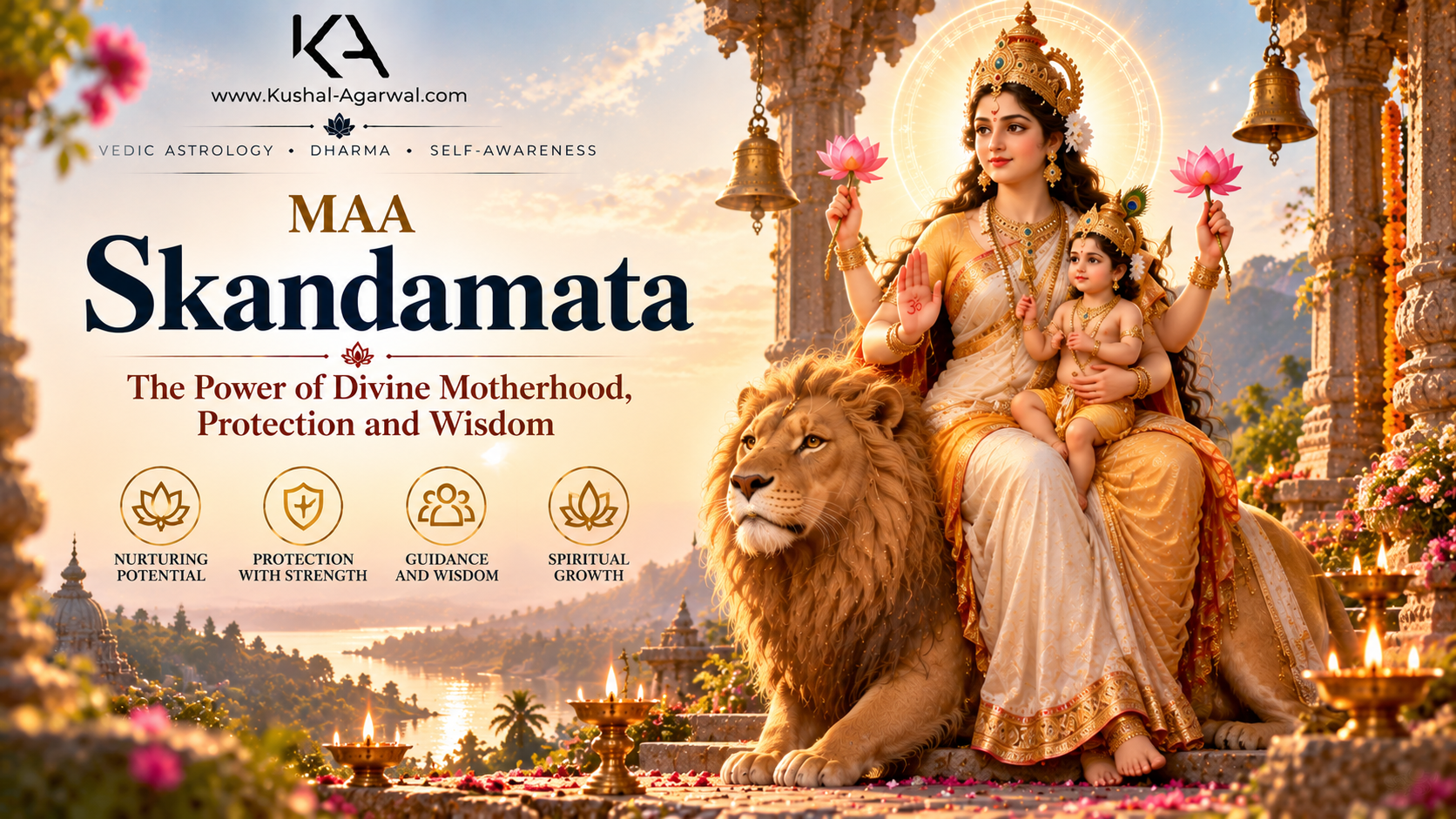
The fifth form of Navadurga, Skandamata is worshipped as the mother of Skanda, also known as Kartikeya. Her traditional iconography presents a striking combination: a mother holding her child, seated upon a lion, with lotus flowers in her hands. Tenderness and formidable power exist together in the same image.
For students of Hindu symbolism, this form offers a deeper lesson. True strength is not merely the ability to conquer opposition; it is also the ability to protect, nurture and guide what has been entrusted to us.
1. Who Is Maa Skandamata?
The name Skandamata combines two words: Skanda, the name of Kartikeya, and Mata, meaning mother.
Skanda is widely associated with divine warfare, courage and the leadership of the celestial forces. In Hindu traditions, he is the son of Shiva and Parvati and is known by several names, including Kartikeya, Kumara and Murugan.
When Parvati is worshipped in her aspect as the mother of Skanda, she is revered as Skandamata.
This is more than a description of a divine relationship. Within the Navadurga tradition, each form highlights a particular dimension of the Goddess. Skandamata brings the qualities of motherhood, protection, compassion and nurturing wisdom to the forefront.
Her image invites us to recognise that the power to create or lead is incomplete without the wisdom to care for those affected by our actions.
A parent, teacher, mentor, leader or spiritual guide may possess knowledge and authority. But those qualities become meaningful when they are accompanied by responsibility and concern for others.
Skandamata represents this integration of strength and care.
2. The Iconography of Maa Skandamata
Traditional depictions of Skandamata are rich in symbolic meaning. Understanding these elements helps us approach the image as more than a devotional representation.
The child Skanda in her lap
The most distinctive feature is the presence of the infant Skanda in the Goddess's lap.
Skanda is associated with courage, discipline and the ability to confront forces that threaten order. Yet, in this form, he appears as a child under his mother's protection.
The symbolism is powerful: even the figure destined for a heroic role begins in a state of dependence, receiving care and guidance.
Applied to everyday life, this reminds us that potential needs nurturing. Talent alone does not guarantee maturity. Knowledge requires guidance, confidence requires encouragement, and leadership requires the development of character.
The lion
The lion represents courage, sovereignty and the capacity to confront danger.
Its presence alongside the mother and child prevents us from interpreting Skandamata as an image of passive affection. Her maternal nature does not diminish her power. Rather, protection itself becomes an expression of that power.
The lesson is that compassion need not mean helplessness. A person can remain kind while maintaining boundaries, offering support while making difficult decisions, and showing patience without tolerating destructive behaviour.
The lotus flowers
Skandamata is commonly depicted holding lotus flowers in her upper hands.
The lotus is widely used in Indian spiritual symbolism to represent purity, spiritual unfolding and the ability to rise above unfavourable surroundings.
Its association with Skandamata adds another dimension to her maternal symbolism. Nurturing should not simply preserve life; it should help life develop towards its fullest potential.
A wise mentor does not make a student permanently dependent. A wise parent does not confuse protection with control. Genuine care creates the conditions in which another person can grow.
The gesture of blessing
In many depictions, one of the Goddess's hands is raised in abhaya mudra, the gesture associated with reassurance and fearlessness.
This communicates protection and confidence. The devotee approaches the Divine Mother not only seeking material assistance, but also seeking the inner steadiness needed to face uncertainty.
The precise details of Skandamata's depiction can vary across artistic and devotional traditions. Her central symbolism, however, remains consistent: maternal care joined with divine strength.
3. The Story of Skanda and the Meaning of Her Motherhood
Traditional accounts of Skanda's birth connect his role to the defeat of Tarakasura, a powerful adversary whose destruction was associated with the birth and intervention of Shiva's son.
The narrative appears in different forms across Hindu mythological traditions. Its central theme is the restoration of order through the emergence of a force capable of confronting a serious threat.
Within this larger narrative, Skandamata's identity as a mother acquires particular significance.
The child in her lap is not merely an object of affection. He represents developing strength, future responsibility and the possibility of overcoming adversity. The mother provides the protective environment within which that potential can mature.
This offers a useful way to understand the relationship between nurture and achievement.
We often celebrate the visible moment of victory but overlook the preparation that made it possible. Behind competence are years of learning. Behind courage may be the reassurance that someone believes in us. Behind responsible leadership may be the influence of a person who taught us discipline and integrity.
Skandamata directs attention to this often-unseen foundation of strength.
Her symbolism also reminds us that care is not limited to biological motherhood. Teaching, mentoring, supporting a community and helping someone develop sound judgement can all express the broader principle of nurturing potential.
4. What Does Maa Skandamata Represent Spiritually?
Skandamata can be contemplated through four interconnected principles.
Compassion with strength
Compassion is sometimes mistaken for an inability to confront difficult situations. Skandamata challenges that interpretation.
Her lion represents courage, while the child in her lap represents care. Together, they suggest that genuine compassion must sometimes make difficult choices to protect what matters.
In personal life, this may mean supporting someone without enabling harmful behaviour, or remaining considerate while communicating a firm boundary.
Protection without possession
Protection is essential, but excessive control can prevent growth.
The symbolism of the mother and child encourages us to distinguish between safeguarding someone and trying to determine every aspect of their life. Healthy guidance builds capability rather than permanent dependence.
This principle applies to families, professional relationships, education and spiritual mentorship.
Wisdom expressed through responsibility
Spiritual understanding is not measured only by how much a person knows. It is also reflected in how that knowledge is used.
A person who understands a principle but applies it carelessly has not fully integrated its meaning. Skandamata invites reflection on the ethical dimension of wisdom: how do our decisions affect the people who depend on us?
Inner reassurance
The maternal aspect of the Goddess can serve as a focus for cultivating steadiness during periods of fear or uncertainty.
Devotional practice may help believers feel supported and connected to something greater than their immediate difficulties. The practical counterpart is the development of emotional resilience, sound judgement and the willingness to seek appropriate help when necessary.
These are spiritual interpretations, not guarantees that worship will automatically remove every difficulty.
5. Maa Skandamata and the Navadurga Journey
The Navadurga sequence can be read as a symbolic progression through different expressions of Shakti.
Shailaputri represents the grounded beginning. Brahmacharini brings the discipline of tapasya. Chandraghanta introduces courage and alertness. Kushmanda evokes creative power and the radiance of existence.
Skandamata follows with the principle of nurturing what has come into being.
This sequence offers a useful contemplative framework. Beginning a journey is not enough; discipline and courage help sustain it, while creative energy enables development. But growth also requires care, protection and wise guidance.
In this reading, Skandamata asks a question that is relevant far beyond religious observance:
What are you nurturing, and are you giving it the conditions required to grow?
The answer might concern a child, a relationship, a business, a professional skill, a spiritual practice or a personal commitment.
Whatever the object of that care, the principle remains the same. Growth needs both freedom and support.
6. Skandamata in Jyotish: What Can We Responsibly Say?
For students and practitioners of Jyotish, it is important to distinguish traditional devotional associations from established astrological rules.
Some contemporary devotional sources associate Maa Skandamata with Budha, or Mercury. This association is not a universal rule across every lineage of Jyotish, nor should it automatically be treated as a standard planetary remedy.
Mercury is traditionally associated in Jyotish with intellect, communication, analytical ability, learning and commerce. These themes can provide a reflective point of comparison with Skandamata's symbolism of guidance and the development of potential.
However, symbolic parallels should not be confused with a classical astrological prescription.
A practitioner's interpretation should be grounded in the relevant tradition and text. If an astrologer recommends a devotional practice, the practitioner should explain whether the recommendation comes from a recognised lineage, a specific textual source or a contemporary interpretive approach.
Worship of Skandamata may be meaningful as a devotional practice in its own right. It does not require a claim that a particular planetary placement will be corrected or that a specific material outcome is guaranteed.
Responsible Jyotish respects both the spiritual significance of worship and the limits of what can be asserted from an astrological perspective.
7. Maa Skandamata Mantra and Devotional Practice
A commonly recited mantra dedicated to Skandamata is:
ॐ देवी स्कन्दमात्रे नमः॥
Om Devi Skandamatre Namah.
A simple translation is: “Salutations to the Divine Goddess Skandamata.”
Devotees may recite the mantra during Navratri or as part of their regular worship. A quiet space, a steady mind and a sincere intention can help make the practice more focused.
One may contemplate the Goddess's image while reflecting on qualities such as compassion, courage, responsible guidance and protection. The practice can also include a few minutes of silence after chanting, allowing the devotee to consider how these principles might be expressed in daily conduct.
Specific rituals, offerings, colours and observances vary by family, region and devotional tradition. Those following a particular lineage should refer to its guidance rather than assuming every custom is universal.
The deeper purpose of devotional practice is not merely repetition. It is the cultivation of a meaningful relationship with the qualities represented by the deity.
8. The Deeper Lesson: Nurturing Is an Act of Shakti
Modern life frequently rewards visible achievement: professional advancement, financial growth, recognition and influence. The quieter work that makes these achievements sustainable can receive much less attention.
Skandamata brings that quieter work into focus.
She represents the patience required to develop another person's abilities, the courage required to protect what is vulnerable, and the wisdom required to guide without dominating.
These qualities matter in leadership as much as they do in family life. A capable leader creates an environment in which others can learn and contribute. A good teacher develops independent thinkers. A responsible practitioner uses knowledge with discernment rather than exploiting another person's uncertainty.
In each case, the real measure of strength is not simply what one can accomplish alone, but also what one helps others become capable of accomplishing.
This does not mean that every person must assume a parental role or sacrifice personal boundaries. Nurturing requires discernment. Care that destroys the caregiver's wellbeing or encourages unhealthy dependence is not necessarily wise care.
Skandamata's symbolism is most useful when compassion and courage remain in balance.
Conclusion: The Courage to Care
Maa Skandamata, the fifth form of Navadurga, unites the tenderness of motherhood with the strength of the lion. Her image of holding the child Skanda reminds us that great potential needs protection, guidance and time to mature.
Her spiritual lesson extends beyond parenthood. Every meaningful responsibility asks us to balance compassion with courage, guidance with freedom, and knowledge with accountability.
For the spiritual seeker, Skandamata offers an opportunity to reflect on the quality of care in one's life. For the teacher, mentor or leader, she provides a reminder that influence carries responsibility. For the devotee, she represents the reassuring presence of the Divine Mother.
The essential lesson is simple: strength is not diminished by compassion. When guided by wisdom, compassion becomes one of strength's highest expressions.
May the contemplation of Maa Skandamata inspire greater courage, wiser guidance and a more compassionate use of our own abilities.
SOURCES:
- Drik Panchang — Goddess Skandamata: https://www.drikpanchang.com/hindu-goddesses/parvati/durga/navdurga-skandamata.html
- The Art of Living — Maa Skandamata: Meaning and Navratri Significance: https://www.artofliving.org/in-en/navratri/skandamata
- Vedic Matters — Navaratri Day 5: Skandamata, Story, Meaning and Traditions: https://vedicmatters.com/article/navaratri-day-5-skandamata/festivals
SUGGESTED INTERNAL LINKS:
- Maa Shailaputri: The First Navadurga and the Power of a Strong Beginning
- Maa Brahmacharini: The Power of Tapasya, Patience and Unwavering Resolve
- Maa Chandraghanta: The Courage to Confront Fear Without Losing Peace
- Maa Kushmanda: The Cosmic Creator and the Power of a Single Smile
- Navadurga: The Nine Forms of Goddess Durga and Their Spiritual Significance
Continue exploring the Navadurga series to understand how each form of the Divine Mother reveals a distinct dimension of Shakti. Visit https://kushal-agarwal.com for more practitioner-focused insights into Vedic astrology, spiritual symbolism and the occult sciences.
Want this read for your own chart?
Every session blends Vedic astrology, numerology and counselling psychology — your chart read as architecture, not prophecy. Bring the decision you are actually sitting with, and leave with timing, language and a next step.