Hindu Festivals
Maa Kalaratri: Confronting Fear, Darkness and Transformation
Kushal Agarwal · 26 Oct 2026 · 13 min read
Maa Kalaratri: Confronting Fear, Darkness and Transformation
Not every stage of transformation feels peaceful. Sometimes, growth demands that we confront the truths we have avoided, challenge the patterns that have controlled us and face circumstances that cannot be resolved through patience alone.
In the Navadurga tradition, Maa Kalaratri represents this fierce dimension of Shakti.
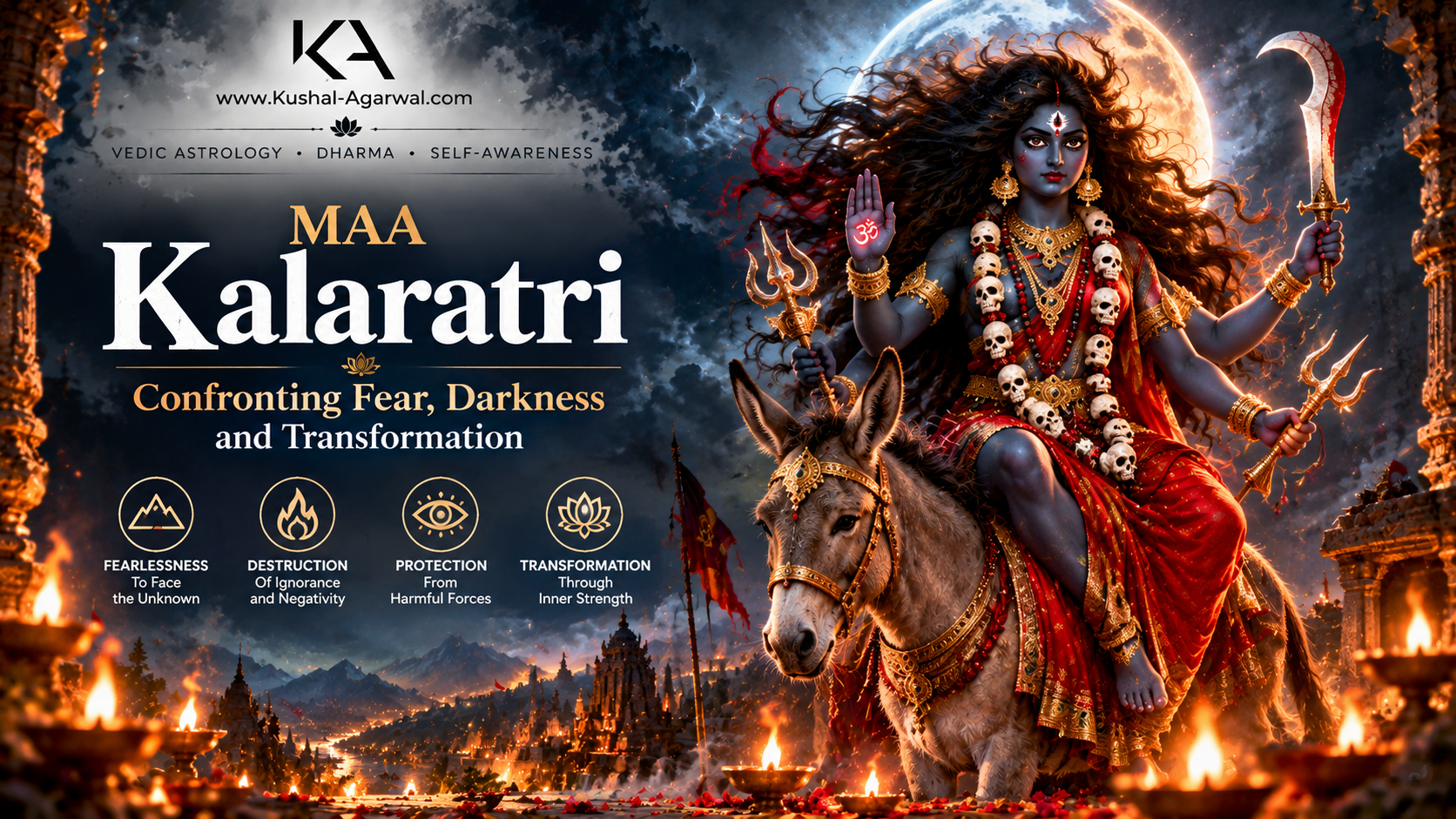
She is the seventh of the nine forms of Goddess Durga, worshipped on the seventh day of Navratri. Her appearance is among the most formidable in the sequence: a dark complexion, dishevelled hair, three eyes, four arms and a donkey as her mount. Traditional depictions show her carrying weapons while offering gestures of reassurance and blessing.
At first glance, her form may appear frightening. Yet she is also known as Shubhankari—the auspicious one.
This apparent contradiction is central to understanding Kalaratri. Her fierce appearance does not signify evil. It represents the power that confronts destructive forces and protects those who seek refuge in the Divine Mother.
For the spiritual seeker, her symbolism raises an important question: what if the darkness we fear is precisely what we need the courage to face?
1. Who Is Maa Kalaratri?
Maa Kalaratri is the seventh form in the traditional Navadurga sequence. Her place in the sequence is named in the Devi Kavacha, a devotional hymn associated with the recitation of the Durga Saptashati.
Her name is commonly understood through the Sanskrit words kala and ratri.
Kala can signify time and, in certain contexts, death or dissolution. Ratri means night. Together, Kalaratri can be interpreted as the dark night or the night associated with time and dissolution.
These meanings carry philosophical depth. Time eventually brings every temporary form to an end. Darkness conceals what the ordinary senses might otherwise reveal. Dissolution challenges our attachment to things we assume will remain unchanged.
Kalaratri's traditional imagery brings these themes into a single divine form.
She is often described as the fiercest of the Navadurga, yet her devotees approach her as a protective mother. Her terrifying appearance is directed towards destructive forces, while her blessing gestures communicate reassurance.
The distinction matters: fierceness in the service of protection is not the same as cruelty.
2. The Iconography of Maa Kalaratri
Kalaratri's iconography is deliberately different from the serene, radiant depictions of several other forms of Durga. Her appearance communicates a power that cannot be understood through conventional ideas of beauty or gentleness alone.
The dark complexion
Kalaratri is traditionally depicted with a dark or black complexion, evoking the depth of night.
Darkness in spiritual literature can carry different meanings depending on the context. It may suggest ignorance, uncertainty and concealment, but it can also evoke the vastness of existence beyond ordinary perception.
In Kalaratri's case, the darkness is not simply something to be feared. It is associated with a power that confronts and overcomes destructive forces.
Her imagery invites us to examine our own reactions to uncertainty. We often prefer situations in which every outcome is visible and every answer is available. But important decisions rarely offer complete certainty.
Courage sometimes means proceeding with discernment even when the entire path is not yet clear.
The flowing or dishevelled hair
Traditional descriptions often portray Kalaratri with unbound hair.
This contributes to her formidable appearance and distinguishes her from more composed, conventionally ornamental depictions of the Goddess.
Symbolically, the image can be read as a reminder that divine power does not have to conform to expectations of gentleness, beauty or social approval.
Not every necessary intervention will appear comfortable. Not every truth will be pleasant. Sometimes, what restores balance initially unsettles those accustomed to the existing arrangement.
This is a contemporary interpretation of the iconography, rather than a universal scriptural explanation of her hair.
The three eyes
Kalaratri is commonly depicted with three eyes, a feature shared with other powerful forms of the Goddess and associated with divine perception.
The third eye can be contemplated as a symbol of insight beyond immediate appearances.
In everyday life, the first impression of a situation may be incomplete. A disagreement may have deeper causes. A seemingly attractive opportunity may carry hidden risks. An uncomfortable truth may be more useful than a reassuring illusion.
The symbolic lesson is to look beyond appearances before deciding how to act.
The donkey as her mount
Unlike several other warrior forms of Durga, Kalaratri is traditionally associated with a donkey.
Her mount is an important part of her distinctive iconography. Interpretations vary, but it can be contemplated as an image of endurance and the capacity to bear difficult burdens.
The symbolism also challenges the assumption that divine power must always be represented through magnificent or prestigious imagery.
What matters is not outward grandeur alone, but the purpose served by the power.
The weapons and blessing gestures
Kalaratri is commonly depicted with four arms. Her attributes vary across artistic and regional traditions, but representations often include a sword and an iron weapon or implement, alongside gestures of fearlessness and blessing.
These features unite two dimensions of the Goddess: the ability to confront destructive forces and the ability to reassure her devotees.
The weapons suggest decisive intervention. The blessing gestures indicate that fierceness is not directed indiscriminately towards everyone.
Kalaratri is both formidable and protective.
3. Why Is Maa Kalaratri Called Shubhankari?
The title Shubhankari is commonly translated as “the auspicious one” or “the one who brings auspiciousness.”
At first, the title may appear surprising. Why would a Goddess with such a fearsome appearance be regarded as auspicious?
The answer lies in the distinction between appearance and purpose.
A power that destroys something harmful may appear frightening while serving a protective function. A necessary ending may be painful without being destructive in the larger sense. A difficult truth may unsettle us while helping us recognise a situation more clearly.
Kalaratri's symbolism reminds devotees that benevolence does not always appear in a gentle form.
This does not mean that every painful experience is automatically beneficial, or that suffering should be accepted without seeking help. Rather, it offers a devotional way to understand the relationship between fierce protection and auspicious intent.
The Goddess's appearance may evoke fear, but her role is associated with protection, the removal of obstacles and the confrontation of destructive forces.
Her name invites us to look beyond appearances and ask what a particular force ultimately serves.
4. Maa Kalaratri and the Story of Raktabija
One of the most striking episodes in the Devi Mahatmya concerns the demon Raktabija.
In this narrative, Raktabija possesses a formidable power: every drop of his blood that falls to the ground produces another demon like him. As the battle progresses, ordinary attacks threaten to multiply the very force they are intended to defeat.
The Goddess's response requires a different strategy. In the account, the fierce Goddess Kali, also identified with Chamunda in the episode, prevents Raktabija's blood from falling to the ground and producing further manifestations. This enables the destructive force to be overcome.
It is important to be precise here. The Devi Mahatmya describes this battle through the Goddess's fierce manifestations; the episode should not automatically be presented as an exclusive biographical story of the Navadurga form Kalaratri. The traditions are closely related in their symbolism, but the identities and narratives are not identical in every source.
Nevertheless, the episode offers a compelling point of reflection.
Some problems become more difficult when we respond to their visible symptoms without understanding the mechanism that keeps reproducing them.
Consider a recurring conflict in a workplace. Each argument may be settled temporarily, but if the underlying incentives remain unchanged, the same disagreement returns. Similarly, repeatedly addressing the immediate consequences of a harmful habit may accomplish little if the conditions sustaining it remain untouched.
The Raktabija narrative illustrates the importance of understanding the structure of a problem before deciding how to confront it.
Sometimes, victory depends not on applying more force, but on understanding why the problem keeps multiplying.
That is a useful contemporary lesson drawn from the story, not a claim that the demon represents one fixed psychological condition in every traditional interpretation.
5. Maa Kalaratri and the Psychology of Fear
Fear is a natural response to perceived danger. It can alert us to genuine risks, encourage preparation and help us avoid reckless decisions.
But fear can also become a limiting force when it governs decisions long after the immediate danger has passed.
A person may remain in an unsuitable professional situation because uncertainty feels more frightening than dissatisfaction. Someone may avoid an important conversation because they anticipate rejection. Another may postpone learning a difficult skill because the possibility of failure threatens their self-image.
Kalaratri's symbolism provides a framework for reflecting on these patterns.
The first step is not to deny fear or pretend that every situation can be overcome through willpower. It is to distinguish between a real danger that requires protection and an anticipated outcome that needs to be examined.
The next step is to choose an appropriate response.
Sometimes the right action is to prepare more thoroughly. Sometimes it is to establish a boundary, seek expert advice, ask for support or leave an unsafe situation. At other times, the task is to accept uncertainty and proceed carefully.
Courage does not require reckless exposure to danger. Nor does devotion mean abandoning practical judgement.
In a spiritual context, contemplating Kalaratri may help a devotee cultivate the intention to face difficulty with steadiness. The practical expression of that intention still requires sound decisions and appropriate action.
6. The Seventh Form in the Navadurga Journey
Kalaratri follows Katyayani, the sixth form of Navadurga.
Katyayani is associated with courage, decisive action and the confrontation of forces that threaten dharma. Kalaratri deepens this theme by bringing attention to fear, darkness and the forces that appear difficult to overcome.
The sequence can be understood as a reflective progression, although these psychological stages are an interpretive framework rather than a universal scriptural doctrine.
Shailaputri establishes the foundation. Brahmacharini emphasises discipline. Chandraghanta evokes courage and alertness. Kushmanda represents creative radiance. Skandamata highlights nurturing protection. Katyayani brings decisive action into focus.
Kalaratri then asks what happens when the challenge cannot be resolved through ordinary confidence alone.
What do we do when the situation is deeply uncomfortable, when familiar methods fail or when confronting reality requires us to question our own assumptions?
Her symbolism encourages the seeker to face such moments without surrendering to panic.
The next form, Mahagauri, is associated with purity, serenity and renewal. Read as a symbolic sequence, the movement from Kalaratri to Mahagauri suggests that confronting darkness may prepare the way for clarity.
It does not imply that every hardship guarantees renewal. It offers a way of contemplating the relationship between confrontation and transformation.
7. Maa Kalaratri Mantra and Devotional Practice
A commonly recited mantra dedicated to Kalaratri is:
ॐ देवी कालरात्र्यै नमः॥
Om Devi Kalaratryai Namah.
A simple translation is: “Salutations to the Divine Goddess Kalaratri.”
Devotees may recite the mantra during Navratri or as part of their regular worship. The practice can be accompanied by quiet contemplation of courage, protection and the willingness to confront what needs attention.
A short reflective practice might involve three questions:
- What am I avoiding because it makes me uncomfortable?
- Is the fear pointing towards a genuine risk, or an assumption I need to examine?
- What is the wisest and safest next step I can take?
These are suggested reflection prompts, not prescribed ritual requirements.
Traditional observances may include offerings, lamps, flowers, recitation of devotional hymns and other forms of worship. Customs vary by region, family and lineage, so no single list of offerings or ritual steps should be treated as universal.
The purpose of the practice is devotional connection and reflection, not a guarantee that every obstacle will disappear or that a particular outcome will occur.
8. Maa Kalaratri and Jyotish: Tradition, Symbolism and Responsible Interpretation
Some contemporary Navadurga traditions associate Kalaratri with Shani, or Saturn, in Jyotish. Drik Panchang records this association within its account of the Goddess.
Such correspondences should be presented as traditional devotional associations rather than universal rules accepted identically by every astrological lineage.
In Jyotish, Shani is commonly associated with discipline, responsibility, limitation, endurance, time and the consequences of actions. These themes can be used as a point of comparison with Kalaratri's symbolism of confronting difficulty and developing steadiness.
However, a symbolic correspondence does not by itself establish a classical remedial prescription.
An astrologer should distinguish between an association recorded in a devotional tradition, an interpretation offered by a particular lineage and a rule explicitly supported by a Jyotish text.
Likewise, worship of Kalaratri should not be presented as a guaranteed method of removing every difficult Saturn placement, eliminating all obstacles or preventing adverse events.
A responsible approach respects the spiritual value of devotion without overstating what can be promised.
For practitioners of the occult sciences, this distinction is especially important. Credibility grows when traditional symbolism is explained carefully and its limits are acknowledged.
Conclusion: The Courage to Face the Dark
Maa Kalaratri, the seventh form of Navadurga, represents the fierce and protective dimension of Shakti. Her dark complexion, formidable appearance, weapons and blessing gestures convey a power that confronts destructive forces while offering reassurance to devotees.
Her title Shubhankari reminds us that a fearsome appearance does not necessarily signify a harmful purpose. The Raktabija narrative, meanwhile, offers a striking illustration of why some problems require a deeper understanding of the mechanism that sustains them.
For the spiritual seeker, Kalaratri is an invitation to examine fear without romanticising suffering, to recognise danger without surrendering to panic and to act with discernment when circumstances demand courage.
Her lesson is not that darkness should be sought or that every difficult experience is destined to produce growth. It is that avoidance is not always protection, and that some transformations begin only when we are willing to face what we would rather not see.
May the contemplation of Maa Kalaratri inspire fearlessness without recklessness, strength without cruelty and the wisdom to confront darkness with discernment.
Next in the Navadurga series: Maa Mahagauri — Purification, Peace and Spiritual Renewal.
SOURCES:
- Devi Kavacha — the traditional naming and sequence of the nine forms of Durga.
- Devi Mahatmya, part of the Markandeya Purana — the Goddess's battles with demonic forces, including the Raktabija episode.
- Drik Panchang — Goddess Kalaratri: https://www.drikpanchang.com/hindu-goddesses/parvati/durga/navdurga-kalaratri.html
- Sanātan World — Kalaratri references and traditional iconography: https://sanatanworld.co.in/deities/deity-kalaratri/references
- Explore Jabalpur — Kalaratri: The Seventh Form of Durga: https://www.explorejabalpur.com/navratri/navadurga/kalaratri/
SUGGESTED INTERNAL LINKS:
- Maa Shailaputri: The First Navadurga and the Power of a Strong Beginning
- Maa Brahmacharini: The Power of Tapasya, Patience and Unwavering Resolve
- Maa Chandraghanta: The Courage to Confront Fear Without Losing Peace
- Maa Kushmanda: The Cosmic Creator and the Power of a Single Smile
- Maa Skandamata: The Power of Divine Motherhood, Protection and Wisdom
- Maa Katyayani: Courage, Decisive Action and the Power of Shakti
- Navadurga: The Nine Forms of Goddess Durga and Their Spiritual Significance
Continue exploring the Navadurga series on Kushal-Agarwal.com. The next article examines Maa Mahagauri, whose symbolism of purity, serenity and renewal offers a striking contrast to Kalaratri's fierce form.
Want this read for your own chart?
Every session blends Vedic astrology, numerology and counselling psychology — your chart read as architecture, not prophecy. Bring the decision you are actually sitting with, and leave with timing, language and a next step.