Hindu Festivals
Maa Chandraghanta: The Courage to Confront Fear Without Losing Peace
Kushal Agarwal · 15 Oct 2026 · 10 min read
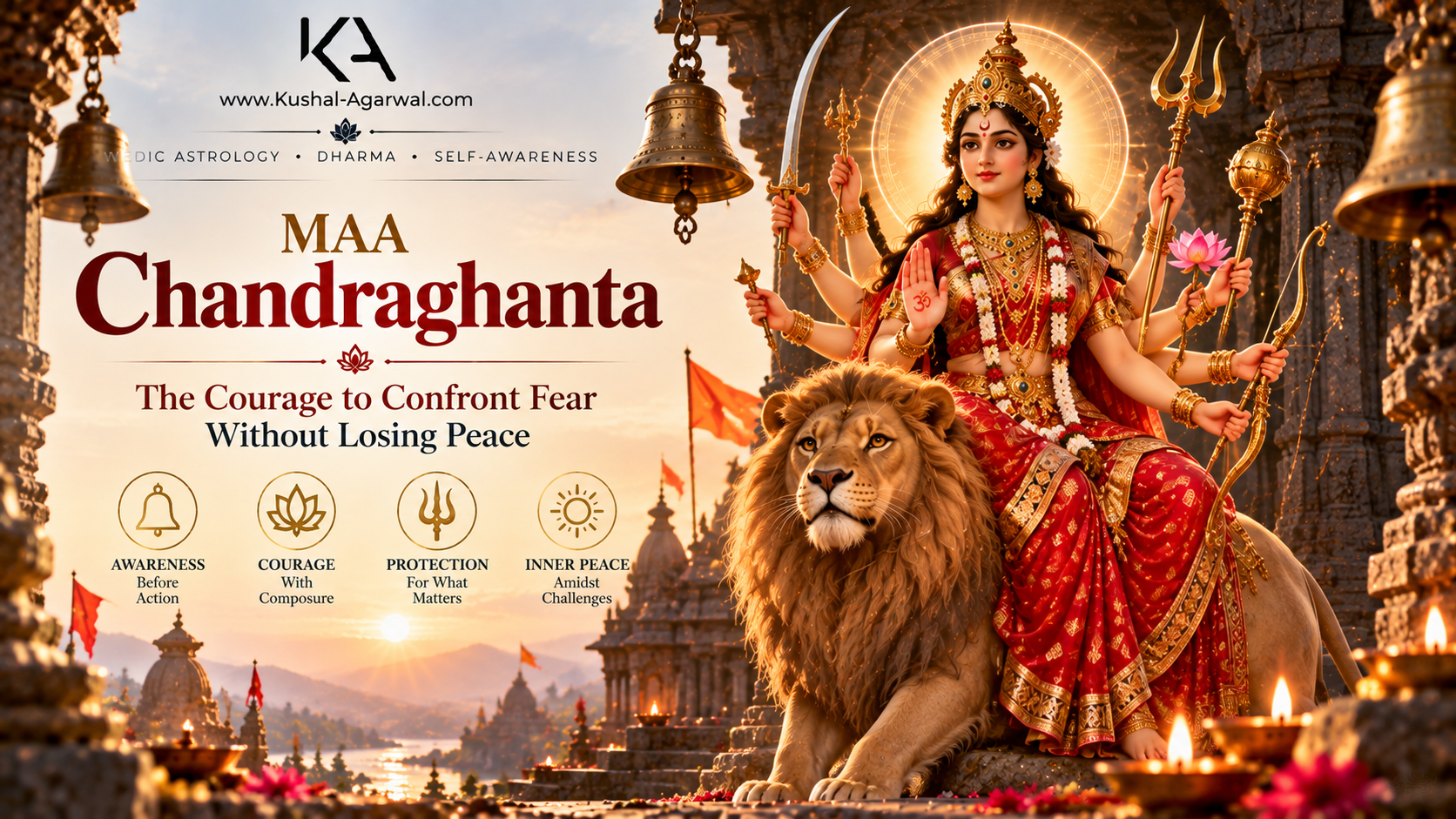
Maa Chandraghanta: The Fierce Face of Divine Courage
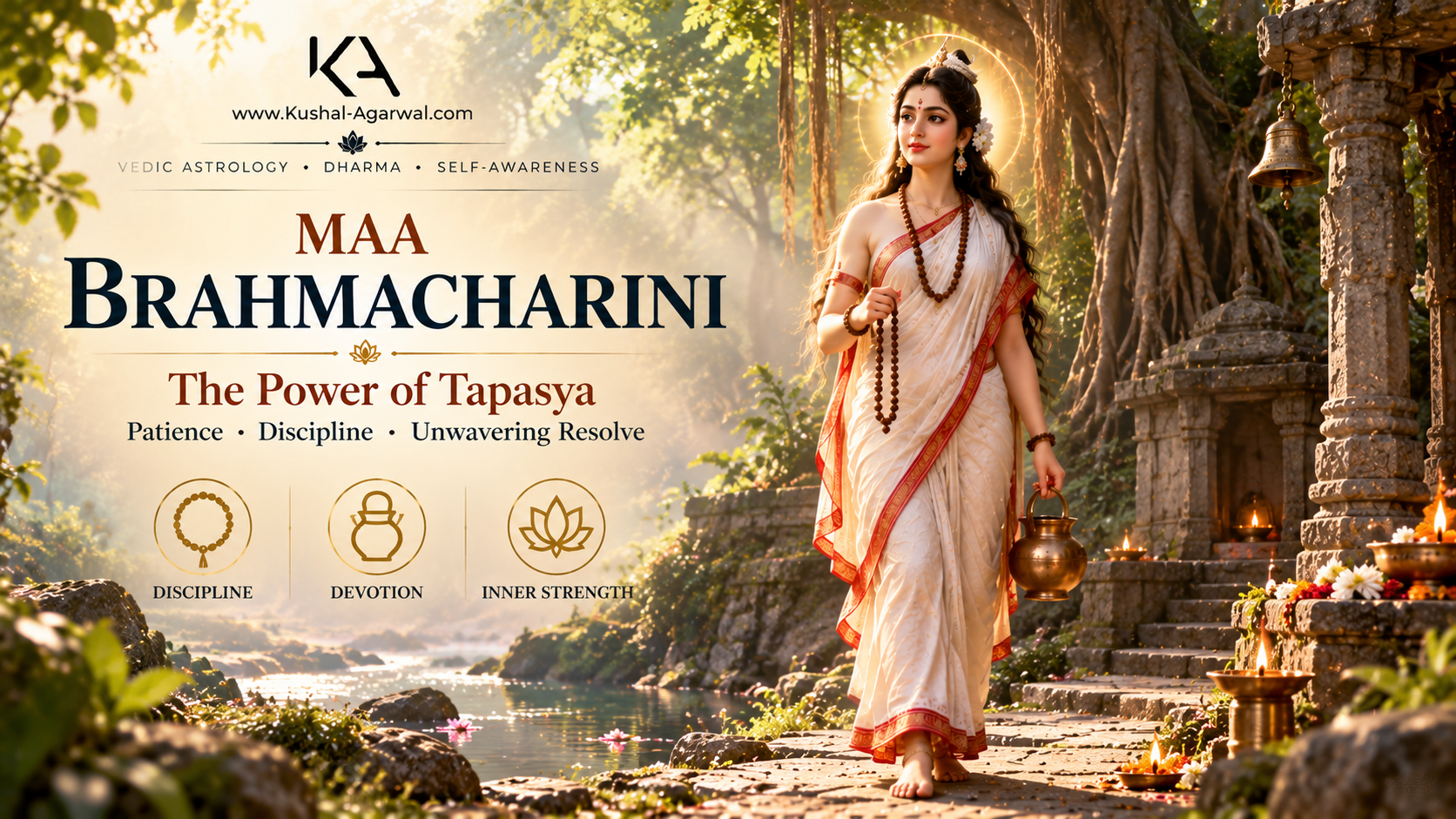
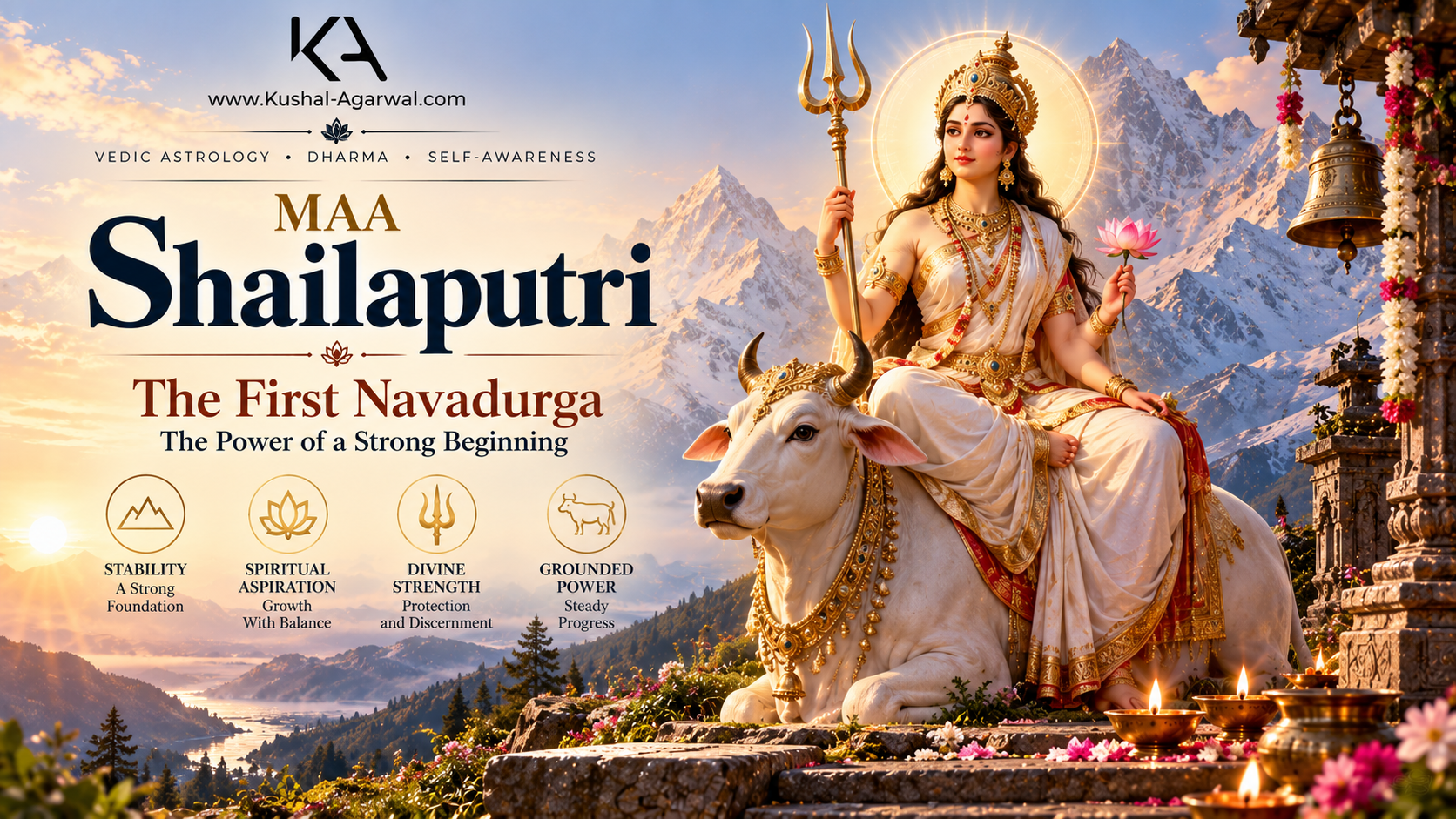
The first form of Navadurga, Maa Shailaputri, represents the foundation. The second, Maa Brahmacharini, embodies tapasya and disciplined devotion. The third form introduces a different dimension of Shakti: the power to confront adversity.
This is Maa Chandraghanta.
Her traditional image is unmistakable. A crescent shaped like a bell adorns her forehead. She is commonly depicted riding a lion or tiger, carrying weapons and other divine attributes in her multiple arms. Her appearance conveys alertness, readiness and formidable power.
Yet the significance of Chandraghanta goes beyond her martial imagery.
She represents the capacity to face a threat without becoming consumed by fear, and to exercise strength without surrendering to uncontrolled anger.
True courage is not the absence of fear. It is the ability to act with clarity when fear is present.
Her iconography invites us to examine what happens when our values are challenged, when circumstances demand a difficult decision, or when protecting what matters requires us to stand firm.
Who Is Maa Chandraghanta?
Maa Chandraghanta is the third form of Goddess Durga in the widely followed Navadurga tradition. Her name combines two Sanskrit elements: Chandra, meaning moon, and ghanta, meaning bell.
She is identified by the crescent-shaped, bell-like mark on her forehead. Her traditional imagery commonly includes a lion or tiger as her mount and multiple arms holding divine weapons, a lotus and other attributes. Specific details vary across depictions and regional traditions.
The name itself creates a distinctive image: the serenity associated with the moon combined with the alertness suggested by a bell.
In Hindu worship, a bell is used to mark ritual moments and focus attention. The Goddess's martial form, meanwhile, communicates preparedness to confront forces that threaten dharma.
Together, these elements provide a rich devotional image of awareness joined with action.
Chandraghanta is not simply a symbol of aggression. Her power is understood within the broader tradition of Goddess worship, in which divine strength is directed towards protection and the restoration of order.
The Story and Traditional Significance of Chandraghanta
The Navadurga tradition presents Chandraghanta as one of the manifestations of Durga worshipped during Navratri. Accounts of the Goddess's forms and their detailed narratives differ across devotional texts and regional traditions.
Her defining significance is expressed particularly through her iconography: the bell-shaped crescent, the lion or tiger, and the weapons she carries.
The martial appearance of the Goddess communicates readiness to confront adversity. Her image stands within the larger Shakta understanding of the Divine Mother as a source of both nurturing power and formidable protection.
Unlike interpretations that reduce spirituality to withdrawal from the world, Chandraghanta's form brings action into the picture. There are circumstances in which peace requires more than avoidance. Protecting the vulnerable, defending a principle or confronting destructive conduct may demand courage.
But the purpose of such action matters.
The Goddess's protective symbolism is best understood in the context of dharma, not as a justification for treating every disagreement as a battle. Strength is meaningful when guided by discernment and directed towards a worthy purpose.
The Symbolism of Maa Chandraghanta's Form
The Crescent-Shaped Bell: Awareness Before Action
The defining feature of Chandraghanta is the crescent-shaped mark on her forehead, resembling a bell.
The bell has an important place in Hindu ritual. Its sound can mark the beginning of worship and draw attention away from ordinary distractions towards the sacred act.
As a reflective symbol, it suggests the importance of awareness before action.
People often react to difficult situations before understanding them fully. Anger narrows attention. Fear encourages avoidance. Pride can make a minor disagreement appear like a serious threat.
Awareness creates a pause between what happens and how we respond.
That pause may be enough to prevent an impulsive decision, recognise a genuine danger or choose a more constructive course of action.
The symbolism of Chandraghanta invites us to become alert without becoming perpetually suspicious, and responsive without becoming reactive.
The Lion or Tiger: Courage Under Direction
Chandraghanta is commonly depicted riding a lion or tiger, though representations vary.
Both animals evoke strength, alertness and fearlessness. They reinforce the Goddess's identity as a protective and formidable manifestation of Shakti.
The image also raises a question about the nature of power.
Strength alone does not determine whether an action is wise. A person may possess authority, influence or physical courage while using these qualities destructively.
Power needs direction.
In everyday life, courage may mean speaking against wrongdoing, accepting responsibility for an unpopular decision or setting a boundary that protects one's well-being. But courage also requires knowing when confrontation is unnecessary.
The lion or tiger becomes a reminder that strength should be guided by judgement rather than impulse.
The Weapons: Readiness to Protect Dharma
The Goddess's multiple arms and weapons communicate preparedness to confront adversity.
The precise weapons shown vary between images, but the larger visual language is clear: Chandraghanta is not helpless before forces that threaten order.
In devotional reflection, her weapons can remind us that good intentions alone are not always sufficient. Protecting a responsibility may require knowledge, courage, decisive action and the ability to recognise when a situation has become harmful.
However, this symbolism should not be used to romanticise conflict. The purpose of protective strength is not to create enemies everywhere. It is to respond appropriately when something genuinely requires protection.
Discernment determines whether the right response is confrontation, negotiation, patience or withdrawal.
The Multiple Arms: The Capacity to Respond
The many arms of the Goddess are a familiar feature of Hindu divine iconography. They express capacities beyond ordinary human limitations and allow different attributes to be represented together.
In Chandraghanta's form, they reinforce the image of readiness and divine power.
As a reflective interpretation, the multiple arms can also suggest that difficult situations rarely require only one quality. Courage may need to be accompanied by patience. Decisiveness may need to be balanced with compassion. A firm boundary may need to coexist with a willingness to listen.
Strength is most useful when it can respond to complexity rather than relying on one habitual reaction.
Courage Is Not the Same as Aggression
One of the most useful lessons to draw from Chandraghanta's iconography is the distinction between courage and aggression.
Aggression often seeks to dominate, retaliate or establish superiority. Courage is the willingness to face difficulty in service of a meaningful objective.
A courageous person can disagree without humiliating another person. They can refuse an unreasonable demand without becoming cruel. They can acknowledge a mistake without interpreting accountability as defeat.
Likewise, remaining calm does not always mean remaining silent. Sometimes a difficult conversation is necessary. Sometimes a harmful pattern must be challenged. Sometimes the responsible decision is to leave a situation rather than continue trying to control it.
The point is not to avoid strong emotions or pretend that fear does not exist. It is to prevent those emotions from making every decision on our behalf.
Chandraghanta's fierce image reminds devotees that compassion and strength are compatible. The Goddess can be protective without her power being reduced to hostility.
Why Is Maa Chandraghanta Worshipped on the Third Day?
In the commonly followed Navadurga sequence, Chandraghanta is worshipped on the third day of Navratri.
A devotional reading of the first three forms reveals a meaningful progression:
- Shailaputri: establishing a foundation and remaining grounded.
- Brahmacharini: developing discipline and sustained commitment.
- Chandraghanta: bringing strength and readiness into action.
This is an interpretive framework rather than a universal doctrine that every tradition prescribes as a fixed psychological progression.
Nevertheless, it offers a useful way to reflect on the sequence. A stable foundation matters, and discipline helps sustain it. But there are moments when stability and discipline must translate into action.
The question then becomes whether we can act without losing the principles that guided us in the first place.
Chandraghanta's iconography makes this question especially vivid.
Maa Chandraghanta, Shakti and the Protection of Dharma
In Shakta traditions, Shakti is understood as divine power, and the Goddess is worshipped as a central expression of that power. Durga's forms reveal different dimensions of divine strength, from nurturing compassion to fierce protection.
Chandraghanta represents a particularly martial expression of this power.
Her weapons and mount communicate readiness to confront adversity, while the broader tradition places the Goddess's strength within the protection and restoration of dharma.
Dharma has meanings that vary according to context, including duty, right conduct and the order that sustains life. It should not be reduced to a simplistic claim that every personal disagreement is a struggle between good and evil.
For the devotee, the more demanding question is whether one's own actions remain consistent with the principles one claims to defend.
It is easy to demand courage from others. It is harder to act honestly when doing so carries a personal cost, to admit an error when pride resists it, or to exercise authority without abusing it.
The worship of Chandraghanta can prompt reflection on these responsibilities.
How Is Maa Chandraghanta Worshipped?
Devotees worship Chandraghanta on the third day of Navratri through puja, prayer, mantra recitation and offerings. Practices vary by region, family tradition and sampradaya.
A commonly recited mantra is:
ॐ देवी चन्द्रघण्टायै नमः॥
Om Devi Chandraghantayai Namah.
This is a devotional salutation to the Goddess.
Traditional worship may include flowers, incense, lamps, food offerings and the recitation of devotional texts. Some devotees observe a fast or spend time in meditation and prayer.
The specific offerings, colours and ritual procedures differ across traditions. Those following a family or temple practice should use its established guidance and consult a reliable local Panchang for date-specific timings.
Devotional practice should not be treated as a guarantee of a particular material outcome. Its significance can be approached through worship, remembrance and a sincere effort to embody the qualities associated with the Goddess.
Is Maa Chandraghanta Linked to a Planet in Vedic Astrology?
Some modern Navadurga and remedial-astrology traditions associate individual Goddess forms with particular planets. However, such correspondences are not uniform across all Jyotish lineages.
The traditional worship of Chandraghanta should therefore be distinguished from the technical interpretation of a horoscope.
In Vedic astrology, planetary judgement depends on the chart as a whole, including placements, house ownership, dignity, aspects, conjunctions and the interpretive system being followed. A person's horoscope cannot be comprehensively assessed through a single Goddess correspondence.
Similarly, worship may be meaningful within a devotee's religious or remedial practice, but it would be misleading to guarantee that it automatically removes every astrological difficulty or produces a specific worldly result.
For serious students of Jyotish, respecting tradition also means being precise about what is a devotional association, what is a lineage-specific practice and what constitutes a technical astrological judgement.
The Deeper Message of Maa Chandraghanta
Maa Chandraghanta embodies the union of awareness and action, strength and restraint, courage and discernment.
Her bell-shaped crescent reminds us to pay attention. Her lion or tiger conveys power and readiness. Her weapons express the capacity to confront adversity. Together, these symbols create an image of the Divine Mother prepared to protect what is sacred and valuable.
Her lesson is not that every difficulty should be met with confrontation. Nor is it that fear must disappear before action becomes possible.
It is that courage becomes more meaningful when it remains guided by clarity and responsibility.
As the third form of Navadurga, Chandraghanta invites us to examine how we respond when life becomes difficult. Do we react impulsively? Do we avoid necessary action? Do we mistake aggression for strength or silence for peace?
The answer may reveal where courage needs to be developed.
A strong foundation gives us stability. Discipline gives us continuity. Courage allows us to act when the moment demands it.
That is the enduring message of Maa Chandraghanta.
SOURCES:
- Drik Panchang — Navratri calendar and daily observances: https://www.drikpanchang.com/navratri/ashwin-shardiya-navratri-dates.html
- The Art of Living — Navadurga and Chandraghanta traditions: https://www.artofliving.org/in-en/navratri
- Devi Mahatmya, part of the Markandeya Purana, for the broader Shakta tradition of Goddess worship and the protective power of Durga.
SUGGESTED INTERNAL LINKS:
- Maa Shailaputri: The First Navadurga and the Power of a Strong Beginning
- Maa Brahmacharini: The Power of Tapasya, Patience and Unwavering Resolve
- Sharad Navratri 2026: The Deeper Meaning of the Nine Nights of Maa Durga
Explore more articles on Vedic Astrology, Hindu spiritual traditions and occult practice at https://kushal-agarwal.com/.
Want this read for your own chart?
Every session blends Vedic astrology, numerology and counselling psychology — your chart read as architecture, not prophecy. Bring the decision you are actually sitting with, and leave with timing, language and a next step.