
Palmistry
Fate Line in Palmistry: Career, Direction and Life Path
Kushal Agarwal · 1 Oct 2026 · 13 min read
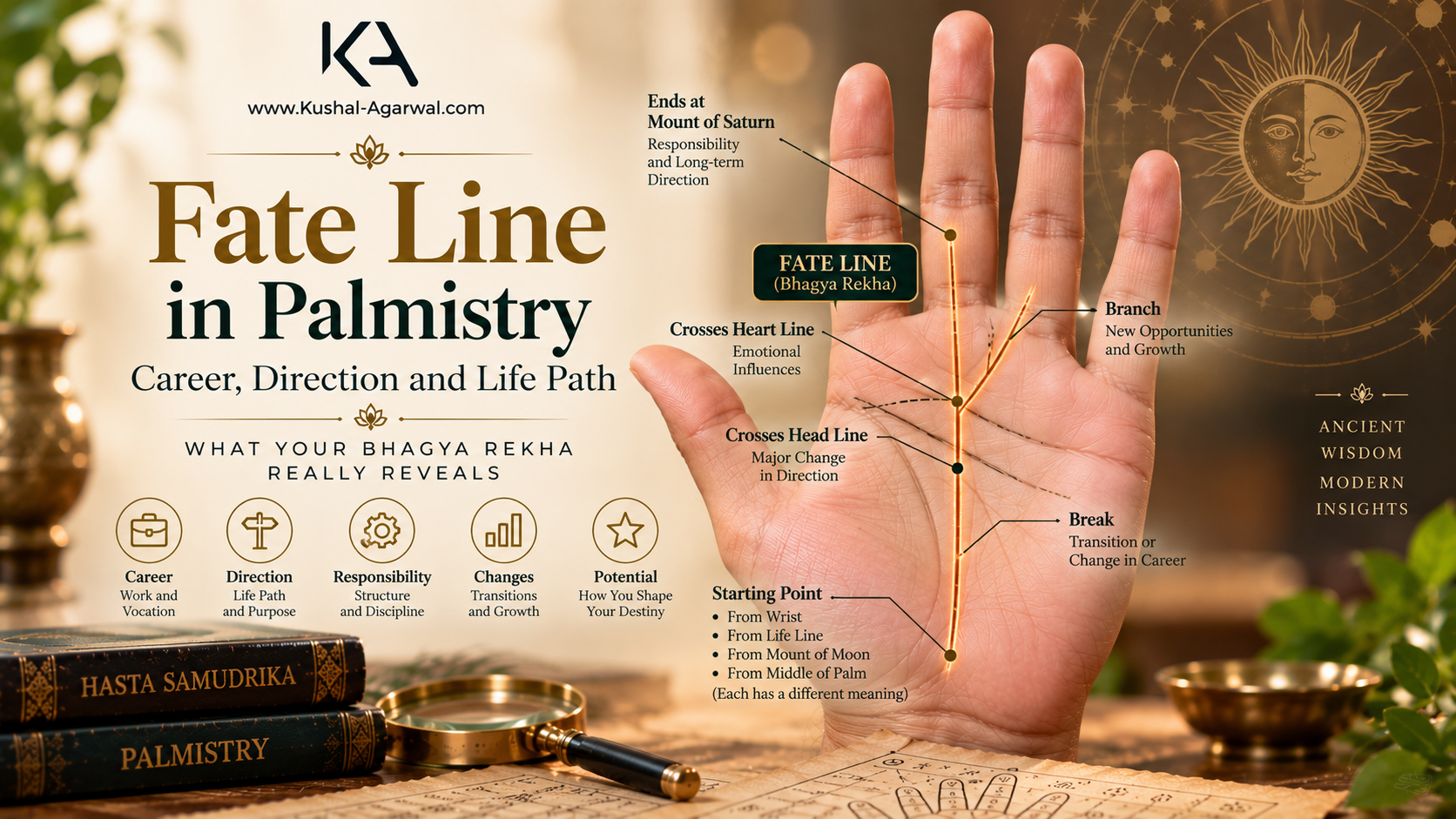
The Fate Line in Palmistry: Career, Direction and Life Path
There is perhaps no line in palmistry with a more misleading name than the Fate Line.
The moment people hear "fate," they imagine something fixed.
A predetermined career.
A guaranteed destiny.
A line that somehow knows exactly what will happen ten years from now.
That is not the most useful way to read it.
In traditional palmistry, the Fate Line — also called the Saturn Line, Destiny Line or Bhagya Rekha — is primarily associated with direction, vocation, responsibility and the forces that shape the course of one's life.
It is usually found running vertically through the palm toward the base of the middle finger, the Saturn finger.
And unlike the Life Line, Head Line and Heart Line, the Fate Line is remarkably variable.
Some hands have a deep, obvious line.
Some have a faint line.
Some have several segments.
And some have almost no visible Fate Line at all.
That absence is not automatically a bad sign.
The more interesting question is:
How does a person find and construct their direction in life?
That is where the Fate Line becomes useful.
What Is the Fate Line?
The Fate Line is traditionally the vertical line that travels upward through the palm toward the Mount of Saturn, beneath the middle finger.
In Hasta Samudrika traditions it is commonly associated with the Bhagya Rekha, while Western palmistry often calls it the Fate Line, Destiny Line or Saturn Line.
Traditionally, it is read in relation to:
- Career and vocation
- Life direction
- Responsibility
- Structure
- External circumstances
- Major changes in one's path
- The degree of continuity in one's working life
It is important to distinguish direction from outcome.
A strong Fate Line does not automatically mean wealth.
A weak Fate Line does not automatically mean failure.
A broken Fate Line does not automatically mean a ruined career.
The line is better understood as describing the structure and continuity of one's path rather than guaranteeing the result.
Why Is It Called the Saturn Line?
The Fate Line traditionally terminates toward the Mount of Saturn.
Saturn symbolism is particularly relevant here.
In Jyotish and related Indian traditions, Saturn is associated with discipline, responsibility, labour, endurance, structure and long-term effort.
This makes the symbolism of the Fate Line quite logical within the traditional system.
The question is not simply:
"Will I become successful?"
It is closer to:
"How does responsibility and purpose organise my life?"
This distinction makes the Fate Line much more interesting than the simplified "career line" label suggests.
Where Does Your Fate Line Begin?
One of the first things to examine is the starting point.
The Fate Line does not begin at exactly the same location on every palm.
Its origin can provide an important interpretive clue.
Fate Line Starting Near the Wrist
A Fate Line that begins near the base of the palm and continues upward can traditionally indicate that a strong sense of direction was established relatively early.
There may be a pronounced connection with structure, duty or a defined path.
The person may have entered a clear educational, professional or family-directed path early in life.
However, do not interpret this as "successful from childhood."
The line describes direction, not guaranteed achievement.
Fate Line Starting From the Life Line
When the Fate Line appears to emerge from or closely connect with the Life Line, traditional palmistry often associates it with personal effort and family influence.
Early circumstances may play an important role in determining the person's direction.
The individual may build their career through sustained personal effort.
This is one of the most interesting starting points because the Life Line represents the individual's personal foundation, while the Fate Line represents direction.
Their meeting creates a symbolic connection between the two.
Fate Line Starting From the Mount of Moon
The Mount of Moon lies on the outer lower portion of the palm, opposite the thumb.
A Fate Line beginning from this region is traditionally associated with influences coming from other people, the public, travel, imagination or external networks.
It is often discussed in connection with professions involving:
- Public interaction
- Clients
- Media
- Travel
- Creativity
- Communication
- Large audiences
The traditional interpretation is that the person's direction is influenced more strongly by the world outside themselves.
Fate Line Beginning From the Middle of the Palm
Sometimes the Fate Line becomes visible only after entering the middle portion of the palm.
This can traditionally be read as direction becoming clearer later rather than being firmly established from the beginning.
The important point is not to assign an exact age simply from the line.
Instead, examine where it becomes stronger and compare it with the Head Line, Heart Line and other markings.
A Deep Fate Line
A deep and clearly visible Fate Line is traditionally associated with a strong sense of direction.
The person may have a relatively defined relationship with work, responsibility or purpose.
There may be a strong internal need to build something, maintain a position or follow a particular direction.
But remember:
Deep does not mean better.
A deep Fate Line can represent strong commitment.
It can also represent strong attachment to a particular structure.
Whether that structure is useful depends on the rest of the hand and the person's actual circumstances.
A Faint Fate Line
A faint Fate Line is one of the most misunderstood signs in palmistry.
Beginners sometimes interpret it as lack of ambition.
That is too simplistic.
A faint Fate Line may traditionally indicate a life that is less rigidly structured around one continuous career direction.
The person may change professions.
They may work independently.
They may have multiple interests.
They may build their direction gradually rather than following one predetermined path.
The absence of a dominant Fate Line can therefore be perfectly compatible with a highly purposeful life.
What Does It Mean If There Is No Fate Line?
This is one of the most common questions in palmistry.
The first thing to understand is:
Not having a clearly visible Fate Line is not a negative prediction.
Many palms simply do not display a prominent Fate Line.
Traditional interpretations often associate its absence with a more self-directed or fluid life path.
The person may create direction through individual decisions rather than following one continuous external structure.
They may have:
- Multiple careers
- Freelance work
- Entrepreneurship
- Portfolio careers
- Changing professional interests
- Strong family or personal responsibilities outside conventional employment
But the correct reading depends on the rest of the hand.
Never tell someone:
"You have no Fate Line, therefore you have no destiny."
That is not responsible palmistry.
The more useful interpretation is:
Your direction may not be represented by one dominant continuous line.
A Broken Fate Line
A break is another feature that attracts unnecessary fear.
A broken Fate Line is traditionally associated with a change in direction.
This may correspond symbolically with:
- Changing careers
- Leaving an established profession
- Starting a business
- Moving into a new field
- Relocation
- A major change in responsibility
- Rebuilding professional identity
The break itself does not tell you whether the change was good or bad.
It tells you that continuity has been interrupted.
That distinction matters.
A person who leaves a job voluntarily has experienced a career break just as surely as someone whose employment ended unexpectedly.
Palmistry should therefore describe the transition before judging it.
When the Line Continues After a Break
A particularly interesting formation is a Fate Line that breaks and then resumes.
Traditionally, this can represent a major redirection followed by the establishment of a new phase.
The new segment may even appear stronger than the old one.
This can be read symbolically as:
Old direction → transition → new direction.
It is a useful model for understanding career reinvention.
Modern careers rarely move in perfectly straight lines.
A person may begin in engineering, move into sales, enter consulting, start a company and eventually become an advisor or teacher.
The job titles change.
The underlying sense of purpose may remain.
This is why the Fate Line should not be reduced to a literal job-title predictor.
A Fate Line With Branches
Branches rising from the Fate Line are traditionally considered important.
An upward branch can be interpreted as an attempt to expand or strengthen the direction represented by the line.
Depending on where it appears and which other markings accompany it, palmists may associate such branches with:
- New opportunities
- Additional responsibilities
- Professional expansion
- A new field of activity
- Greater ambition
But a branch should never be interpreted in isolation.
Look at the destination of the branch.
Look at the mount it approaches.
Look at the Head Line and Sun Line.
Then look at both hands.
The same branch can carry different significance depending on the overall structure of the palm.
Multiple Fate Lines
Some palms show two or more vertical lines running toward Saturn.
Traditionally, multiple Fate Lines may indicate that more than one significant direction is operating simultaneously.
This can be particularly interesting in people who maintain:
- A primary career plus a business
- Professional work plus creative work
- Employment plus consulting
- A family occupation plus an independent vocation
- Two distinct professional identities
It does not necessarily mean "two jobs."
The broader idea is parallel direction.
Again, the complete palm determines how strongly that interpretation should be applied.
The Fate Line and the Head Line
The Fate Line should always be compared with the Head Line.
The Head Line is traditionally associated with thinking, reasoning, judgement and the way the mind approaches life.
The Fate Line represents direction.
Together they answer two different questions:
Head Line: How do I think?
Fate Line: Where am I directing that thinking?
If the two show strong development, the palm may indicate a person whose intellectual abilities are closely connected with their chosen direction.
If they tell very different stories, the contrast itself becomes interesting.
Perhaps the person thinks one way but works in an environment that demands something else.
Perhaps their career has changed because their thinking changed.
That is the kind of synthesis a serious palm reading should explore.
The Fate Line and the Sun Line
The Fate Line is often confused with the Sun Line.
They are not the same.
The Fate Line generally rises toward the Mount of Saturn, beneath the middle finger.
The Sun Line generally rises toward the Mount of Sun/Apollo, beneath the ring finger.
Their symbolism is also different.
A useful simplified distinction is:
Fate Line = direction and vocation
Sun Line = recognition, expression and visibility
Someone may have a strong Fate Line without a particularly prominent Sun Line.
That could symbolically represent a strong professional direction without an equally strong emphasis on public recognition.
Conversely, a developed Sun Line may indicate a strong desire or capacity for expression and recognition, while the Fate Line tells us how structured the professional path is.
The two should therefore be read together.
The Fate Line and Career Success
This is where palmistry websites often become misleading.
A Fate Line cannot responsibly be reduced to:
"Strong line = rich."
"Broken line = career failure."
"Long line = successful."
Those statements turn a symbolic system into a fortune-telling formula.
A better reading separates three concepts:
Direction
Where is the person's life moving?
Continuity
How stable or changing is that direction?
Recognition
How visible is the person's work?
The Fate Line primarily belongs to the first two questions.
The Sun Line contributes more to the third.
This distinction immediately produces a more sophisticated reading.
Can the Fate Line Change?
Palmists have long observed that some finer lines appear to change in visibility over time.
Modern palmistry commonly interprets an emerging or strengthening Fate Line symbolically as a developing sense of direction.
But this should not be presented as proof that the palm physically records future events.
Skin creases can vary in visibility for ordinary physical reasons.
Therefore, if you compare photographs of your palm over several years, treat changes as observations rather than guaranteed predictions.
Within palmistry, however, such changes may be used as reflective markers.
A previously faint direction becoming more visible can be read symbolically as greater clarity or commitment.
How to Read the Fate Line Properly
For a practical reading, follow this sequence.
Step 1: Locate the line
Find the vertical line travelling toward the middle finger.
Step 2: Identify the starting point
Is it near the wrist?
The Life Line?
The Mount of Moon?
The middle of the palm?
Step 3: Assess its strength
Is it deep, clear, faint or fragmented?
Step 4: Trace the entire line
Do not stop after the first few centimetres.
Look for:
- Breaks
- Branches
- Islands
- Crosses
- Parallel lines
- Changes in direction
Step 5: Observe its relationship with other lines
Especially:
- Life Line
- Head Line
- Heart Line
- Sun Line
Step 6: Compare both hands
This is essential.
The dominant hand can be read for current expression and developed direction, while the non-dominant hand provides the traditional background or starting pattern.
Step 7: Ask the person about their history
This is where professional palmistry becomes much more interesting.
If the hand suggests a transition, ask:
"Did your professional direction change significantly at some point?"
Do not simply announce the answer.
Use the hand to begin a conversation.
The Biggest Misconception About the Fate Line
The biggest misconception is that the Fate Line tells you what must happen.
It is better understood as a symbolic map of how direction, responsibility and circumstance are traditionally interpreted in the hand.
That leaves room for choice.
A broken line can represent reinvention.
A faint line can represent independence.
A strong line can represent commitment.
A missing line can represent a life that does not follow one obvious professional structure.
None of these needs to be feared.
The Fate Line Is Really About Direction
Perhaps the name "Fate Line" makes more sense when we stop thinking about fate as something imposed upon us.
The deeper palmistry question is:
What gives your life direction?
Family?
Duty?
Ambition?
Opportunity?
Other people?
Your own decisions?
A profession?
A calling?
A combination of all of them?
The Fate Line attempts to capture that relationship.
And that is why it should never be read alone.
Read the thumb to understand will.
Read the Head Line to understand thought.
Read the mounts to understand the qualities being emphasised.
Read the Sun Line to understand recognition and expression.
Then read the Fate Line.
Because the Fate Line does not simply ask:
"What will happen to you?"
It asks something much more interesting:
"What direction are you building?"
SOURCES
Paramarsh Patrika — Fate Line: Career and Life Direction https://paramarsh.app/patrika/palmistry/fate-line-destiny-line
Satyori — Fate Line in Hasta Samudrika Shastra https://satyori.com/palmistry/fate-line/
Wishastro — Fate Line Palm Reading: What It Means for Career https://wishastro.com/blog/how-to-read-your-fate-line-for-career-direction
Life Palmistry — Fate Line Palmistry: Meaning, Types & What No Fate Line Says https://lifepalmistry.com/blog/fate-line-meaning
Palmify — Fate Line Palm Reading: Career, Purpose and Direction https://www.palmify.app/wiki/fate-line/
Rekhai — Fate Line Palm Reading: Destiny, Career and Life Purpose https://www.rekhai.in/blog/fate-line-palmistry
SUGGESTED_INTERNAL_LINKS
- The Mounts of the Palm: How to Read the Seven Planetary Mounts in Palmistry
- The Thumb in Palmistry: Willpower, Logic and the Power to Decide
- Right Hand vs Left Hand in Palmistry: Which Hand Should You Read?
- How to Read the Major Lines in Palmistry
- Life Line in Palmistry: What It Actually Reveals
- Head Line in Palmistry: Understanding the Mind Through the Hand
- Heart Line in Palmistry: Reading Love, Emotion and Attachment
- The Sun Line in Palmistry: Recognition, Creativity and Success
Want to learn Palmistry beyond memorised meanings and isolated lines?
Explore more practical Palmistry and Hasta Samudrika insights at Kushal-Agarwal.com.
Want this read for your own chart?
Every session blends Vedic astrology, numerology and counselling psychology — your chart read as architecture, not prophecy. Bring the decision you are actually sitting with, and leave with timing, language and a next step.