Palmistry
The Thumb in Palmistry: Willpower, Logic and the Power to Decide
Kushal Agarwal · 7 Sept 2026 · 11 min read

The Thumb in Palmistry: Willpower, Logic and the Power to Decide
Most people begin palmistry by looking at the Life Line, Head Line and Heart Line.
That is understandable. The major lines are visually striking and they form the foundation of many palm readings.
But there is another feature that deserves attention before you interpret those lines too deeply: the thumb.
In traditional palmistry and Hasta Samudrika Shastra, the thumb is regarded as a major indicator of character. It is associated with the way a person exercises will, makes decisions, reasons through situations and converts intention into action.
The reason is also practical.
The thumb is the only digit that stands apart from the other four fingers. It opposes them, controls grip and gives the hand much of its ability to act.
Symbolically, palmistry sees something similar in human behaviour.
The other parts of the hand may show tendencies, abilities and circumstances. The thumb shows how strongly the individual is able to direct those tendencies.
That makes the thumb particularly valuable when assessing character.
What Does the Thumb Represent in Palmistry?
The traditional reading of the thumb can be simplified into three interconnected ideas:
Will.
Logic.
Vitality.
The two physical phalanges of the thumb are traditionally read separately.
The upper phalange, the section containing the nail, is associated with willpower, determination and the ability to act.
The second phalange is associated with logic, reasoning and judgement.
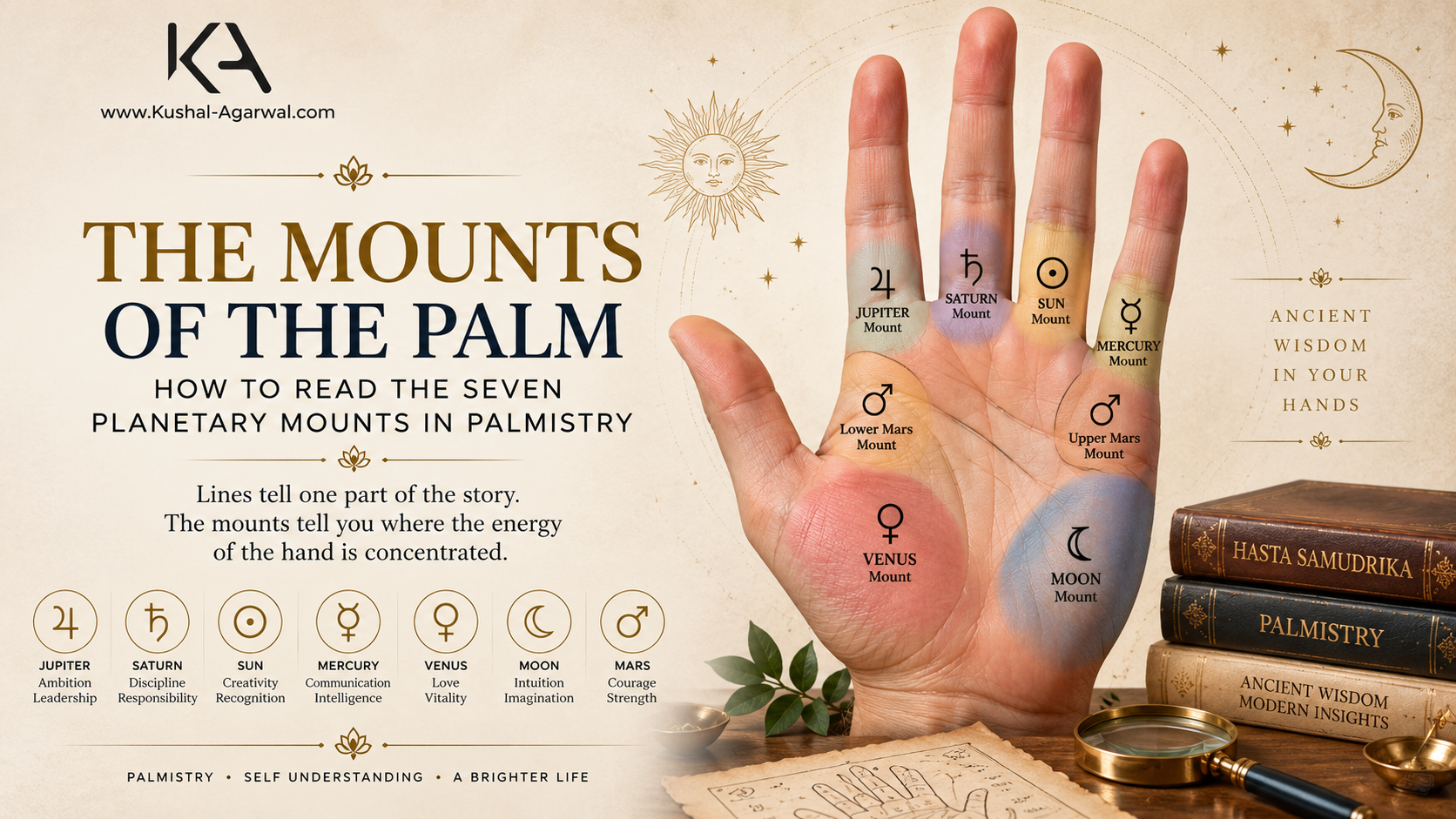
At the base of the thumb is the Mount of Venus, which introduces another dimension: vitality, affection, pleasure, warmth and the individual's engagement with life.
So a thumb is not merely about being "strong-willed."
It is about understanding the relationship between wanting, thinking and feeling.
A person may have enormous determination but poor judgement.
Another may possess excellent reasoning but struggle to act.
A third may have both will and logic strongly developed, while being influenced heavily by desire, affection or emotional attachment.
This is why the thumb should be read as a system rather than through a single feature.
The First Phalange: Willpower
The upper section of the thumb is traditionally associated with willpower.
This is the part extending from the tip of the thumb to the first major joint.
When this phalange is well developed and proportionate, traditional palmistry associates it with determination, firmness and the ability to follow through.
Such a person may be capable of making a decision and staying with it even when circumstances become difficult.
But stronger does not automatically mean better.
An excessively long, thick or dominant will phalange can traditionally indicate an individual who insists on having things their way.
The positive expression is determination.
The negative expression is stubbornness.
The distinction is important.
Palmistry is not simply asking:
"How much willpower does this person have?"
It is also asking:
"How intelligently is that will being used?"
That brings us to the second phalange.
The Second Phalange: Logic and Reason
The second section of the thumb is traditionally associated with reasoning, judgement and the ability to evaluate before acting.
A well-developed second phalange is generally considered an indication of a mind that wants to understand before committing.
This can be extremely useful in decision-making.
A strong will without reasoning can become impulsive.
Strong reasoning without sufficient will can become hesitation.
The classical palmistry approach therefore places considerable importance on the relationship between the two phalanges.
When the Will Phalange Is Stronger
When the first phalange is noticeably longer or stronger than the second, traditional interpretation gives greater weight to will.
The person may be decisive, forceful and action-oriented.
They may prefer experience over prolonged analysis.
At its best, this can produce initiative and courage.
At its extreme, it may become impatience, stubbornness or a tendency to act before considering consequences.
When the Logic Phalange Is Stronger
When the second phalange dominates, reasoning becomes more prominent.
Such a person may prefer to analyse, compare and understand before taking action.
This can produce excellent judgement.
But when taken to an extreme, excessive analysis can delay action.
The person may know exactly what should be done but continue evaluating possibilities instead of committing.
When Both Are Balanced
This is one of the most interesting formations to look for.
When the two phalanges are reasonably proportionate, palmistry traditionally sees a better integration between thought and action.
The person can think and act.
They can evaluate a situation without becoming paralysed by analysis, while also avoiding blind determination.
In practical palm reading, this balance is often more meaningful than simply declaring a thumb "long" or "short."
Thumb Length: Is a Long Thumb Better?
Not necessarily.
Traditional palmistry generally associates a relatively long thumb with stronger individuality, determination and reasoning capacity.
A shorter thumb is traditionally associated with a softer or more yielding temperament.
But length must always be judged relative to the hand.
A thumb that looks long on a small hand may not carry the same interpretation as a proportionately long thumb on a large hand.
Similarly, a short thumb does not automatically indicate weakness.
The rest of the hand can modify the expression considerably.
This is one of the most important principles in palmistry:
Never interpret one feature in isolation.
A short thumb combined with a strong Head Line, firm palm and developed mounts may produce a very different reading from a short thumb accompanied by generally weak development.
The thumb establishes a tendency. The rest of the hand tells you how that tendency operates.
The Flexibility of the Thumb
Now look at how easily the thumb bends backwards.
This is one of the simplest observations you can make during a palm reading.
A flexible thumb is traditionally associated with adaptability.
Such individuals may be willing to compromise, adjust their approach and respond to changing circumstances.
A very flexible thumb can therefore be useful in social and professional situations where negotiation is important.
However, excessive flexibility can also indicate a tendency to give way too easily.
The opposite is a stiff thumb.
A firm, less flexible thumb is traditionally associated with determination, caution and resistance to external influence.
This can be excellent when persistence is required.
But again, the shadow side is rigidity.
The question is not:
"Is the thumb flexible or stiff?"
The better question is:
"How does this person's firmness or flexibility affect their decisions?"
That turns a simplistic palmistry observation into an actual reading.
The Angle of the Thumb
The thumb should also be observed in its natural position.
Do not force it open.
Simply relax the hand and observe the angle at which the thumb naturally moves away from the palm.
A relatively wide angle is traditionally associated with openness, independence and generosity.
Such a person may be comfortable expressing themselves and making their own choices.
A narrower angle can indicate greater caution, reserve or a preference for security.
Again, neither is inherently good or bad.
A wide thumb angle may create independence.
Taken to an extreme, it may create excessive individualism.
A narrow angle may create discipline and restraint.
Taken too far, it may become excessive caution.
Palmistry becomes more useful when we stop treating signs as moral judgements.
The Mount of Venus and the Thumb
The base of the thumb contains the Mount of Venus.
This area is associated traditionally with vitality, affection, sensuality, warmth and enjoyment of life.
This is important because the thumb cannot really be separated from the Mount of Venus.
A strong thumb sitting over a well-developed Mount of Venus can produce a very different character expression from the same thumb over a flat or poorly developed mount.
Think of the combination this way:
Thumb = how I direct myself.
Mount of Venus = what energises me.
The thumb gives direction.
Venus provides warmth, attraction and life-force symbolism.
Together, they can tell us much more than either feature by itself.
The Waisted Thumb
There is another interesting feature worth observing: the shape of the second phalange.
If the middle portion appears slightly narrower, producing a subtle "waist," traditional palmistry associates this with tact and diplomacy.
The person may know how to express an opinion without unnecessarily creating confrontation.
This can be particularly interesting when reading people involved in negotiation, sales, management or public-facing professions.
A thick and straight second phalange is traditionally interpreted more directly.
The person may prefer clarity over diplomacy.
They may say what they think rather than carefully packaging the message.
Neither style is superior.
One negotiates.
The other confronts.
The rest of the hand tells us whether that tendency becomes an advantage or a liability.
How to Read the Thumb in an Actual Palm Reading
If you are practising palmistry, avoid immediately assigning labels such as "strong thumb" or "weak thumb."
Instead, follow a sequence.
Step 1: Observe the overall size
Compare the thumb with the size of the palm and the other fingers.
Step 2: Examine the first phalange
Ask how strongly developed the will principle appears.
Step 3: Examine the second phalange
Assess the development of reasoning and judgement.
Step 4: Compare the two
Is will stronger than logic?
Is logic stronger than will?
Or are they reasonably balanced?
Step 5: Check flexibility
Observe whether the thumb is naturally flexible or relatively stiff.
Step 6: Observe the natural angle
Does the thumb open widely from the palm or remain relatively close?
Step 7: Read the Mount of Venus
Finally, examine the fleshy area around its base.
Only after these observations should you integrate the thumb with the rest of the palm.
Why the Thumb Should Be Read Before the Lines
This is perhaps the most useful practical lesson.
Suppose you see a strong Head Line.
You might conclude that the person is analytical.
But what happens if the thumb shows very strong will and comparatively little flexibility?
The person may not merely analyse.
They may analyse in order to execute their own decision.
Now imagine the opposite.
The Head Line is strong, but the thumb is highly flexible and the logic phalange dominates.
The same intellectual ability may express itself through consultation, analysis, research or prolonged deliberation.
The line tells you about one dimension.
The thumb tells you how the individual operates that dimension.
That is why experienced palmistry is not a catalogue of isolated signs.
It is the art of synthesis.
The Thumb Does Not Predict Your Fate
A final distinction is important.
Traditional palmistry uses the thumb as a symbolic indicator of character, will and decision-making tendencies.
It should not be treated as a scientific test of personality or as a guaranteed prediction of future events.
More importantly, a palm reading should not tell someone that they are permanently "weak," "stubborn," "successful" or "unsuccessful."
The more useful approach is to identify tendencies.
A strong will can become leadership.
It can also become stubbornness.
A strong logical faculty can become strategic thinking.
It can also become overthinking.
Flexibility can become adaptability.
It can also become excessive compliance.
The purpose of reading the thumb is therefore not to label the person.
It is to understand the mechanism through which they make choices.
The Real Lesson of the Thumb
The most interesting thing about the thumb is that it brings three human forces together:
I want.
I think.
I act.
Palmistry traditionally reads the thumb as the point where these forces meet.
A strong palm may show potential.
A beautiful mount may show a developed quality.
A clear line may reveal a particular tendency.
But the thumb asks a more fundamental question:
What does the person actually do with what they have?
That is why, when reading a palm, do not rush directly to the Life Line.
Look at the thumb first.
Understand the will.
Understand the reasoning.
Understand the flexibility.
Then read the rest of the hand.
The lines will make much more sense when you know the person who is holding them.
SOURCES
Satyori — The Thumb in Hasta Samudrika Shastra https://satyori.com/palmistry/thumb/
AstroSight — Thumb Reading: Shape, Length & Personality Decoded https://astrosight.ai/palmistry/thumb-reading-shape-length-personality-decoded
Palmistry Path — Thumb Meaning in Palmistry https://palmistrypath.com/blog/beginner/thumb-meaning-palmistry/
Lessons in Palmistry — The Thumb Library of Congress https://tile.loc.gov/storage-services/public/gdcmassbookdig/firstlessonsinpa00gaff/firstlessonsinpa00gaff.pdf
Benham — The Laws of Scientific Hand Reading https://iapsop.com/ssoc/1901__benham___laws_of_scientific_hand_reading.pdf
SUGGESTED_INTERNAL_LINKS
- The Mounts of the Palm: How to Read the Seven Planetary Mounts in Palmistry
- How to Read the Major Lines in Palmistry
- Life Line in Palmistry: What It Actually Reveals
- Head Line in Palmistry: Understanding the Mind Through the Hand
- Heart Line in Palmistry: Reading Love, Emotion and Attachment
- Right Hand vs Left Hand in Palmistry: Which One Should You Read?
Want to go beyond isolated palm lines and learn how the entire hand works together?
Explore more practical Palmistry and Hasta Samudrika insights at Kushal-Agarwal.com.
Want this read for your own chart?
Every session blends Vedic astrology, numerology and counselling psychology — your chart read as architecture, not prophecy. Bring the decision you are actually sitting with, and leave with timing, language and a next step.