Palmistry
Right Hand vs Left Hand in Palmistry: Which Hand Should You Read?
Kushal Agarwal · 28 Sept 2026 · 10 min read
Right Hand vs Left Hand in Palmistry: Which Hand Should You Read?
One of the first questions almost every student of palmistry asks is surprisingly simple:
Which hand should I read?
The right hand?
The left hand?
The dominant hand?
Both?
Different traditions have different answers, which is why this question continues to create confusion among beginners.
You may have heard the traditional statement that men should show the right hand and women the left.
You may also have heard the opposite.
Modern palmists often use a different framework altogether: the dominant hand and the non-dominant hand.
The practical answer is simple:
Read both hands.
The real interpretation often lies not in choosing one hand over the other, but in understanding what has changed between them.
The Basic Principle
A useful way to approach the two hands is:
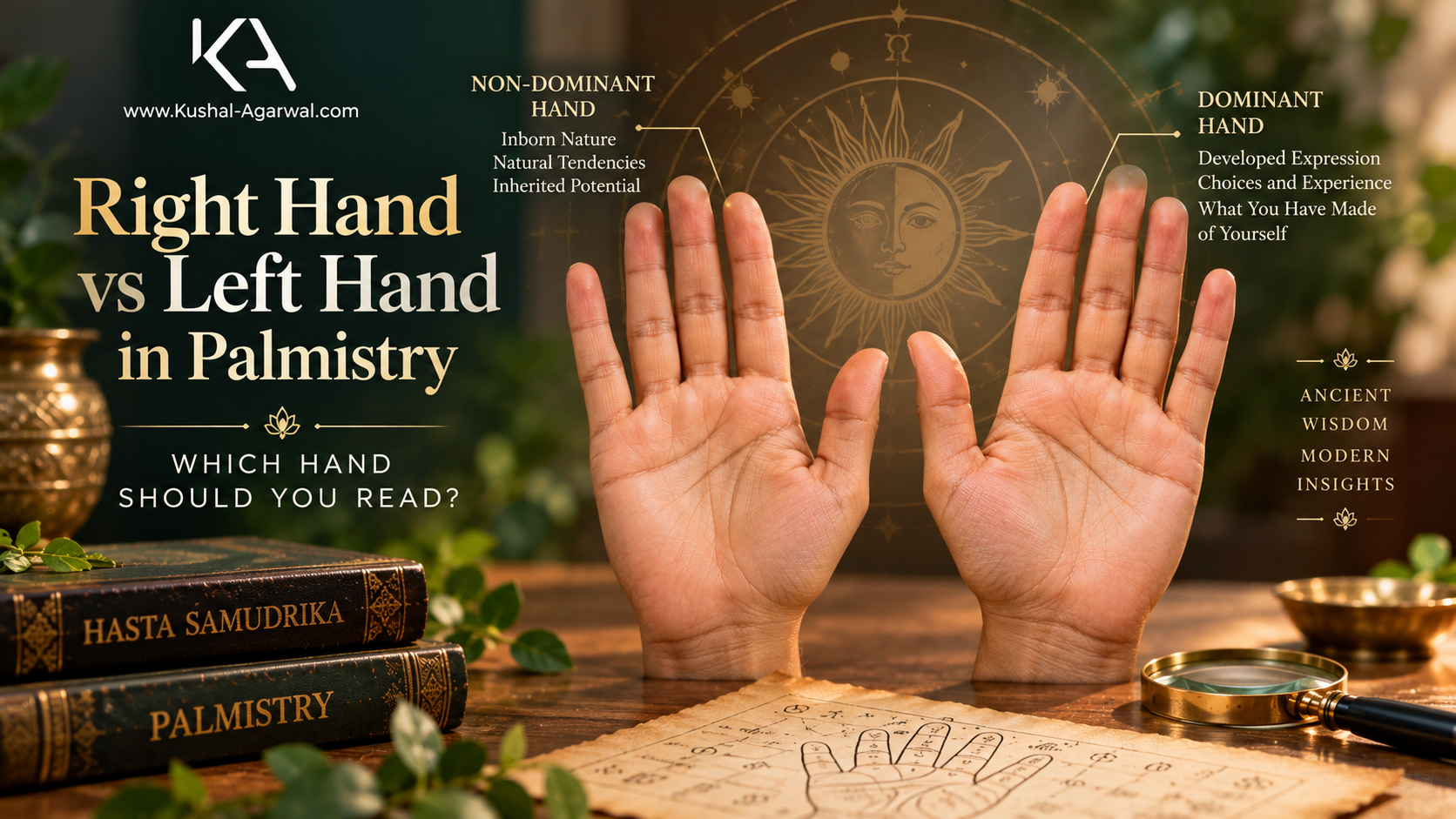
Non-dominant hand = inherited potential
Dominant hand = developed expression
The non-dominant hand is traditionally associated with what a person starts with: natural tendencies, inherited qualities, temperament and latent potential.
The dominant hand is associated with what the person has actually done with those tendencies through choices, experiences, effort and circumstances.
This creates a fascinating possibility.
The two hands do not always tell exactly the same story.
And that difference is often where the reading becomes interesting.
What Is the Dominant Hand?
Your dominant hand is generally the hand you use most naturally for tasks such as writing.
For most people this is the right hand, but not for everyone.
If you write primarily with your left hand, your left hand is your dominant hand.
The important point is not whether the hand is technically "right" or "left."
The important point is whether it is active or passive in your daily life.
The dominant hand represents the hand that has been repeatedly used, exercised and influenced by your lived experience.
In palmistry, this makes it particularly useful when examining your present expression.
It can be thought of as:
"This is what I have made of myself."
What Is the Non-Dominant Hand?
The non-dominant hand provides the other side of the picture.
It is traditionally associated with the qualities that existed before conscious development had a major influence.
It can be thought of as:
"This is what I started with."
This does not mean that everything seen on the non-dominant hand is fixed.
Rather, it gives the palmist a reference point.
When the dominant hand looks significantly different, the difference can be interpreted as development, adaptation or change.
That is much more useful than treating one hand as "correct" and the other as irrelevant.
Why You Should Not Read Only One Hand
Imagine that you are looking at someone's Head Line.
On the non-dominant hand, it is long and relatively straight.
On the dominant hand, it has developed a more pronounced curve.
If you read only the dominant hand, you might describe the person simply as imaginative or intuitive.
But comparing both hands gives you another possibility.
Perhaps the person started with a more analytical disposition but gradually developed a more imaginative way of thinking.
The two hands provide the timeline.
One gives you the starting point.
The other gives you the current expression.
This is why comparison is more powerful than isolated observation.
The Traditional Indian Approach
Indian palmistry and Hasta Samudrika Shastra have their own traditional conventions concerning the two hands.
A commonly taught Indian convention gives greater importance to the right hand for men and the left hand for women, with the other hand providing complementary information.
This gender-based framework is still encountered in traditional teaching and popular palmistry practice.
However, modern practitioners may instead emphasise dominance and read both hands.
This is important because there is no single universal palmistry system.
Different schools inherited different rules.
The mistake is not following one tradition.
The mistake is mixing rules from several traditions without knowing where they came from.
If you are practising palmistry professionally, be clear about the framework you are using.
Dominant Hand vs Non-Dominant Hand
For practical reading, the following framework is particularly useful:
Dominant Hand
Traditionally read for:
- Present development
- Choices and decisions
- Active personality
- Current direction
- Developed abilities
- Experience
- Changes over time
- How potential is being expressed
Non-Dominant Hand
Traditionally read for:
- Natural tendencies
- Inherited qualities
- Early temperament
- Latent abilities
- Original patterns
- Background influences
- Potential before development
The distinction can be summarised in one sentence:
The non-dominant hand shows the starting material; the dominant hand shows how that material has been developed.
What If Both Hands Look Almost the Same?
This is also meaningful within traditional palmistry.
If the two hands are remarkably similar, there may be less visible divergence between inherited tendencies and lived expression.
The person may have remained relatively consistent with their natural disposition.
That does not mean that they have not changed.
It simply means that the hand does not show a dramatic contrast between the two.
The absence of a major difference is itself something to observe.
A palmist should never force a dramatic interpretation where the hand does not show one.
What If the Hands Look Very Different?
This is where comparison becomes particularly interesting.
Significant differences between the two palms may traditionally be read as evidence of development or adaptation.
For example:
A softer, more delicate non-dominant hand combined with a firmer dominant hand may suggest a person who has developed greater resilience through experience.
A highly emotional Heart Line on one hand and a more restrained version on the other may be interpreted as a change in emotional expression.
A pronounced Fate Line developing more strongly on the dominant hand may be read as greater direction or structure emerging through life.
The key is not to say:
"Your left hand says X, therefore you are X."
Instead ask:
"What changed between the two hands?"
That is the better palmistry question.
Compare the Major Lines
When reading both hands, begin with the major lines.
Life Line
Compare:
- Length
- Depth
- Curvature
- Branches
- Breaks
- Parallel supporting lines
Do not interpret the Life Line simply as a measurement of lifespan.
Its traditional symbolism is much broader and includes vitality, engagement with life and major transitions.
Head Line
Compare:
- Length
- Direction
- Curvature
- Starting point
- Clarity
- Branches
The difference can provide insight into how thinking and decision-making have developed.
Heart Line
Compare:
- Length
- Curve
- Starting position
- Ending position
- Branches
- Major markings
This can help distinguish between emotional tendencies and their developed expression.
Fate Line
The Fate Line is particularly interesting because it is not equally prominent on every hand.
It is traditionally associated with direction, vocation, responsibility and one's relationship with the larger structure of life.
If it is stronger on one hand than the other, compare the two rather than immediately calling one hand "good" and the other "bad."
Compare the Mounts Too
The comparison should not stop with the lines.
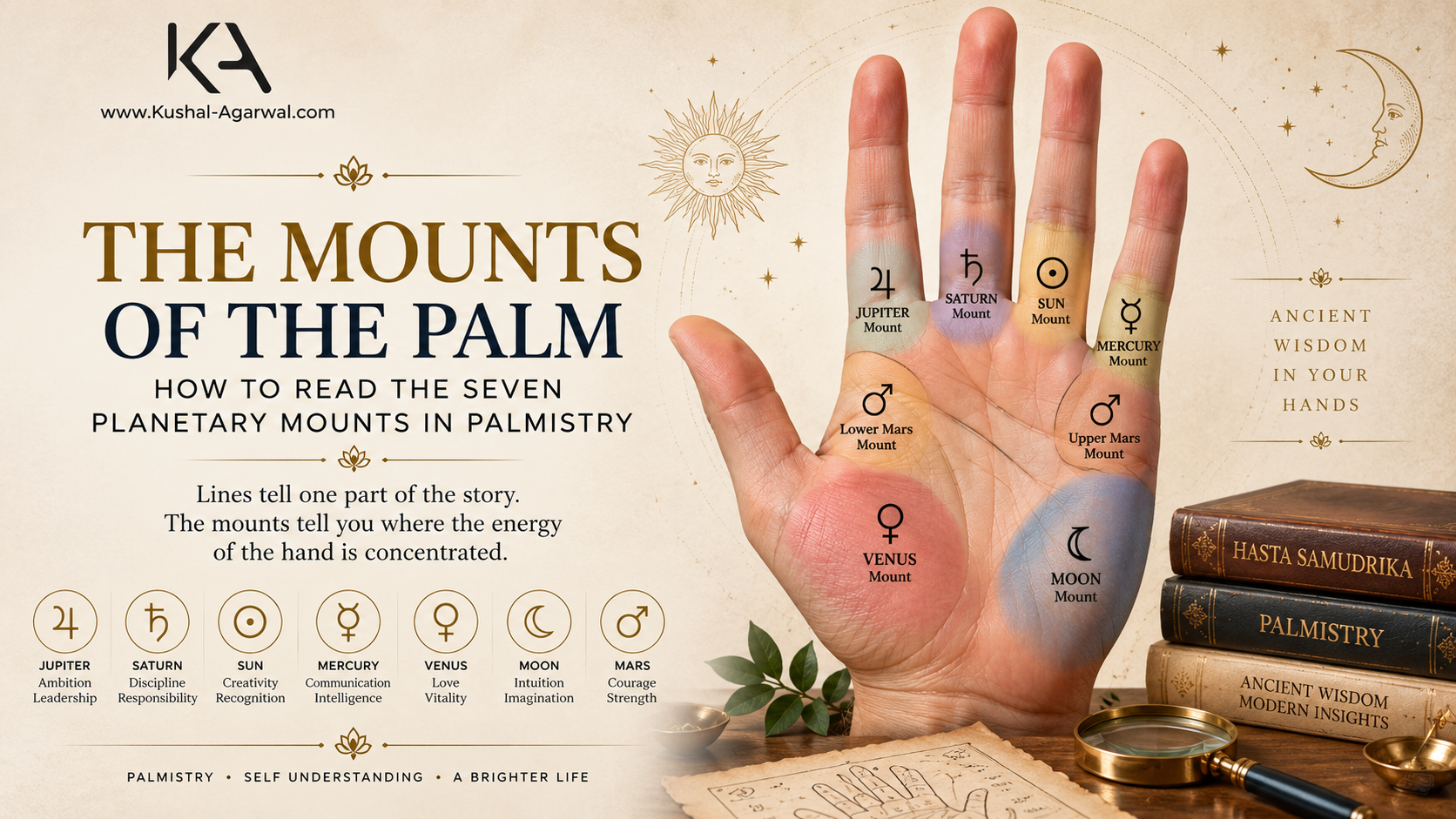
Look at the planetary mounts.
Compare:
Jupiter — ambition, leadership and aspiration.
Saturn — discipline, responsibility and seriousness.
Sun — creativity, recognition and expression.
Mercury — communication, intelligence and commercial ability.
Venus — vitality, affection and enjoyment.
Moon — imagination, sensitivity and inner world.
Mars — courage, resistance and assertiveness.
If one mount is noticeably more developed on the dominant hand, traditional palmistry may interpret that as a quality that has become more actively expressed.
Again, the reading becomes much richer when the two hands are compared.
Do Not Ignore the Thumb
The thumb is especially useful here.
As we discussed in the previous article, the thumb is traditionally associated with willpower, reasoning and the ability to act.
Compare:
- Thumb length
- First phalange
- Second phalange
- Flexibility
- Natural angle
- Mount of Venus
A change in thumb flexibility or apparent development can add an important layer to the interpretation of the lines.
For example, a person may have strong intellectual indicators but a much firmer dominant thumb.
That combination can suggest that their ability to act decisively has developed with experience.
This is why palmistry should be read as a system.
What About the Old "Men Right, Women Left" Rule?
This is one of the most repeated statements in popular palmistry.
But it should not be treated as the only valid method.
Traditional Indian schools may retain gender-based conventions, while many modern practitioners use dominant and non-dominant hands.
Western palmistry traditions also developed their own approaches to the active and passive hands.
Therefore, when studying palmistry seriously, ask:
Which school am I following?
That question is more important than memorising a single rule from the internet.
A professional palmist should understand the origin of a method before applying it.
The Biggest Beginner's Mistake
The biggest mistake is asking:
"Which hand is the real hand?"
There isn't much value in thinking that way.
The better question is:
"What does each hand contribute to the reading?"
One gives context.
The other shows development.
One gives you the starting pattern.
The other shows how life has interacted with it.
Together they create a more complete picture.
A Practical Two-Hand Reading Method
If you are learning palmistry, try this method.
Step 1: Establish dominance
Ask which hand the person naturally uses for writing.
Step 2: Photograph or observe both palms
Do not begin by analysing only one.
Step 3: Compare the overall hand
Look at:
- Shape
- Size
- Texture
- Fingers
- Thumb
- Mounts
Step 4: Compare the major lines
Start with:
- Life Line
- Head Line
- Heart Line
- Fate Line
Step 5: Identify the strongest differences
Do not try to interpret every tiny variation.
Find the three or four most obvious differences.
Step 6: Ask what changed
This is the heart of the reading.
Step 7: Integrate
Bring the lines, mounts, fingers and thumb together.
The final interpretation should be based on the whole hand rather than a single sign.
Your Hands Are Not Two Separate Stories
This is perhaps the most useful way to think about palmistry.
Your two palms are not competing answers.
They are two chapters.
One represents the pattern you began with.
The other represents the pattern you are actively expressing.
The space between them represents development.
And that makes palmistry far more interesting than simply looking for predictions.
A palmist who only reads one hand may see a pattern.
A palmist who compares both hands can begin to see a process.
The Real Question Is Not Which Hand Is Right
So, should you read the right hand or the left hand?
Read both.
Use the dominant and non-dominant framework when appropriate, understand the traditional school you are working within, and most importantly, compare the two palms.
Because the most valuable information may not be sitting on either hand individually.
It may be sitting in the difference between them.
That difference can tell the story of how natural tendencies, choices, experiences and circumstances have interacted over time.
And that is where palmistry moves beyond memorising lines.
It becomes the study of development.
SOURCES
The Daily Jagran — Left Hand vs Right Hand in Palmistry https://www.thedailyjagran.com/lite/spiritual/left-hand-vs-right-hand-in-palmistry-what-does-each-palm-reveal-10322733
ReadMyPalms — Left Hand vs Right Hand https://www.readmypalms.com/palm-reading/left-vs-right-hand
Life Palmistry — Left Hand vs Right Hand in Palmistry https://www.lifepalmistry.com/blog/left-hand-vs-right-hand-palmistry
PalmVision AI — Left Hand vs Right Hand https://palmvisionai.com/articles/left-hand-vs-right-hand-palm-reading
Palm & Line — Which Hand Do You Read? https://palm.yairtech.co.uk/journal/which-hand-do-you-read
SUGGESTED_INTERNAL_LINKS
- The Mounts of the Palm: How to Read the Seven Planetary Mounts in Palmistry
- The Thumb in Palmistry: Willpower, Logic and the Power to Decide
- How to Read the Major Lines in Palmistry
- Life Line in Palmistry: What It Actually Reveals
- Heart Line in Palmistry: Reading Love, Emotion and Attachment
- Head Line in Palmistry: Understanding the Mind Through the Hand
- Fate Line in Palmistry: Career, Direction and Life Path
Want to learn Palmistry beyond isolated lines and memorised meanings?
Explore more practical Palmistry and Hasta Samudrika insights at Kushal-Agarwal.com.
Want this read for your own chart?
Every session blends Vedic astrology, numerology and counselling psychology — your chart read as architecture, not prophecy. Bring the decision you are actually sitting with, and leave with timing, language and a next step.