
Palmistry
The Mounts of the Palm: How to Read the Seven Planetary Mounts in Palmistry
Kushal Agarwal · 5 Sept 2026 · 12 min read
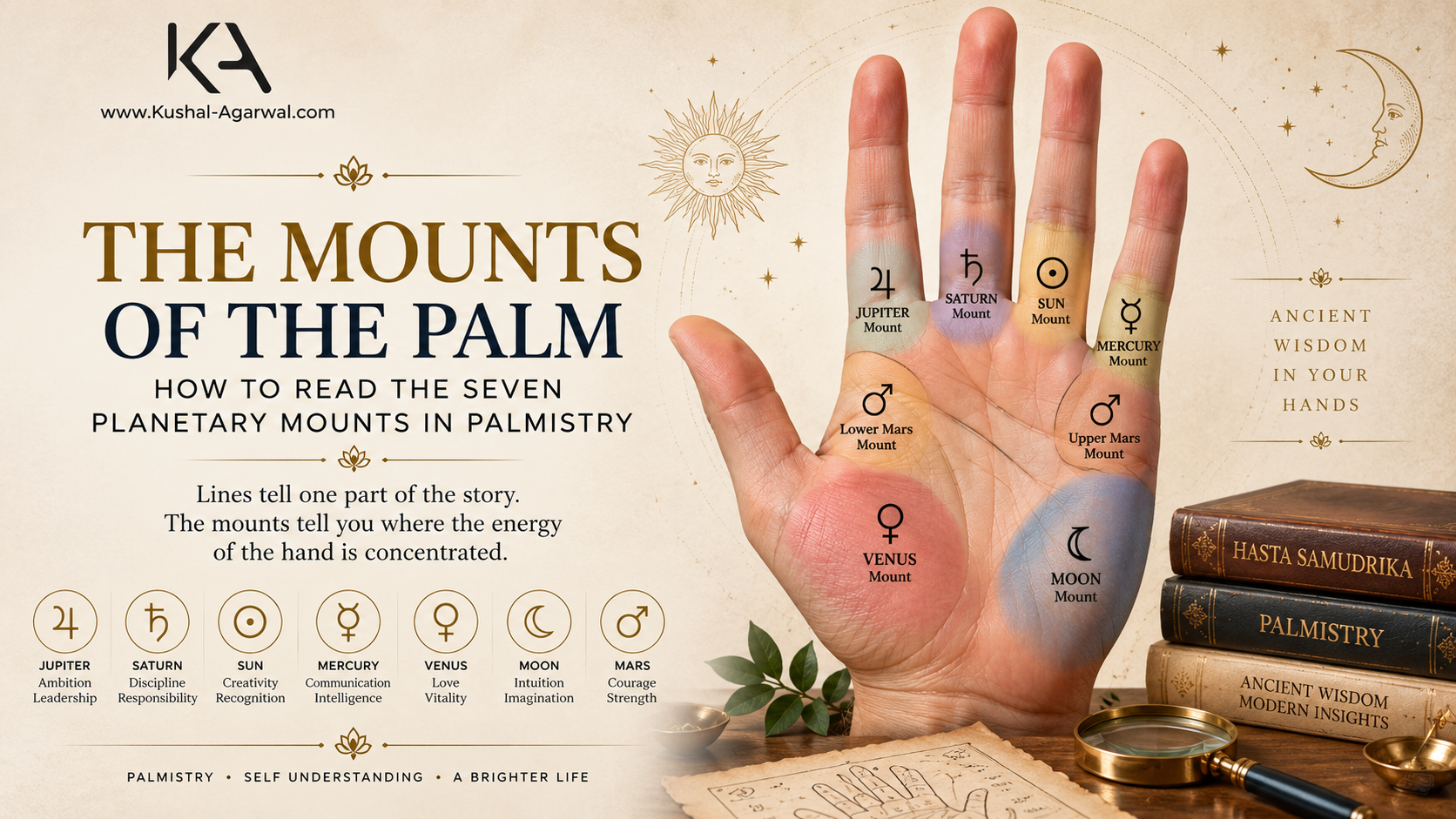
The Mounts of the Palm: How to Read the Seven Planetary Mounts in Palmistry
Most beginners start palmistry by looking at lines.
The Heart Line.
The Head Line.
The Life Line.
The Fate Line.
That is a good starting point.
But if you want to move from basic palm reading to actual interpretation, there is another part of the hand you need to understand:
The mounts.
The mounts are the raised or fleshy areas of the palm traditionally associated with different planetary principles.
They can tell you something different from the lines.
A line may describe a particular pattern of experience.
A mount can indicate where a particular quality has greater or lesser expression in the hand.
This is why an experienced palmist does not simply look at one line and make a prediction.
The hand has to be read as a system.
What Are the Mounts of the Palm?
The mounts are the fleshy areas of the palm found beneath the fingers and around the lower portions of the hand.
Traditional palmistry associates these areas with planetary principles.
The commonly studied mounts are:
- Jupiter
- Saturn
- Sun
- Mercury
- Venus
- Moon
- Upper Mars
- Lower Mars
The central area of the palm is also often considered in relation to Mars and the overall balance of the hand.
The exact terminology and classification can vary between palmistry traditions.
But the basic principle remains the same:
Different areas of the hand are associated with different qualities.
Why Are the Mounts Important?
Imagine reading someone's palm and seeing a very strong Venus mount.
That immediately gives you additional information.
Now imagine the same person has a strong Venus mount but a very different Heart Line.
The interpretation changes.
Or suppose someone has a prominent Jupiter mount but a weak Fate Line.
Again, the reading becomes more nuanced.
This is why palmistry should not work like a dictionary:
“Strong Jupiter mount = this.”
Instead, think:
What quality is prominent, and how is that quality expressed through the rest of the hand?
That is the beginning of synthesis.
1. Mount of Jupiter
The Mount of Jupiter lies beneath the index finger.
Traditionally, Jupiter is associated with:
- ambition
- leadership
- confidence
- authority
- aspiration
- learning
- status
- principles
- desire for recognition
A well-developed Jupiter mount is traditionally associated with confidence and aspiration.
Such a person may naturally want to take responsibility or occupy a position of influence.
But there is an important distinction.
A developed Jupiter does not necessarily mean someone is arrogant.
Its expression depends upon the rest of the hand.
A balanced Jupiter may indicate healthy ambition.
An excessive Jupiter may traditionally be interpreted as excessive pride, dominance or self-importance.
A weak Jupiter may suggest less interest in authority or recognition.
So the question is not simply:
“Is Jupiter strong?”
It is:
“How is Jupiter behaving?”
2. Mount of Saturn
The Mount of Saturn lies beneath the middle finger.
Saturn traditionally represents:
- discipline
- responsibility
- seriousness
- patience
- solitude
- endurance
- caution
- structure
A developed Saturn mount can indicate a serious and reflective temperament.
Such people may prefer depth over superficiality.
They may be willing to work patiently towards something rather than expecting immediate results.
But excessive Saturn can become excessive seriousness.
The person may become overly cautious, pessimistic or withdrawn.
A very weak Saturn, on the other hand, may traditionally suggest difficulty with sustained discipline or responsibility.
Again, balance matters.
A good mount is not necessarily the largest mount.
3. Mount of the Sun
The Mount of the Sun, also called the Mount of Apollo, lies beneath the ring finger.
It is traditionally associated with:
- creativity
- recognition
- confidence
- aesthetics
- visibility
- expression
- achievement
- appreciation
A well-developed Sun mount may indicate a strong desire to create, express or be recognised for one's abilities.
This does not necessarily mean fame.
That distinction is important.
A person may have strong Sun qualities but express them privately through art, design, teaching, writing or another creative pursuit.
The Sun is fundamentally about expression and illumination.
Its highest expression is not simply:
“Look at me.”
It is:
“I have something worth expressing.”
4. Mount of Mercury
The Mount of Mercury lies beneath the little finger.
Mercury is traditionally associated with:
- communication
- intelligence
- business
- negotiation
- adaptability
- wit
- commerce
- practical reasoning
A developed Mercury mount may be seen in hands associated traditionally with communication and commercial ability.
This is particularly interesting when combined with a strong Head Line.
A strong Mercury mount with a clear Head Line can suggest a person who is comfortable processing information and communicating it.
But once again, context matters.
A strong Mercury does not automatically mean someone will become a successful businessperson.
Palmistry is interpretive.
The mount is one indicator among several.
5. Mount of Venus
The Mount of Venus is the large fleshy area at the base of the thumb, inside the Life Line.
It is one of the most visually prominent regions of the palm.
Venus traditionally represents:
- vitality
- affection
- sensuality
- pleasure
- relationships
- warmth
- attraction
- creativity
- enjoyment of life
A broad and well-developed Venus mount is traditionally associated with warmth, vitality and an affectionate temperament.
The quality of the mount matters.
A firm and balanced Venus can indicate healthy expression of Venusian qualities.
An excessively prominent Venus may traditionally suggest indulgence or excessive attachment to pleasure.
A flat Venus mount may indicate a more restrained temperament.
This is also why the Life Line cannot be interpreted independently.
The Life Line surrounds the Mount of Venus.
The relationship between the two becomes part of the reading.
6. Mount of Moon
The Mount of Moon, or Luna, occupies the outer lower portion of the palm opposite Venus.
Moon traditionally represents:
- imagination
- intuition
- sensitivity
- receptivity
- travel
- fantasy
- emotional perception
- subconscious impressions
A developed Moon mount is traditionally associated with imagination and sensitivity.
These qualities can manifest in very different ways.
A person might become:
- an artist
- a writer
- a traveller
- a dreamer
- a highly intuitive individual
But an excessively developed Moon may traditionally indicate excessive fantasy or emotional instability.
A balanced Moon is more interesting.
It suggests imagination that can actually be integrated into life.
7. Mount of Mars
Mars is particularly interesting because palmistry traditionally divides it into more than one region.
The upper and lower Mars areas are associated with somewhat different expressions of Martian energy.
Mars represents:
- courage
- assertion
- resistance
- physical drive
- competition
- conflict
- determination
The lower Mars region, closer to the thumb side of the palm, is traditionally connected with active courage and initiative.
The upper Mars region, toward the outer side of the palm, is associated more with resistance, endurance and the ability to withstand pressure.
This gives us an important distinction.
Starting a fight and surviving a fight are not exactly the same quality.
One requires initiative.
The other requires endurance.
Palmistry's Mars symbolism attempts to capture this difference.
The Plain of Mars
Between the major mounts lies the central field of the palm, often referred to in palmistry as the Plain of Mars.
This area is particularly interesting because it can reflect the overall balance of the hand's active and resistant qualities.
A firm, balanced central palm may traditionally be interpreted differently from one that is unusually tense, flat or heavily marked.
This is one reason experienced palmists don't immediately jump to individual lines.
They first look at the whole hand.
Strong Mount vs Excessive Mount
This is one of the most important principles to understand.
A large mount is not automatically a good mount.
There is a difference between:
Developed
and
Excessive.
Think about Jupiter.
Healthy Jupiter:
Confidence → Leadership → Responsibility
Excessive Jupiter:
Confidence → Ego → Dominance
The same principle applies elsewhere.
Venus can become warmth or indulgence.
Moon can become intuition or fantasy.
Saturn can become discipline or pessimism.
Mercury can become communication or manipulation.
Mars can become courage or aggression.
Sun can become creativity or vanity.
The goal is therefore not to find the “biggest” mount.
The goal is to understand balance.
How Should You Judge a Mount?
A practical palm reading should consider at least five things.
1. Size
Is the mount flat, moderate or prominent?
2. Firmness
Does it feel firm and elastic or soft and yielding?
3. Texture
Is the skin smooth, coarse, fine or heavily marked?
4. Lines and Marks
Are there stars, crosses, islands, grids, triangles or other markings?
5. Relationship With Other Mounts
Is one mount dramatically more developed than the others?
That last question is especially important.
Palmistry is about proportion.
The Mounts Must Be Read Together
Suppose someone has:
Strong Jupiter
Strong Sun
Strong Mercury
You might see a combination of:
ambition + recognition + communication.
That could manifest through leadership, entrepreneurship, public speaking, teaching or business.
Now imagine another person has:
Strong Moon
Strong Venus
Strong Mercury
The expression may be completely different.
The combination could favour creativity, communication, imagination and interpersonal sensitivity.
Neither combination is inherently superior.
They simply describe different concentrations of qualities.
That is the real value of mounts.
Mounts and Lines: The Real Reading Begins Here
This is where palmistry becomes much more interesting.
Suppose the Venus mount is prominent.
Then examine the Life Line.
Suppose the Jupiter mount is prominent.
Then examine the Head Line and Fate Line.
Suppose the Sun mount is strong.
Look at the Sun Line and the quality of the Head Line.
Suppose Mercury is developed.
Look at the Mercury Line, Head Line and overall hand shape.
The mount gives you the field of energy.
The lines show how that energy is expressed through patterns and experiences.
This is why one should never read a mount in isolation.
The Seven Planetary Mounts as a Quick Reference
| Mount | Traditional Planet | Core Theme |
|---|---|---|
| Jupiter | Jupiter | Ambition, leadership, principles |
| Saturn | Saturn | Discipline, responsibility, depth |
| Sun | Sun | Creativity, recognition, expression |
| Mercury | Mercury | Communication, commerce, adaptability |
| Venus | Venus | Vitality, affection, pleasure |
| Moon | Moon | Imagination, intuition, sensitivity |
| Mars | Mars | Courage, assertion, resistance |
The important word here is theme.
A mount does not mechanically predict an event.
It indicates a traditional field of interpretation.
What About Signs, Stars and Other Marks?
Once you understand the mounts, the next level is learning the markings that appear upon them.
A star on Jupiter is not interpreted in the same way as a star on Venus.
An island on a line is not interpreted in exactly the same way as an island elsewhere.
A square, cross, triangle or grille can modify the interpretation depending upon its location and the surrounding hand.
This is why memorising symbols without learning their location often produces poor palmistry.
Location comes first.
Meaning comes second.
The Biggest Beginner Mistake
The biggest mistake is asking:
“Which mount is strongest?”
That question is too simplistic.
Instead ask:
“Which qualities dominate this hand?”
Then ask:
“Are those qualities balanced?”
Then:
“How are they expressed through the lines?”
And finally:
“What does the other hand tell me?”
That is how you move from symbol reading to palm reading.
A Practical Order for Reading the Hand
If you are learning palmistry, try this sequence:
STEP 1
Look at the overall shape of the hand.
STEP 2
Observe the fingers and thumb.
STEP 3
Assess the major mounts.
STEP 4
Read the Heart Line.
STEP 5
Read the Head Line.
STEP 6
Read the Life Line.
STEP 7
Read the Fate Line if present.
STEP 8
Examine the Sun, Mercury and other secondary lines.
STEP 9
Look for special marks.
STEP 10
Synthesize everything.
This order prevents you from becoming obsessed with one dramatic line or mark.
The Hand Is a Map of Tendencies, Not a Single Prediction
This is perhaps the most useful mindset for anyone learning palmistry.
A palm is not a collection of fortune-telling symbols.
It is a system.
The mounts show concentrations of traditional planetary qualities.
The lines show patterns.
The fingers add another dimension.
The thumb speaks to will and control.
The texture and flexibility of the hand add further nuance.
And the comparison between the hands can reveal change and development.
The more you study palmistry, the more you realise that no single feature should be allowed to dominate the entire reading.
Final Takeaway
If the major lines are the sentences of the palm, the mounts are part of its vocabulary.
Jupiter speaks of aspiration.
Saturn speaks of discipline.
The Sun speaks of expression.
Mercury speaks of communication.
Venus speaks of vitality and affection.
Moon speaks of imagination.
Mars speaks of courage and resistance.
But none of these should be judged alone.
The real art of palmistry lies in understanding proportion, interaction and synthesis.
So the next time you look at a palm, don't immediately search for the longest line.
Look at the whole hand.
Where is it full?
Where is it flat?
Where is it firm?
Where is it soft?
Which planetary qualities dominate?
And then ask the most important question:
How do those qualities interact with the lines?
That is where palmistry stops being a collection of rules and starts becoming an interpretive system.
CTA
Want to learn palmistry systematically rather than memorising isolated signs?
Explore more practical palmistry and occult studies at Kushal-Agarwal.com.
SOURCES
PalmGuru — Palm reading lines and traditional interpretation of the major lines and mounts https://www.palmguru.app/blog/palm-reading-lines-meaning
AstroSight — Traditional palmistry overview of major lines, mounts and planetary associations https://astrosight.ai/palmistry/palmistry-lines-heart-head-life-fate-decoded
Life Palmistry — Palm lines, mounts and traditional reading methodology https://lifepalmistry.com/blog/palm-reading-lines
SUGGESTED_INTERNAL_LINKS
- How to Read the Major Lines in Palmistry
- Life Line in Palmistry: What It Actually Reveals
- Heart Line in Palmistry: Reading Love, Emotion and Attachment
- Head Line in Palmistry: Understanding the Mind Through the Hand
- Fate Line in Palmistry: Career, Direction and Life Path
RELATED_ARTICLE_IDEAS
- The Thumb in Palmistry: Willpower, Logic and the Power to Decide
- Hand Shapes in Palmistry: Earth, Air, Fire and Water Hands
- The Sun Line: Recognition, Creativity and Success in Palmistry
- The Fate Line: What Its Starting Point Reveals
- The Life Line: Why It Does Not Predict How Long You Will Live
- Stars, Islands, Crosses and Squares: The Major Marks in Palmistry
- Right Hand vs Left Hand in Palmistry: Which One Should You Read?
- How Palm Lines Change Over Time—and What Palmists Make of It
Want this read for your own chart?
Every session blends Vedic astrology, numerology and counselling psychology — your chart read as architecture, not prophecy. Bring the decision you are actually sitting with, and leave with timing, language and a next step.