
Bhakti & Spirituality
Laddu Gopal Ji: The Divine Child Who Turns Worship Into Love
Kushal Agarwal · 4 Sept 2026 · 9 min read
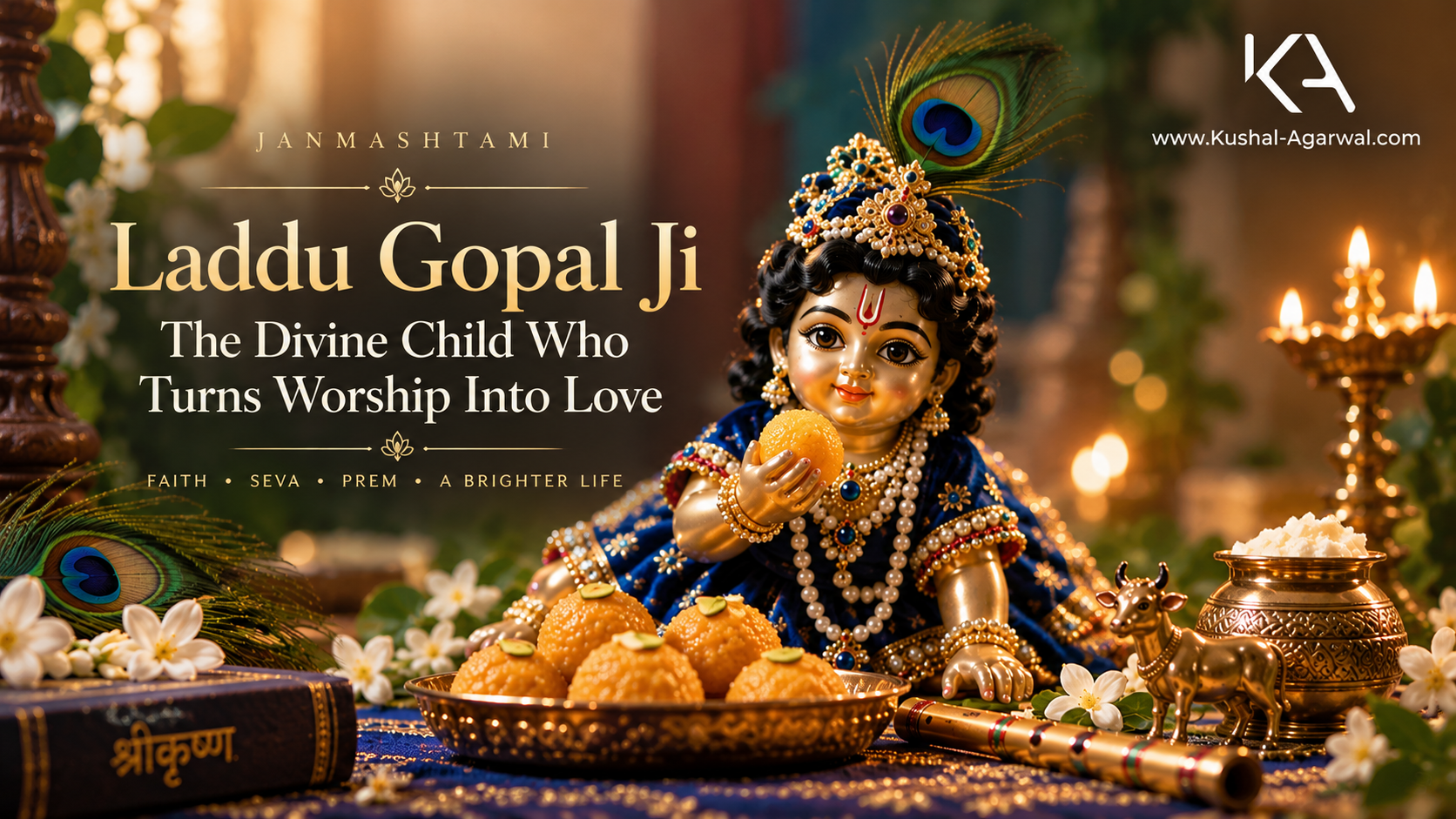
Laddu Gopal Ji: The Divine Child Who Turns Worship Into Love
There is something profoundly beautiful about the way devotees love Laddu Gopal Ji.
He is not always approached with the distance and solemnity with which we imagine God.
He is dressed.
He is fed.
He is bathed.
He is placed in a little swing.
He is offered toys.
He is given a bed.
He is woken in the morning.
And at night, He is lovingly put to sleep.
For someone seeing this tradition for the first time, it can appear almost unusual.
Why would a devotee treat God like a little child?
The answer lies in one of the most tender dimensions of Krishna bhakti:
The devotee does not merely want to worship Krishna.
The devotee wants to love Krishna.
And Laddu Gopal Ji makes that love deeply personal.
Janmashtami and the Arrival of the Divine Child
Janmashtami celebrates the appearance of Shri Krishna.
In 2026, Krishna Janmashtami was observed on Friday, September 4. The principal worship is traditionally associated with the midnight period because Krishna's birth is celebrated at night. The exact puja timings vary by location. :contentReference[oaicite:1]{index=1}
But beyond the calendar date and ritual timing lies something more intimate.
Janmashtami allows the devotee to experience Krishna not only as the Supreme Being, teacher, king, warrior or charioteer.
It allows us to experience Him as Kanha.
As the little child of Gokul.
As the mischievous butter thief.
As the child who runs through the streets of Vrindavan.
As the beloved little one whom Yashoda lovingly cares for.
And this is where Laddu Gopal Ji becomes so special.
Who Is Laddu Gopal Ji?
Laddu Gopal Ji is the beloved child form of Shri Krishna, also known as Bal Gopal or Kanha.
The form evokes Krishna's childhood pastimes in Gokul and Vrindavan.
Rather than approaching God only through awe, the devotee approaches Him through affection.
This is the essence of Vatsalya Bhava—the devotional attitude of loving the Divine with the tenderness of a parent toward a child.
The relationship changes.
You don't simply stand before God and ask for something.
You begin to think:
“Has Kanha eaten?”
“Is He comfortable?”
“Has He been dressed?”
“Is He sleeping?”
That shift is spiritually significant.
The centre of devotion moves from:
“What can God give me?”
to:
“What can I lovingly offer to God?”
Why Do Devotees Treat Laddu Gopal Ji Like Their Own Child?
This is perhaps the most beautiful question.
The answer is bhava.
Bhakti is not merely the performance of an external ritual.
It is a relationship.
Different traditions of devotion allow a devotee to relate to the Divine in different emotional modes.
Krishna can be approached as:
- a master
- a friend
- a beloved
- a child
Laddu Gopal represents one of the most intimate of these relationships.
The devotee assumes the emotional position of a caretaker.
And suddenly ordinary activities become acts of devotion.
Giving Him food becomes seva.
Dressing Him becomes seva.
Decorating His jhula becomes seva.
Preparing His bed becomes seva.
Even arranging His little clothes can become an expression of love.
Recent accounts of Laddu Gopal worship similarly describe the practice as a daily relationship of care rather than simply the worship of an object. :contentReference[oaicite:2]{index=2}
The Beauty of Seva
The word seva means service.
But when the object of that service is Laddu Gopal Ji, seva takes on a very intimate character.
A devotee may begin the day by waking Him.
Then comes snan.
Then shringar.
Then bhog.
Then darshan.
Then rest.
The exact routine differs between households and traditions.
There is no need to turn devotion into a competition about how elaborate the routine is.
The essence is simple:
Serve with love.
A single flower offered with genuine devotion can be more meaningful than an elaborate ritual performed mechanically.
The external act matters.
But the bhava behind the act matters more.
Shringar: When Love Takes Form
One of the most delightful aspects of Laddu Gopal worship is shringar.
Tiny poshaks.
Small crowns.
Jewellery.
A bansuri.
A peacock feather.
Garlands.
Flowers.
Jhulas.
Everything is prepared with extraordinary attention.
But there is something deeper here.
A parent naturally enjoys dressing a child.
The child may not understand why the clothes were selected.
The child may not care how carefully the jewellery was arranged.
But the parent enjoys doing it.
That is precisely the emotional beauty of Laddu Gopal seva.
The devotee dresses Krishna because the act of dressing Him is itself an act of love.
Shringar therefore becomes less about decoration and more about relationship.
Why Is Makhan-Mishri So Closely Associated With Krishna?
Few images are more strongly associated with Krishna's childhood than butter.
Krishna's childhood pastimes with makhan are central to the affectionate image of Makhan Chor.
This is why makhan and mishri are among the most familiar offerings associated with Krishna devotion and Janmashtami celebrations. Traditional Janmashtami observances also include offerings and midnight worship of the child form of Krishna. :contentReference[oaicite:3]{index=3}
But again, the deeper principle is not simply:
“Krishna likes this food.”
The offering represents something more fundamental.
We offer what we have with love.
Food becomes bhog.
Bhog becomes prasada.
And the act of offering becomes an expression of surrender.
The Jhula of Laddu Gopal
There is another beautiful Janmashtami tradition:
Jhula.
The image of little Krishna being placed in a decorated swing captures the emotional heart of His childhood.
At midnight, when devotees celebrate His appearance, the child Krishna is often placed in a cradle or swing and lovingly rocked while bhajans and aarti are performed. :contentReference[oaicite:4]{index=4}
The symbolism is simple and profound.
The Divine has entered our home.
And the devotee welcomes Him.
Not with fear.
Not with distance.
But with joy.
Laddu Gopal Changes the Meaning of a Home
When a family begins caring for Laddu Gopal Ji, something interesting happens.
The home mandir can stop feeling like a place that is visited only during puja.
It becomes part of everyday life.
Morning begins with darshan.
Food is prepared with an awareness of bhog.
Festivals become occasions to dress Him.
Children become involved in His seva.
The family gathers around Him.
In this way, devotion moves from a scheduled activity to a lived experience.
That may be one of the greatest strengths of Bal Gopal worship.
It brings the Divine into the ordinary.
The Child Who Teaches Us to Become Childlike
There is another layer to Laddu Gopal Ji that is easy to miss.
Perhaps Krishna appears as a child because the devotee also needs to rediscover something childlike.
Not childishness.
Childlikeness.
Wonder.
Playfulness.
Trust.
Curiosity.
The ability to laugh.
The ability to love without constantly calculating what will come back.
As adults, we become increasingly transactional.
We ask:
“What will I get?”
“What is the benefit?”
“What will happen if I do this?”
Bhakti can interrupt that calculation.
Laddu Gopal teaches us to simply love.
Krishna as the Supreme and Krishna as the Child
This is perhaps the paradox that makes Krishna so fascinating.
The same Krishna who is revered as the Supreme Lord is remembered as the mischievous child of Yashoda.
The same Krishna who gives Arjuna the wisdom of the Bhagavad Gita is the Krishna whom devotees imagine running around Gokul with butter on His hands.
The same Divine Being can inspire awe and tenderness.
And Laddu Gopal allows the devotee to experience the second.
The infinite appearing intimate.
That is the magic of Krishna bhakti.
What Does Laddu Gopal Ji Teach Us?
Perhaps the greatest teaching is not a ritual rule.
It is an attitude.
When we care for Laddu Gopal, we are reminded that devotion can exist in the smallest things.
A clean altar.
A fresh garment.
A flower.
A little bowl of bhog.
A lullaby.
A moment of darshan.
A whispered:
“Kanha, aapne khana kha liya?”
These may appear ordinary.
But when performed with genuine bhakti, they become sacred.
The Divine does not always enter our lives through dramatic experiences.
Sometimes He enters through affection.
Do You Need an Elaborate Ritual to Love Laddu Gopal?
No.
This is important.
Devotion should not become anxiety.
Different families and sampradayas follow different practices for seva, shringar, bhog and daily worship.
Some maintain an elaborate routine.
Others have a much simpler practice.
There is no need to believe that Krishna's love is proportional to the number of rituals performed.
The essence of bhakti is shraddha and prema.
Do what you can.
Do it sincerely.
And allow devotion to become natural.
After Janmashtami, Let the Celebration Continue
Janmashtami does not have to end when the midnight celebration is over.
The real question is:
What happens to our relationship with Krishna the next morning?
The decorations may come down.
The special clothes may be put away.
The bhog may return to its normal routine.
But Krishna remains.
That is where Laddu Gopal seva becomes especially beautiful.
Janmashtami celebrates the arrival of Krishna.
Daily seva celebrates His presence.
And perhaps that is the deeper invitation of the festival:
Don't merely celebrate Krishna's birth once a year.
Make space for Krishna in everyday life.
The Greatest Offering Is Love
There are elaborate rituals.
There are mantras.
There are beautiful temples.
There are ornaments and festivals.
There are flowers, bhog, jhulas and aarti.
But beneath all of them is something much simpler.
Love.
Laddu Gopal Ji reminds the devotee that God can be approached not only through reverence, but through affection.
Not only through prayer, but through seva.
Not only through philosophy, but through relationship.
And perhaps that is why the little form of Krishna has such an extraordinary place in the hearts of devotees.
You may stand before Him as a worshipper.
But eventually, if bhakti deepens, you begin to feel something different.
You begin to feel:
“He is not merely in my mandir.
He is part of my home.”
And that is the beauty of Laddu Gopal Ji.
The Divine Child does not merely ask to be worshipped.
He invites us to love.
CTA
For more reflections on Jyotish, Sanatana Dharma, spirituality and the deeper symbolism behind India's sacred traditions, explore more articles at Kushal-Agarwal.com.
SOURCES
Drik Panchang — Krishna Janmashtami 2026 https://www.drikpanchang.com/dashavatara/lord-krishna/krishna-janmashtami-date-time.html
BAPS — Janmashtami and Krishna's birth, midnight worship and child-form celebration https://www.baps.org/cultureandheritage/Traditions/AnnualCelebrationsandFestivals/Janmashtami.aspx
Drik Panchang — Krishna Janmashtami Puja Vidhi https://www.drikpanchang.com/dashavatara/lord-krishna/janmashtami/puja-vidhi/krishna-janmashtami-puja-vidhi.html
Economic Times — Laddu Gopal and the devotional significance of treating Krishna as a child https://economictimes.indiatimes.com/astrology/why-is-laddu-gopal-treated-like-a-child-7-janmashtami-traditions-every-krishna-devotee-should-know/articleshow/133705276.cms
SUGGESTED_INTERNAL_LINKS
- Janmashtami: Why Krishna Was Born at Midnight and What His Birth Means in Jyotish
- Bhadrapada: The Month That Moves Us From Celebration to Deeper Sadhana
- The Deeper Meaning of Bhakti in Sanatana Dharma
- Krishna and the Bhagavad Gita: What Jyotish Practitioners Can Learn
- Nakshatra, Tithi and Muhurta: Understanding Sacred Time in Jyotish
RELATED_ARTICLE_IDEAS
- Vatsalya Bhava: Why Devotees Love God as Their Own Child
- Why Krishna Is Called Makhan Chor
- The Spiritual Meaning of Krishna's Flute
- Radha and Krishna: Understanding Divine Love Beyond Romance
- Why Krishna Is Called Yogeshwara
- Krishna in Jyotish: What Does Shri Krishna's Birth Chart Tell Us?
- The Symbolism of Peacock Feather, Flute and Yellow Pitambar
- Gokul to Kurukshetra: The Many Forms of Krishna
Want this read for your own chart?
Every session blends Vedic astrology, numerology and counselling psychology — your chart read as architecture, not prophecy. Bring the decision you are actually sitting with, and leave with timing, language and a next step.