Hindu Festivals
Maa Kushmanda: The Cosmic Creator and the Power of a Single Smile
Kushal Agarwal · 16 Oct 2026 · 11 min read
Maa Kushmanda: The Goddess Associated With the Birth of the Universe
What existed before creation? What brought light into darkness? And what is the power through which an apparently empty universe becomes filled with life, movement and possibility?
Hindu traditions approach these questions through different philosophical and theological frameworks. In the Navadurga tradition, one particularly striking image is Maa Kushmanda, the fourth form of Goddess Durga.
She is associated with the cosmic act of creation. Traditional accounts describe her radiant smile as bringing the universe into existence when darkness prevailed. Her name is often connected in popular explanations with the Sanskrit words ku, ushma and anda, interpreted respectively as a small or subtle element, warmth or energy, and the cosmic egg. The precise etymological explanation varies across popular and devotional sources.
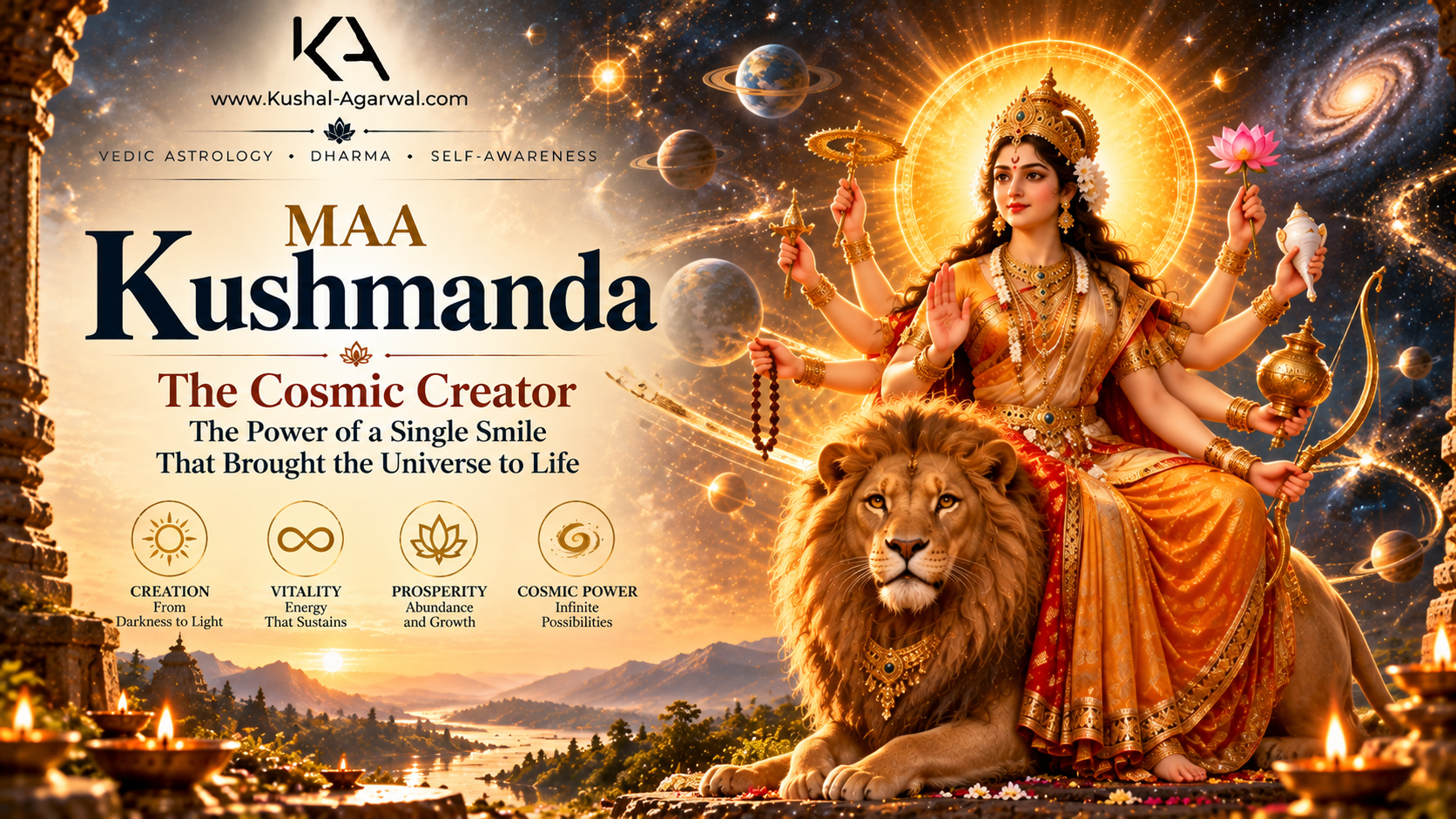
Her iconography is equally distinctive. Kushmanda is commonly depicted with eight arms, holding various divine attributes, and riding a lion. Her radiant form evokes the energy and vitality associated with creation.
But the significance of Kushmanda extends beyond a creation story.
She represents the creative power through which possibility becomes manifestation.
Her symbolism invites us to reflect on the relationship between energy, intention and the act of bringing something new into existence.
Who Is Maa Kushmanda?
Maa Kushmanda is the fourth of the nine forms of Durga worshipped during Navratri. Her name and iconography are associated in devotional tradition with cosmic creation and radiant energy.
She is often described as the Goddess whose smile illuminated the darkness and initiated creation. This account belongs to the religious and symbolic world of Goddess worship; it should not be confused with a scientific explanation of the origin of the universe.
Within Hindu devotional traditions, the image expresses the creative power of Shakti. The universe is not portrayed merely as a mechanical arrangement of lifeless objects, but as an expression of divine power.
Kushmanda is also associated with the sun and its life-sustaining energy in popular descriptions of the Navadurga. Her radiant imagery reinforces the connection with light, vitality and the power that sustains existence.
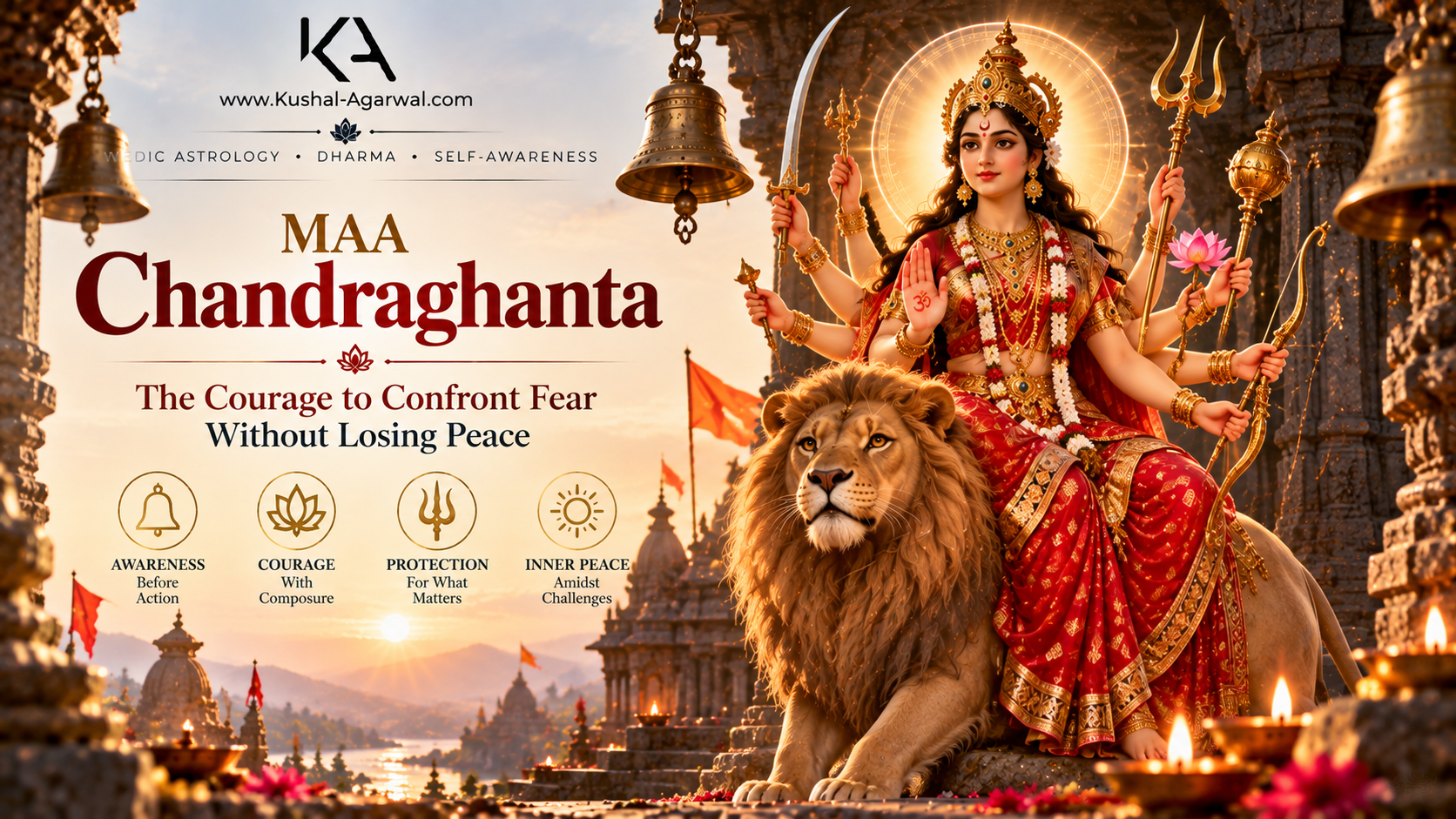
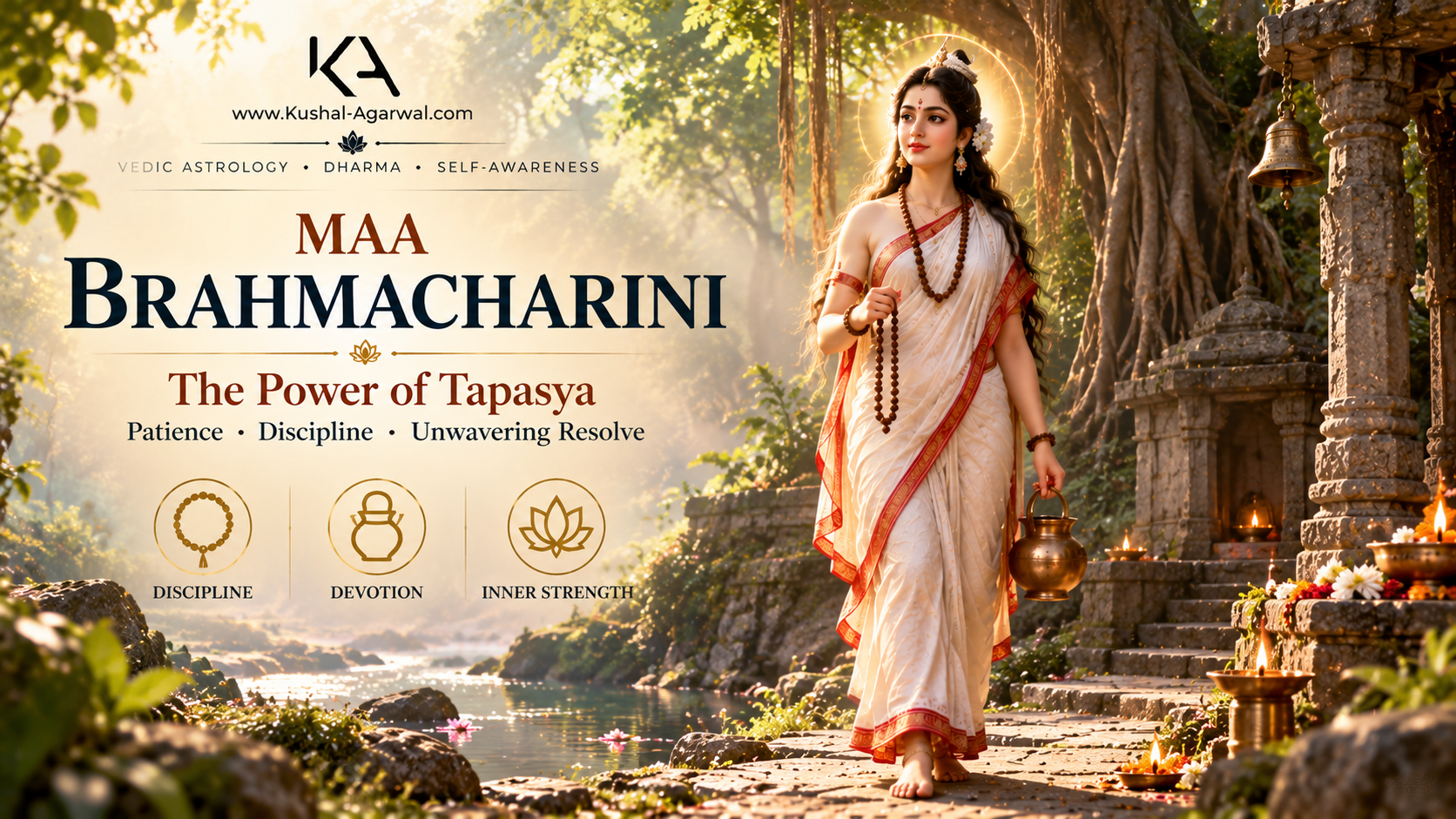
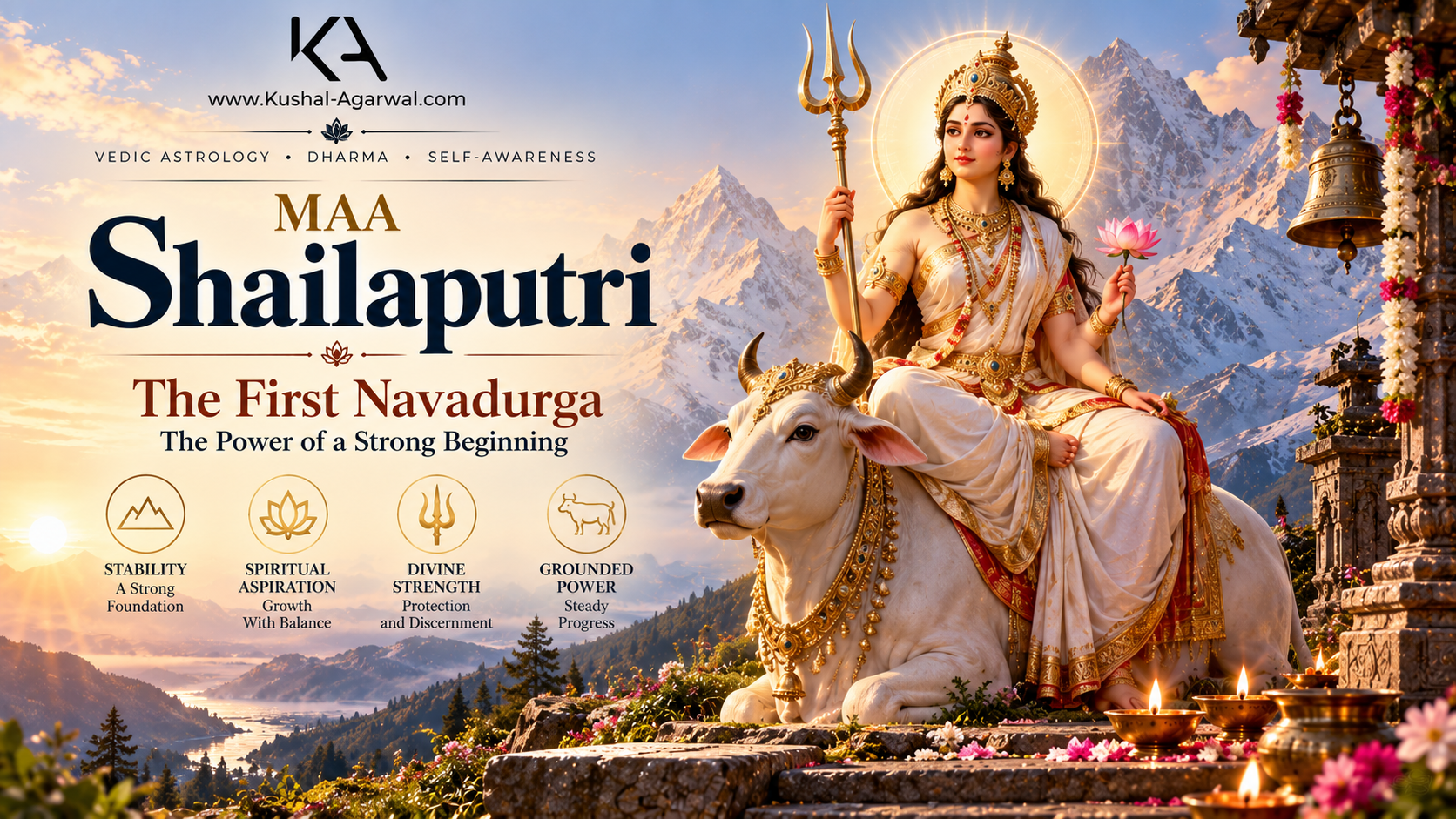
Her position in the Navadurga sequence gives her a distinctive role. Shailaputri opens the journey with the symbolism of grounding, Brahmacharini represents disciplined devotion, and Chandraghanta embodies protective courage. Kushmanda introduces the theme of creation: the capacity to bring something into being.
The Story of Maa Kushmanda and Cosmic Creation
According to a widely repeated devotional account, darkness prevailed before the universe came into existence. Maa Kushmanda manifested and, through her radiant smile, brought the cosmos into being.
The story presents creation as an expression of divine energy. The Goddess is not merely a participant within an already existing universe; she is associated with the power through which the universe emerges.
This is a symbolic account rather than a single, universally detailed narrative shared identically across every Hindu scripture and tradition. Different Hindu philosophical schools explain creation through different concepts, deities and cosmological models.
The importance of Kushmanda's story lies in the image it offers: creation begins through a power capable of transforming darkness into a universe filled with possibility.
The smile is particularly striking. The Goddess's creative act is not represented only through force or struggle. It is associated with radiance, vitality and the emergence of life.
The image invites us to consider creation as more than the destruction of what came before. Sometimes the most consequential act is to bring something into existence that did not previously exist.
A new idea, a meaningful institution, a work of art or a better way of living all begin as possibilities before they become realities.
What Does the Name Kushmanda Mean?
The name Kushmanda is frequently explained in devotional literature through an interpretation involving the cosmic egg and the energy of creation. Popular explanations break the name into elements associated with subtlety, warmth and the cosmic egg.
However, these explanations should be presented as traditional or popular interpretations rather than treated as an uncontested linguistic derivation.
The cosmic egg is an important image in several Hindu cosmological traditions. It evokes the universe as an ordered whole emerging from an initial state of potential.
The image is not unique to one Goddess or one text, and different traditions interpret it in different ways. In the context of Kushmanda worship, it offers a useful symbol of the universe as a manifestation of creative power.
The name and its associations therefore reinforce the Goddess's connection with cosmic creation, though the details of the symbolism vary by source.
The Symbolism of Maa Kushmanda's Form
The Eight Arms: Many Expressions of Divine Power
Maa Kushmanda is commonly depicted with eight arms, which is why she is also associated with the name Ashtabhuja in devotional descriptions.
Her hands hold different divine attributes. The precise arrangement varies across images, but commonly depicted objects include a bow, arrow, lotus, discus, mace, rosary and a vessel associated with nectar, alongside other attributes.
The many arms communicate a power that operates through multiple capacities. The Goddess is not confined to a single function or expression.
As a reflective interpretation, this imagery reminds us that creation requires more than one quality. An idea may need imagination, patience, knowledge, resources, discipline and the ability to respond when circumstances change.
Creativity is rarely a single moment of inspiration. It is the coordination of different abilities towards a meaningful outcome.
The Lion: Creative Power Requires Courage
Kushmanda is commonly depicted riding a lion, a symbol associated with strength, authority and courage.
Creation is often celebrated as a positive act, but bringing something new into existence can also involve uncertainty. A person may need to challenge an established assumption, accept the possibility of failure or take responsibility for an unfamiliar undertaking.
The lion complements the Goddess's creative symbolism by evoking the courage required to act.
However, courage alone does not guarantee a good result. It must be accompanied by judgement, preparation and responsibility.
The image suggests that creative power is not merely the ability to imagine possibilities. It is also the capacity to act on them with purpose.
The Radiant Aura: Light and Vitality
Kushmanda's imagery frequently emphasises brilliance, warmth and a radiant aura. In popular devotional descriptions, she is associated with the sun and the energy that sustains life.
Light has a natural symbolic connection with visibility and understanding. Something that was unclear becomes visible; something that was concealed becomes available to examination.
In this sense, the Goddess's radiance offers a metaphor for the moment when a possibility becomes clear enough to pursue.
An idea that remains vague cannot easily be translated into action. It needs definition, direction and sustained effort.
The radiant form of Kushmanda can therefore prompt reflection on how clarity and energy work together: understanding helps us identify what is possible, while effort helps us bring it into reality.
The Rosary: Creation and Sustained Practice
A rosary is among the attributes associated with Kushmanda in commonly circulated iconographic descriptions. The rosary is widely used in Hindu devotional practice for mantra recitation and repeated prayer.
Its presence introduces an important counterpoint to the idea of sudden creation.
Even when an idea arrives in a moment of inspiration, its realisation may require repeated effort. The rosary evokes continuity, discipline and the willingness to return to a practice.
Creative work often develops in the same way. A moment of insight may initiate the process, but repetition, refinement and correction are what allow the idea to mature.
The symbolism of the rosary reminds us that inspiration and discipline are not competing forces. They can work together.
Is Maa Kushmanda the Same as the Sun?
Kushmanda is frequently associated with solar energy in popular Navadurga descriptions. Some accounts portray her as residing in the inner region of the Sun, emphasising her radiance and the energy connected with life.
These descriptions are devotional and symbolic. They should not be read as a literal astronomical claim or as a complete account of the Goddess's identity across all Hindu traditions.
The sun itself has a significant place in Hindu religious and philosophical thought. It is associated with light, vitality and the sustaining conditions of life. The radiant imagery of Kushmanda draws upon these associations.
The distinction matters because Hindu traditions include many forms of solar worship as well as different theological understandings of the Goddess.
Kushmanda's association with the sun can enrich devotional reflection without requiring us to treat every popular description as a uniform scriptural doctrine.
What Does Maa Kushmanda Teach Us About Creativity?
The most accessible lesson in Kushmanda's symbolism concerns the difference between imagining something and creating it.
Many people have ideas. Fewer turn them into sustained work. The gap between possibility and manifestation is where effort, judgement and responsibility become essential.
The Goddess's association with creation invites us to consider several questions.
What are we bringing into existence through our repeated choices?
A relationship is shaped by repeated acts of attention or neglect. A professional reputation develops through patterns of conduct. A skill emerges from practice. An organisation takes form through decisions about people, priorities and resources.
Creation is not limited to dramatic beginnings. Much of what we create happens gradually, through small actions repeated over time.
The symbolism of Kushmanda encourages us to take that process seriously.
It also offers a reminder that creation carries responsibility. Bringing something into existence is not automatically beneficial. What matters is the nature of what is created, the consequences it produces and the care with which it is sustained.
Creative power becomes meaningful when guided by discernment.
Maa Kushmanda and the Navadurga Sequence
The Navadurga tradition worships nine forms of the Goddess during Navratri. Kushmanda occupies the fourth position.
A reflective reading of the first four forms can be understood as a progression through different expressions of Shakti:
- Shailaputri: the foundation and the importance of remaining grounded.
- Brahmacharini: discipline, austerity and sustained commitment.
- Chandraghanta: courage and readiness to confront adversity.
- Kushmanda: creative energy and the manifestation of possibility.
This is an interpretive framework, not a universal doctrine that every Hindu tradition prescribes as a fixed psychological progression.
Nevertheless, the sequence offers a useful reflection. Grounding provides stability. Discipline sustains effort. Courage helps us act under pressure. Creative power allows us to bring something new into existence.
Each quality is valuable, but none operates entirely in isolation.
An ambitious project may fail without discipline. Discipline may become aimless without a clear purpose. Courage may be wasted when it is disconnected from judgement. Creativity may remain unrealised when there is no willingness to act.
The Navadurga sequence provides a devotional setting in which to contemplate these different expressions of power.
How Is Maa Kushmanda Worshipped?
Devotees worship Kushmanda on the fourth day of Navratri through puja, mantra recitation, prayer and offerings. Ritual details vary by region, family tradition and sampradaya.
A commonly recited mantra is:
ॐ देवी कूष्माण्डायै नमः॥
Om Devi Kushmandayai Namah.
This is a devotional salutation to the Goddess.
Traditional observances may include flowers, lamps, fruit and food offerings, alongside prayer or the recitation of devotional texts. Some popular traditions associate the Goddess with offerings such as malpua, though specific customs differ.
Devotees should follow their own established tradition and consult a reliable local Panchang for date-specific ritual timings.
Worship can be accompanied by reflection on creation, gratitude for the conditions that sustain life and a commitment to use one's abilities responsibly.
There is no need to treat the ritual as a guaranteed transaction for wealth, health or success. Its significance can be approached through devotion, remembrance and the cultivation of qualities associated with the Goddess.
Is Maa Kushmanda Associated With a Planet in Vedic Astrology?
Some contemporary Navadurga and remedial-astrology lists connect individual forms of the Goddess with particular planets. These associations vary, and they should not be presented as universal rules of Jyotish.
Kushmanda's devotional association with radiance and solar energy is sometimes used to draw parallels with Surya. However, a symbolic resemblance is not the same as a standardised astrological prescription.
In Vedic astrology, the Sun is assessed through its placement, dignity, house ownership, aspects, conjunctions and the context of the entire horoscope, according to the method being followed.
Worship of Kushmanda may be meaningful within a person's devotional practice, but it would be misleading to promise that it automatically resolves every Sun-related difficulty or guarantees a particular worldly result.
For serious students of astrology, the distinction between religious symbolism, lineage-specific remedial practice and technical horoscope interpretation is essential.
The Deeper Message of Maa Kushmanda
Maa Kushmanda is revered as a manifestation of the creative power of Shakti. Her radiant form, eight arms and association with cosmic creation communicate the possibility of bringing order, vitality and life into existence.
Her story offers an expansive image of creation: darkness gives way to light, potential becomes manifestation, and the universe emerges as an expression of divine power.
At a personal level, the symbolism encourages us to reflect on what we create through our intentions and actions. Ideas matter, but they become
Want this read for your own chart?
Every session blends Vedic astrology, numerology and counselling psychology — your chart read as architecture, not prophecy. Bring the decision you are actually sitting with, and leave with timing, language and a next step.