Hindu Festivals
Maa Brahmacharini: The Power of Tapasya, Patience and Unwavering Resolve
Kushal Agarwal · 14 Oct 2026 · 10 min read

Maa Brahmacharini: When Devotion Becomes Discipline
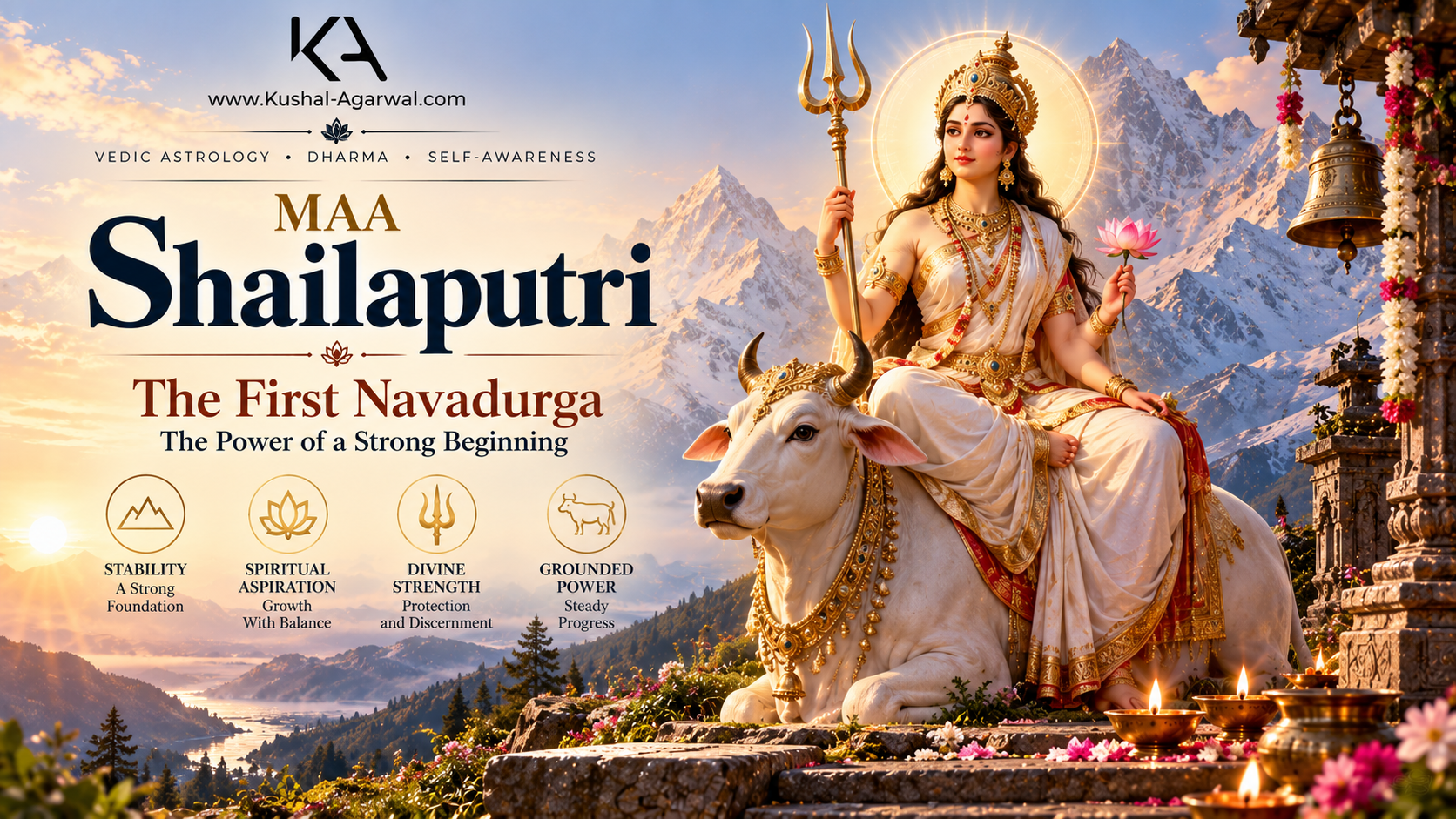
The Navadurga journey begins with Maa Shailaputri, the daughter of the mountains, whose symbolism points towards stability and a strong foundation. The next step is more demanding: learning to remain committed to a path even when progress is slow.
This is the domain of Maa Brahmacharini, the second form of Navadurga.
Her traditional image is striking in its simplicity. Unlike the more visibly martial forms of Durga, Brahmacharini is depicted walking barefoot, holding a japamala, or rosary, in one hand and a kamandalu, or water pot, in the other. Her appearance expresses austerity, contemplation and unwavering resolve.
She is worshipped as Parvati in the form of an ascetic, undertaking intense tapasya in pursuit of Lord Shiva.
Her story raises a question that remains relevant far beyond religious practice: What happens when we remain committed to something meaningful even when the reward is neither immediate nor guaranteed?
Maa Brahmacharini represents the discipline that sustains intention after the excitement of beginning has passed.
Who Is Maa Brahmacharini?
Maa Brahmacharini is the second of the nine forms of Goddess Durga worshipped during Navratri. Her name is associated with brahmacharya and disciplined spiritual conduct.
The word is commonly interpreted in devotional contexts as referring to one who follows a path of spiritual discipline, austerity and dedication to the Divine. Its meaning can vary across philosophical and religious traditions, so it should not be reduced to a single modern definition.
Within the Navadurga tradition, Brahmacharini represents Goddess Parvati during her period of intense penance.
According to widely known Puranic narratives, Parvati undertook rigorous tapasya to attain Shiva as her husband. Her commitment was not expressed merely through desire or declaration. It was demonstrated through sustained spiritual effort.
This is the central distinction between wanting something and dedicating oneself to it.
Desire identifies an objective. Discipline shapes the conduct required to pursue it.
Brahmacharini embodies the second.
The Story of Parvati's Tapasya
The story of Brahmacharini is rooted in the larger narrative of Sati and Parvati.
In Hindu Puranic traditions, Sati was Shiva's consort. Following Sati's death in the account associated with Daksha's sacrifice, the Goddess was reborn as Parvati, the daughter of Himavan and Maina.
As Parvati grew, she became devoted to Shiva and resolved to attain him as her husband. Her path involved intense tapasya in the Himalayas.
Traditional accounts describe her austerities in vivid terms. She relinquished comforts, endured difficult conditions and progressively intensified her penance. Some tellings describe her living on fruits and leaves before eventually giving up food altogether. The details and durations vary between retellings.
Her austerity became so severe that she was also known in tradition as Aparna, a name associated with her renunciation of leaves.
Eventually, Shiva accepted Parvati, and their union became a central expression of the relationship between Shiva and Shakti.
The story is not simply a tale of a woman enduring hardship to secure a marriage. Within the broader theological framework, it expresses the meeting of Shiva and Shakti, consciousness and divine power.
It also offers a powerful image of resolve: Parvati's commitment is demonstrated through sustained practice rather than a momentary declaration.
What Does Tapasya Really Mean?
Tapasya is often translated as austerity or penance, but its significance in Indian spiritual traditions extends beyond the idea of suffering.
It refers to disciplined effort undertaken for a purpose. Depending on the tradition and context, that purpose may involve spiritual realisation, self-purification, mastery of the senses or commitment to a religious vow.
The central element is not discomfort for its own sake. It is the deliberate training of one's conduct and attention.
This distinction matters.
Making life unnecessarily difficult does not automatically make a person spiritually advanced. Nor does enduring hardship prove that a particular objective is wise or achievable.
Tapasya becomes meaningful when discipline is connected to discernment, ethical conduct and a worthwhile purpose.
Maa Brahmacharini's story invites us to examine the quality of our own commitments.
Do we abandon a goal whenever it becomes inconvenient? Do we confuse intense motivation with sustained effort? Are we prepared to learn, adapt and continue when progress is less visible than we expected?
The symbolism of Brahmacharini does not promise that every desire will be fulfilled if we suffer enough. Instead, it directs attention towards the inner qualities required to pursue a meaningful path.
The Symbolism of Maa Brahmacharini's Form
The Japamala: Repetition That Builds Focus
The japamala, or rosary, represents mantra recitation and sustained spiritual practice.
A mantra may be recited once, but a regular practice involves returning to it repeatedly. The act of repetition gives structure to attention and creates a rhythm within which contemplation can deepen.
This offers a useful parallel with learning and skill development.
A person does not become proficient through one inspired session. Proficiency emerges through repeated practice, feedback and correction. Progress may be uneven, but the process builds familiarity and discipline over time.
The japamala symbolises this patient return to practice.
Its lesson is not that repetition alone guarantees wisdom. Repetition becomes useful when accompanied by attention and understanding.
The Kamandalu: Simplicity and Self-Restraint
The kamandalu, a traditional water vessel associated with ascetics, reinforces the image of a life oriented towards spiritual practice rather than unnecessary accumulation.
It represents a way of living in which external simplicity supports inner focus.
This does not mean that wealth, comfort or material responsibilities are inherently opposed to spirituality. Hindu traditions encompass householders, renunciants and many different ways of living.
The more practical lesson is to examine what is essential and what has become a distraction.
Can we distinguish a genuine need from an impulse? Can we enjoy comfort without becoming entirely dependent on it? Can we remain committed to a purpose when convenience is unavailable?
Brahmacharini's kamandalu invites reflection on restraint without glorifying deprivation.
Bare Feet: Walking the Path Personally
Brahmacharini is commonly depicted walking barefoot, without an animal mount.
Her posture conveys the image of a seeker moving forward through her own effort. The absence of elaborate ornamentation or a dramatic vehicle reinforces the emphasis on austerity and personal commitment.
There is a simple lesson here: no one else can perform every part of our inner work for us.
Teachers can guide us. Texts can provide insight. Mentors can help us recognise mistakes. But practice, reflection and the responsibility for our choices remain our own.
The journey cannot be completed merely by admiring someone else's discipline.
The Serene Expression: Discipline Without Restlessness
Brahmacharini's appearance is generally calm and contemplative. Her strength is not expressed through an aggressive posture but through steadiness.
This is an important distinction.
Discipline is often confused with relentless pressure. People may believe that commitment requires constant tension, self-criticism or the refusal to rest.
Yet sustainable discipline needs clarity. It requires knowing when to continue, when to reassess and when a particular method is no longer serving the intended purpose.
The calmness of Brahmacharini's image offers a reminder that determination need not be noisy. A person can be deeply committed without constantly announcing their effort.
What Maa Brahmacharini Teaches About Patience
Patience is frequently misunderstood as passive waiting.
The patience associated with disciplined effort is different. It means continuing to act responsibly even when the outcome has not yet appeared.
A student studies before knowing the result. An entrepreneur builds before knowing whether the market will respond. A practitioner develops a skill through repeated effort before reaching mastery.
In each case, progress depends on more than optimism. It requires action, evaluation and the willingness to continue learning.
However, patience should not become an excuse for refusing to reconsider a failing strategy. Persistence without reflection can turn into stubbornness.
The deeper lesson of Brahmacharini is steadfastness guided by discernment.
Remain committed to a meaningful objective, but examine whether your methods are effective. Continue your effort, but do not mistake suffering for proof of progress.
Her story encourages endurance without abandoning judgement.
Is Maa Brahmacharini Associated With a Planet in Vedic Astrology?
Some Navadurga and remedial-astrology traditions associate individual forms of Durga with particular planets. Certain lists connect Brahmacharini with Mars, while other popular references may differ in their correspondences.
These associations should not be treated as a universal rule of Jyotish.
In Vedic astrology, Mars is interpreted through its placement, dignity, house ownership, aspects, conjunctions and the wider horoscope context. No planetary assessment should be made solely from a person's relationship with a particular form of the Goddess.
Likewise, worship of Brahmacharini may form part of a devotee's religious or remedial practice, but it would be misleading to guarantee that it automatically removes every Mars-related difficulty or produces a specific material result.
For serious astrology practitioners, the distinction between devotional tradition and horoscope interpretation is essential. Both can be discussed respectfully without making claims that go beyond the evidence of the tradition being described.
How Is Maa Brahmacharini Worshipped?
Devotees worship Brahmacharini on the second day of Navratri through puja, prayer, mantra recitation and other observances. Practices vary according to family customs, region and sampradaya.
A commonly recited mantra is:
ॐ देवी ब्रह्मचारिण्यै नमः॥
Om Devi Brahmacharinyai Namah.
The mantra is a devotional salutation to the Goddess.
Some traditions offer flowers, fruits, sweets, water, incense and lamps. Fasting, meditation and the reading of devotional texts may also form part of the observance.
White is commonly associated with Brahmacharini in several contemporary Navratri colour traditions, although colours and ritual customs can vary.
Those observing Navratri should follow the practices of their own tradition and consult a reliable local Panchang for date-specific timings. Fasting should be approached responsibly and according to individual circumstances.
The purpose of worship is not to prove one's capacity for deprivation. It is to cultivate devotion, attention and a sincere commitment to spiritual practice.
The Difference Between Desire and Sankalpa
Brahmacharini's story also invites a distinction between desire and sankalpa, a term commonly used for intention or resolve.
Desire expresses what we would like to happen. Resolve begins to shape how we will conduct ourselves in pursuit of it.
Someone may desire knowledge but remain unwilling to study. Someone may desire professional success but avoid developing the skills required. Someone may wish to become more spiritually disciplined but continually postpone regular practice.
In each case, the distance between aspiration and action remains unaddressed.
Sankalpa becomes meaningful when intention is supported by conduct.
This does not mean that every objective is achievable through willpower alone. Circumstances, resources, other people's choices and unexpected events all matter. Disciplined effort does not guarantee control over the final outcome.
But it can change the quality of the effort we bring to the journey.
Brahmacharini's tapasya reminds us that commitment is demonstrated through the path we walk, not merely through the result we hope to obtain.
The Deeper Message of Maa Brahmacharini
Maa Shailaputri represents the foundation. Maa Brahmacharini represents the discipline required to build upon it.
Her story of tapasya, her japamala and kamandalu, and her calm ascetic form all point towards a similar idea: meaningful growth requires sustained effort guided by a clear purpose.
The lesson is not that suffering is always necessary, that every desire must be pursued at any cost or that persistence guarantees success.
It is that worthwhile commitments demand more than enthusiasm.
They require patience when progress is slow, restraint when distraction is tempting and discernment when the path needs to be reassessed.
As the second form of Navadurga, Brahmacharini invites us to look honestly at the relationship between our intentions and our daily conduct.
What have we committed ourselves to? What practice supports that commitment? Where do we repeatedly surrender to convenience? And what might change if we replaced occasional bursts of motivation with steady, thoughtful effort?
The Goddess's example offers a devotional image of resolve that remains relevant across spiritual practice, learning and everyday life.
A strong beginning gives a journey its foundation. Discipline gives it continuity.
That is the enduring lesson of Maa Brahmacharini.
SOURCES:
- Drik Panchang — Goddess Brahmacharini: https://www.drikpanchang.com/hindu-goddesses/parvati/durga/navdurga-brahmacharini.html
- The Art of Living — Maa Brahmacharini: https://www.artofliving.org/in-en/navratri/brahmacharini
- KaalPanchang — Brahmacharini, story and symbolism: https://kaalpanchang.com/figures/brahmacharini
- Shiva Purana and Devi Bhagavata Purana — traditional narratives concerning Parvati's tapasya; retellings vary across traditions.
SUGGESTED INTERNAL LINKS:
- Maa Shailaputri: The First Navadurga and the Power of a Strong Beginning
- Maa Chandraghanta: The Power of Courage Without Losing Inner Peace
- Sharad Navratri 2026: The Deeper Meaning of the Nine Nights of Maa Durga
- Saturn and Karma in Vedic Astrology: Why Shani Makes You Face What You Have Built
Explore more articles on Vedic Astrology, Hindu spiritual traditions and occult practice at https://kushal-agarwal.com/.
Want this read for your own chart?
Every session blends Vedic astrology, numerology and counselling psychology — your chart read as architecture, not prophecy. Bring the decision you are actually sitting with, and leave with timing, language and a next step.