Hindu Festivals
Maa Katyayani: Courage, Decisive Action and the Power of Shakti
Kushal Agarwal · 25 Oct 2026 · 12 min read
Maa Katyayani: Courage, Decisive Action and the Power of Shakti
There comes a point in every meaningful journey when patience alone is no longer enough. Understanding must become action. Awareness must translate into a decision. And the willingness to protect what matters must become stronger than the fear of confrontation.
In the Navadurga tradition, Maa Katyayani represents this decisive expression of divine power.
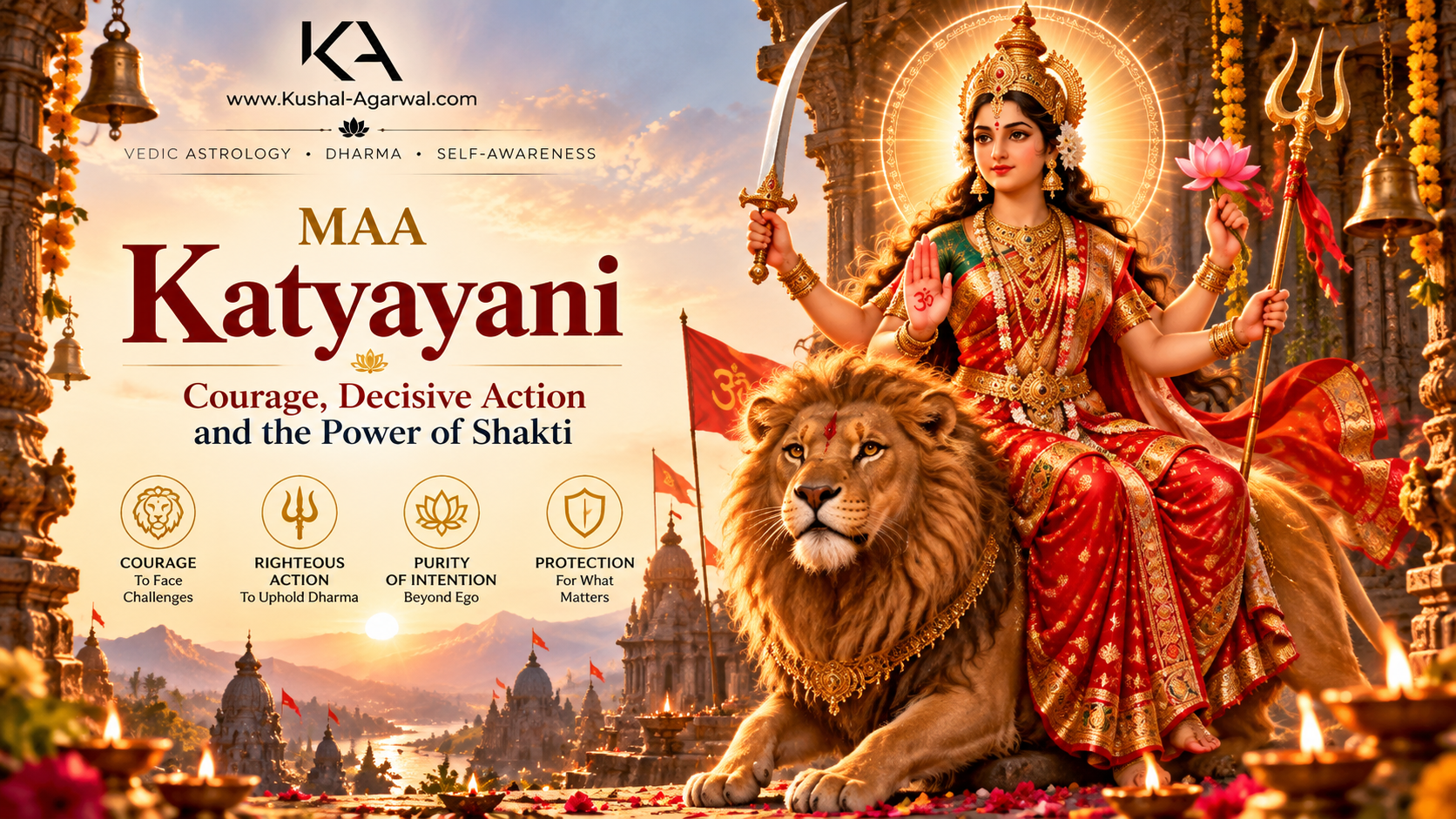
Worshipped as the sixth form of Goddess Durga, Katyayani is widely associated with the defeat of Mahishasura, the buffalo demon who challenged the authority of the gods. Her traditional image is that of a warrior Goddess, often depicted riding a lion and holding weapons that signify her capacity to confront destructive forces.
But the symbolism of Katyayani extends beyond the battlefield.
Her story invites us to examine the difference between aggression and courage, between impulsive reaction and decisive action, and between the pursuit of personal power and the responsibility to uphold dharma.
Katyayani represents strength that does not remain passive in the face of disorder—but acts with purpose.
1. Who Is Maa Katyayani?
Maa Katyayani is the sixth of the nine forms of Durga worshipped during Navratri. Her name is traditionally connected with Sage Katyayana, and accounts of her manifestation appear in different Puranic traditions.
In a widely circulated account, the Goddess manifests in connection with the sage's devotion and becomes associated with the defeat of Mahishasura. Other tellings emphasise the combined divine radiance of the gods taking form as the warrior Goddess.
These accounts should not be collapsed into one supposedly uniform narrative: Hindu texts and later devotional traditions preserve variations in how Katyayani's origin and identity are described.
Her defining association, however, is clear within the Navadurga tradition. She is the warrior form of Shakti who confronts a force that threatens cosmic and moral order.
The name Katyayani is also important in the Bhagavata Purana. In its account of the young gopis of Vraja, they worship Katyayani and pray that Krishna may become their husband. This reveals a devotional dimension beyond her warrior identity: Katyayani is also approached by devotees seeking the fulfilment of sincere aspirations.
Together, these traditions present a Goddess associated with both decisive strength and devoted prayer.
2. The Story of Maa Katyayani and Mahishasura
The battle with Mahishasura is one of the most enduring narratives associated with the Goddess in Hindu tradition.
Mahishasura, whose name is connected with the buffalo, becomes powerful enough to challenge the gods. In the broader narrative of the Devi Mahatmya, the gods are unable to overcome him through their individual strength.
Their combined radiance gives rise to the manifestation of the Goddess, who receives divine weapons and confronts the asura.
In later and related retellings, this warrior Goddess is identified with Katyayani and linked to Sage Katyayana.
The conflict is not simply a contest between two powerful beings. It expresses the restoration of order when destructive power becomes dominant.
Mahishasura is frequently interpreted as representing arrogance, uncontrolled ambition and the misuse of strength. The Goddess, by contrast, represents the power that confronts these tendencies and restores balance.
This is a symbolic reading of the narrative, rather than a claim that every traditional source assigns the demon one fixed psychological meaning.
The story's enduring appeal lies in its central reversal: power that appears invincible is not necessarily invulnerable. A force that has grown dominant can still be challenged when the conditions for resistance emerge.
For the spiritual seeker, this raises a relevant question: what happens when a problem is allowed to grow because everyone assumes that confronting it is impossible?
Katyayani's story offers a devotional image of the courage required to face that question.
3. The Iconography of Maa Katyayani
Traditional depictions of Katyayani vary. She may be shown with four arms, while more elaborate representations of the warrior Goddess can have many more. A lion or tiger commonly appears as her mount.
Each element offers a different way of contemplating her power.
The lion: courage and sovereignty
The lion represents strength, authority and the capacity to confront danger.
Its presence suggests that courage is not simply the absence of fear. It is the willingness to respond when circumstances demand action.
In ordinary life, courage might mean speaking honestly when silence would be easier, challenging an unfair decision, leaving a destructive situation or accepting responsibility for a difficult choice.
The point is not to seek confrontation for its own sake. It is to avoid confusing the absence of conflict with the presence of justice.
The sword: discernment and decisive action
The sword is among the most recognisable attributes of the warrior Goddess.
Symbolically, it can represent the ability to distinguish between what must be preserved and what must be confronted. A decision sometimes requires cutting through confusion, denial or prolonged indecision.
Yet a sword is only as wise as the hand that wields it.
Decisiveness without understanding can become recklessness. Strong opinions without adequate reflection can create unnecessary harm. Katyayani's symbolism is most useful when courage is joined with discernment.
The lotus: purity of intention
The lotus appears in many depictions of Katyayani alongside martial attributes.
This pairing is significant. The Goddess's power is not represented solely through weapons; it is also associated with a symbol of purity and spiritual unfolding.
The lotus invites reflection on intention. Are we acting to protect something meaningful, or merely to satisfy anger? Are we confronting a problem to restore balance, or because our pride has been challenged?
A clear intention does not guarantee a correct decision, but it creates a better starting point for responsible action.
The gestures of blessing and reassurance
In common four-armed depictions, Katyayani may raise one hand in abhaya mudra, associated with fearlessness, and another in varada mudra, associated with granting blessings.
These gestures complement the warrior imagery. The Goddess is not only the force that confronts danger; she is also the reassuring presence to whom devotees turn for strength and support.
The combination reflects a central theme of Shakti: power can protect as well as overcome.
4. Katyayani and the Meaning of Righteous Anger
Anger is often treated as either entirely destructive or automatically justified. Neither assumption is reliable.
Anger can signal that a boundary has been crossed, that an injustice has occurred or that something important is being threatened. It can also distort judgement, exaggerate perceived offences and encourage retaliation.
Katyayani offers a useful framework for distinguishing the emotion from the action that follows it.
Her warrior symbolism does not suggest that every conflict deserves a battle. It invites us to ask whether a situation genuinely requires intervention, what outcome would restore balance, and what consequences our response may create.
Consider a workplace where a manager repeatedly takes credit for another person's contribution. Remaining silent may allow the pattern to continue. Reacting impulsively, however, may undermine the person's own position.
A considered response could involve documenting the work, communicating clearly, establishing boundaries and escalating the issue through appropriate channels if necessary.
That is not a literal equivalent of a mythological battle. It is a contemporary application of the distinction between reaction and purposeful action.
The lesson is not to eliminate anger at all costs, but to prevent anger from becoming the decision-maker.
5. Katyayani in the Navadurga Journey
Katyayani follows Skandamata, the fifth form of Navadurga.
Skandamata emphasises motherhood, nurturing and protection. Katyayani introduces a related but distinct principle: sometimes protection requires direct intervention.
This sequence can be understood as a reflective progression. Care creates the responsibility to protect; protection sometimes requires courage; courage must then be translated into action.
The progression does not mean that one form is superior to another. The nine forms represent distinct expressions of the Goddess within the devotional tradition.
Within a contemporary interpretation, Katyayani asks us to consider whether our values remain meaningful when they require something difficult from us.
It is easy to speak about fairness when no one challenges our interests. It is easy to value honesty when the truth carries no cost. It is easy to claim courage when no decision has to be made.
The real test comes when acting according to one's principles requires effort, discomfort or risk.
Katyayani symbolises that moment of decision.
6. Maa Katyayani and the Vow of the Gopis
Katyayani's identity is not limited to her warrior form.
In the tenth book of the Bhagavata Purana, the young gopis of Vraja observe a Katyayani vow and pray that Krishna may become their husband.
This account provides an important devotional perspective. The Goddess who confronts a formidable adversary is also approached through disciplined worship, longing and sincere prayer.
The two aspects need not be contradictory. Strength and devotion can coexist. Decisive action and humility can belong to the same spiritual life.
The gopis' observance has also influenced devotional customs in which Katyayani is worshipped by unmarried women seeking a suitable marriage. Such practices vary, and their significance depends on the traditions and beliefs of the devotees.
It is important not to turn this custom into a universal promise that worship guarantees marriage or a particular relationship outcome.
A more careful understanding recognises the role of devotion, hope and ritual within a religious tradition while respecting the uncertainty of human relationships.
The story also invites a broader reflection on aspiration: what do we seek, and how sincerely are we prepared to align our conduct with what we value?
7. Maa Katyayani Mantra and Devotional Practice
A commonly recited mantra dedicated to Katyayani is:
ॐ देवी कात्यायन्यै नमः॥
Om Devi Katyayanyai Namah.
A simple translation is: “Salutations to the Divine Goddess Katyayani.”
Devotees may recite this mantra during Navratri or as part of regular worship. A quiet setting and focused attention can help create a space for reflection.
Another verse commonly associated with her worship is:
चन्द्रहासोज्ज्वलकरा शार्दूलवरवाहना। कात्यायनी शुभं दद्याद् देवी दानवघातिनी॥
Chandrahasojjvalakara Shardulavaravahana, Katyayani Shubham Dadyad Devi Danavaghatini.
The verse praises the Goddess whose hand shines with a sword and who rides a powerful animal, asking Katyayani to grant auspiciousness and protection. Translations vary slightly according to the interpretation of the Sanskrit.
A devotee may use the practice as an opportunity to reflect on courage, clarity and the responsible exercise of strength.
Ritual details, offerings, colours and regional customs vary. Anyone following a specific family or spiritual lineage should consult its established practice rather than assuming that every observance is universal.
Devotional practice can be meaningful in itself, without a guarantee of a particular material result.
8. Maa Katyayani and Jyotish: Separating Tradition from Interpretation
Readers of Vedic astrology may encounter contemporary interpretations linking the Navadurga forms with particular chakras, planetary influences or remedial practices.
These associations are not always uniform across traditions. They should therefore be presented with care rather than treated as universally established rules of classical Jyotish.
Katyayani's symbolism can certainly serve as a point of reflection for an astrologer discussing courage, decision-making, conflict and responsibility. But symbolic relevance is not the same as a classical planetary prescription.
An astrologer should distinguish between a recommendation grounded in a specific text or lineage and a contemporary spiritual interpretation.
Similarly, worship should not be marketed as a guaranteed method for defeating rivals, controlling another person, securing marriage or producing a predetermined astrological outcome.
The ethical value of a devotional practice lies partly in the way it is understood and applied. If contemplation of Katyayani helps someone become more courageous, measured and responsible, that is a meaningful personal outcome. It does not establish that the ritual guarantees an external event.
For practitioners of the occult sciences, this distinction matters. Credibility depends not only on knowledge of traditional symbolism but also on intellectual honesty about what that symbolism can and cannot establish.
9. The Deeper Lesson: Courage Must Serve a Purpose
Katyayani's warrior form can be misunderstood if it is reduced to the celebration of power.
Power by itself does not establish righteousness. A person may be forceful and still be wrong. A person may win a confrontation while creating greater disorder. A decisive action may be necessary, but its consequences still require consideration.
The deeper question is what the power is serving.
In professional life, courage may mean taking responsibility for an unpopular but necessary decision. In personal relationships, it may mean communicating honestly rather than allowing resentment to accumulate. In spiritual practice, it may mean examining one's own conduct instead of blaming every obstacle on external forces.
These examples differ in scale from the Goddess's mythological battle, but they illustrate a common ethical principle: strength becomes constructive when it is guided by discernment and responsibility.
Katyayani's symbolism therefore asks us to move beyond the desire to appear powerful.
Can we recognise when action is necessary? Can we act without becoming consumed by hostility? Can we protect our values without assuming that every disagreement is an enemy to be defeated?
These questions make the warrior Goddess relevant to the inner life as well as to the world of outward challenges.
Conclusion: When Courage Becomes Action
Maa Katyayani, the sixth form of Navadurga, represents the decisive power of Shakti. Her association with Mahishasura's defeat expresses the restoration of order, while her traditional iconography brings together courage, discernment, purity of intention and divine protection.
Her message is not that conflict should be pursued or that strength alone can solve every problem. It is that meaningful values sometimes require decisive action—and that such action must be guided by wisdom.
The Navadurga journey has moved from the grounded beginning of Shailaputri through the discipline of Brahmacharini, the courage of Chandraghanta, the creative radiance of Kushmanda and the nurturing strength of Skandamata. Katyayani now brings the question of action into sharper focus.
What do we do when understanding is no longer enough?
The answer is not impulsive aggression. It is the courage to act when action is necessary, the discernment to choose the right response, and the humility to remain accountable for its consequences.
May the contemplation of Maa Katyayani inspire courage without arrogance, strength without cruelty and decisive action guided by dharma.
SOURCES:
- Bhagavata Purana, Book 10, Chapter 22 — the Katyayani vow of the gopis.
- Devi Mahatmya, within the Markandeya Purana — the Goddess's battle with Mahishasura and the restoration of divine order.
- Explore Jabalpur — Katyayani: The Sixth Form of Durga, including a discussion of differing textual traditions: https://www.explorejabalpur.com/navratri/navadurga/katyayani/
- Drik Panchang — Navadurga and Katyayani devotional tradition: https://www.drikpanchang.com/hindu-goddesses/parvati/durga/navdurga.html
- Bṛhat — Kātyāyanī, Navadurgā Part 6: https://www.brhat.in/dhiti/katyayani
SUGGESTED INTERNAL LINKS:
- Maa Shailaputri: The First Navadurga and the Power of a Strong Beginning
- Maa Brahmacharini: The Power of Tapasya, Patience and Unwavering Resolve
- Maa Chandraghanta: The Courage to Confront Fear Without Losing Peace
- Maa Kushmanda: The Cosmic Creator and the Power of a Single Smile
- Maa Skandamata: The Power of Divine Motherhood, Protection and Wisdom
- Navadurga: The Nine Forms of Goddess Durga and Their Spiritual Significance
Continue exploring the Navadurga series on Kushal-Agarwal.com to understand the distinct expressions of Shakti through traditional stories, spiritual symbolism and practitioner-focused interpretation.
Next in the series: Maa Kalaratri — Confronting Fear, Darkness and Transformation.
Want this read for your own chart?
Every session blends Vedic astrology, numerology and counselling psychology — your chart read as architecture, not prophecy. Bring the decision you are actually sitting with, and leave with timing, language and a next step.