
Hindu Festivals
Mahalaya 2026: The Call of the Ancestors and the Arrival of Maa Durga
Kushal Agarwal · 9 Oct 2026 · 10 min read
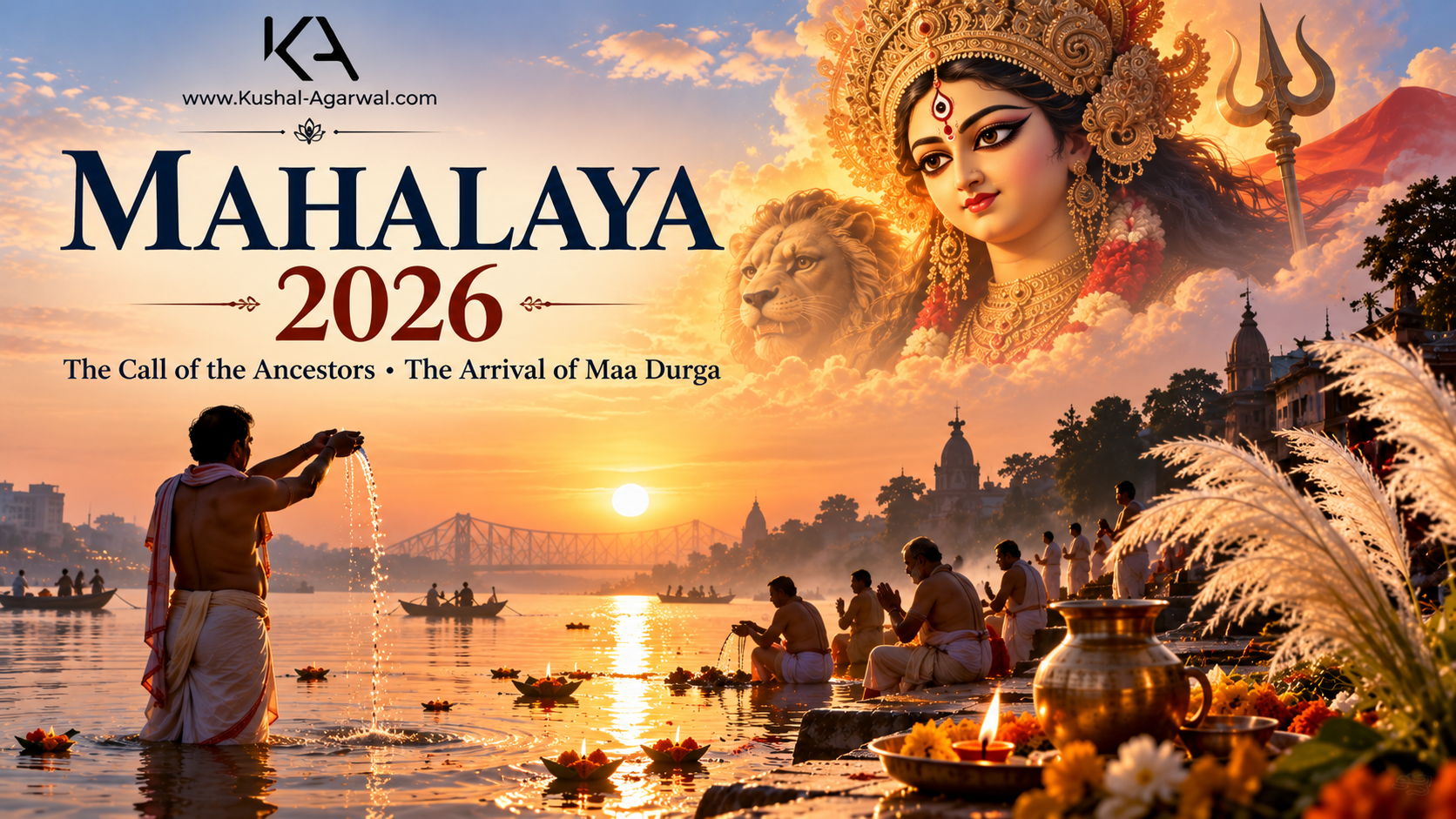
Mahalaya 2026: The Dawn When Remembrance Meets the Arrival of Maa Durga
There is a morning in Bengal when the world seems to wake up differently.
The sky is still dark. The air carries the first chill of autumn. Somewhere, a familiar voice begins to recite verses invoking the Divine Mother. In homes across Bengal, families listen to Mahishasura Mardini, while along the banks of the Ganges, people gather to offer water to their ancestors.
It is Mahalaya.
In 2026, Mahalaya falls on Saturday, October 10, marking the concluding day of Pitru Paksha through Sarva Pitru Amavasya. The Amavasya tithi begins on the evening of October 9 and continues until the evening of October 10. <Cite refs={["turn142592search2","turn142592search17"]}/>
For Bengalis, however, Mahalaya carries a meaning that goes beyond the calendar.
It is a day of remembrance and anticipation. A moment when thoughts turn towards those who came before us, even as hearts begin preparing for the arrival of Maa Durga.
One looks backwards, towards one's ancestors.
The other looks forwards, towards the Divine Mother.
And somewhere between these two movements lies the deeper spiritual significance of Mahalaya.
What Is Mahalaya?
Mahalaya is associated with the end of Pitru Paksha, the traditional fortnight devoted to honouring departed ancestors.
During this period, families remember their forebears through rituals such as Shraddha, Tarpan, prayers and acts of charity.
The final Amavasya is widely known as Sarva Pitru Amavasya. It is particularly significant for families wishing to perform ancestral rites when the appropriate death tithi is unknown or when the prescribed observance could not be completed earlier.
In Bengal, Mahalaya also signals the emotional beginning of the Durga Puja season.
The formal Durga Puja rituals take place later, but Mahalaya marks the moment when anticipation becomes tangible. The Divine Mother is invoked, the familiar sounds of the season return, and the wait for her arrival begins in earnest.
This is the beauty of Mahalaya: it brings together two traditions that might initially appear separate.
Ancestral remembrance and the worship of the Divine Mother.
One honours the past. The other celebrates the renewal of life.
Pitru Paksha: Remembering Those Who Came Before Us
In modern life, it is easy to think of ourselves as independent individuals who have arrived where we are through our own effort.
But no life begins in isolation.
Before us were generations of people who worked, struggled, loved, raised families, made sacrifices and navigated circumstances we may never fully understand.
Some left behind wealth. Others left behind difficulties.
Some gave us opportunities. Others passed down habits, beliefs and unresolved conflicts.
Every family carries a history, whether it speaks openly about that history or not.
The tradition of Pitru Paksha asks us to pause and remember this inheritance.
In Hindu belief, the Pitrs, or ancestors, are honoured through ritual offerings and prayers. Tarpan, the offering of water, expresses reverence and remembrance. Shraddha rituals similarly embody the duty of acknowledging those who have departed.
These observances are not merely about asking for blessings.
At their heart is an act of gratitude.
We acknowledge that our lives are connected to lives that came before ours.
We remember that we did not create every advantage we possess, and that the sacrifices of others may have made our own journeys possible.
This recognition is itself a form of humility.
What Is Pitru Tarpan?
Tarpan is a traditional Hindu offering made in honour of ancestors and other revered beings.
During Pitru Paksha, families commonly perform Pitru Tarpan by offering water while remembering departed relatives. Depending on family tradition, the ritual may involve black sesame seeds, Kusha grass, prayers and specific invocations.
The precise procedure varies across regional customs, family traditions and ritual lineages.
For many Bengalis, Mahalaya begins with ancestral remembrance at a riverbank or another appropriate place of observance.
The symbolism is powerful.
Water flows. Life moves. Generations pass.
The person making the offering stands in the present but directs their thoughts towards those who are no longer physically present.
The ritual creates a moment of connection across that divide.
For those observing Mahalaya, local Panchang timings and family customs should guide the actual performance of Tarpan and Shraddha.
The Spiritual Meaning of Remembering Ancestors
Ancestral remembrance can be understood on several levels.
The first is gratitude.
We recognise the people whose lives contributed to our own.
The second is responsibility.
We inherit more than property, family names or physical characteristics. We also inherit expectations, values, patterns of behaviour and, sometimes, unresolved difficulties.
The third is discernment.
Respecting our ancestors does not mean repeating every choice they made. We can honour their struggles while learning from their mistakes.
This distinction matters.
Tradition is not simply the act of carrying everything forward unchanged. It can also mean understanding what deserves preservation and what needs to evolve.
In that sense, Mahalaya invites us to consider our relationship with the past.
What have we received that deserves gratitude?
What have we learned that deserves preservation?
And what should end with us?
These questions give ancestral remembrance a meaning that extends beyond the ritual itself.
Why Is Mahalaya Associated With Maa Durga?
In Bengal, Mahalaya is inseparable from the anticipation of Maa Durga's arrival.
The transition from Pitru Paksha to Devi Paksha is experienced as a movement from ancestral observance towards the celebration of the Divine Mother.
Maa Durga represents Shakti, the divine power that protects, sustains and restores order when destructive forces become overwhelming.
Her mythology centres on the defeat of Mahishasura, the asura whose growing power threatened the cosmic order. The Goddess emerges as the force capable of confronting what the other divine powers cannot overcome individually.
This is not merely a story of physical victory.
It is also a story about the restoration of balance.
When arrogance becomes destructive, when power becomes oppressive, and when disorder threatens to overwhelm the world, the Divine Mother appears as the force that confronts it.
That is why her arrival inspires such profound anticipation.
Mahalaya marks the emotional beginning of that anticipation in Bengal, even though the principal Durga Puja rituals occur later.
Mahishasura Mardini: The Voice That Announces the Season
For generations of Bengalis, Mahalaya has been inseparable from Mahishasura Mardini, the celebrated devotional broadcast associated with Birendra Krishna Bhadra's recitation.
Its verses, music and invocations have become part of Bengal's collective cultural memory.
For many households, hearing it at dawn is not simply listening to a programme. It is an annual return to something familiar.
A sound from childhood.
A reminder of parents and grandparents.
A memory of waking before sunrise.
A signal that the festive season has begun.
The experience is remarkable because it crosses generations. People who heard the broadcast as children now share it with their own families.
The tradition connects personal memory with collective identity.
And beneath the familiar music lies a powerful devotional theme: the invocation of the Goddess and the celebration of her victory over destructive forces.
Mahalaya therefore becomes an experience of sound, memory, devotion and anticipation all at once.
The Deeper Symbolism: From Pitru Paksha to Devi Paksha
The movement from Pitru Paksha to Devi Paksha offers a compelling spiritual metaphor.
Pitru Paksha directs our attention towards what came before us.
Devi Paksha directs our attention towards the power that sustains and renews life.
The first asks us to remember.
The second invites us to awaken.
One is associated with gratitude for the past. The other with the anticipation of divine presence and transformation.
Together, they suggest that spiritual life requires both remembrance and renewal.
We cannot understand ourselves fully without acknowledging our roots.
But we cannot live entirely in the past either.
We must carry forward what is meaningful, learn from what was difficult, and remain open to the possibility of transformation.
This is one of the most profound ways to understand the emotional journey of Mahalaya.
Mahalaya, Karma and the Inheritance of Life
There is also a meaningful connection between Mahalaya and the broader Hindu understanding of karma.
Karma concerns action and consequence. Our choices influence the lives we lead, but our lives are also shaped by circumstances we did not personally choose.
We are born into families, communities and historical conditions that precede us.
Some inherit resources and security. Others inherit hardship or instability.
Ancestral remembrance acknowledges this continuity without requiring us to believe that every difficulty is punishment for a past-life action.
That distinction is important.
It is neither necessary nor compassionate to interpret every misfortune as proof of ancestral wrongdoing.
Instead, Mahalaya can be approached as an opportunity to cultivate gratitude, perform the rites meaningful to one's tradition, and reflect on the kind of inheritance one wishes to leave behind.
After all, we are not only descendants.
We are also ancestors in the making.
Our actions today may shape the circumstances, memories and values of generations that follow us.
That is a responsibility worth remembering.
How Is Mahalaya Traditionally Observed?
Practices differ by region and family, but common observances include:
Pitru Tarpan: Offering water in remembrance of departed ancestors.
Shraddha: Performing prescribed rites in honour of the Pitrs, according to family tradition.
Prayer and remembrance: Taking time to remember departed relatives and acknowledge their place in the family's history.
Charity: Giving food, clothing or other assistance to people in need, where appropriate to one's tradition and means.
Listening to Mahishasura Mardini: Participating in the Bengali devotional tradition that marks the emotional beginning of the Durga Puja season.
Those performing formal ancestral rites should follow their family customs and a reliable local Panchang. Ritual timings can vary by location and observance.
For those unable to perform elaborate rituals, sincere remembrance and prayer can still provide a meaningful way to observe the spirit of the day, in accordance with their beliefs.
Mahalaya Is More Than the Beginning of Durga Puja
It is tempting to think of Mahalaya only as the day that announces the arrival of Durga Puja.
But that interpretation captures only part of its meaning.
Mahalaya is also a day of gratitude.
A day to acknowledge the people whose lives made our own possible.
A day to recognise that the past continues to influence the present.
A day to remember that traditions survive because generations choose to carry them forward.
And a day to prepare ourselves for renewal.
The Goddess's arrival represents the possibility that darkness can be confronted and balance restored. Ancestral remembrance reminds us that our lives are part of a much larger human story.
Together, these themes encourage both humility and hope.
The Message of Mahalaya
Perhaps the most meaningful way to approach Mahalaya is to recognise the two directions in which it asks us to look.
Look backwards with gratitude.
Look forwards with courage.
Remember those who came before you, without becoming imprisoned by the past.
Honour your inheritance, while accepting responsibility for the choices that are yours to make.
Welcome the Divine Mother not merely as a figure in mythology, but as a symbol of the strength required to confront disorder and restore balance.
As the dawn breaks on Mahalaya, Bengal begins its annual journey towards Durga Puja.
The sounds of Mahishasura Mardini rise through the morning air. Families remember their ancestors. The anticipation of Maa Durga's arrival begins to fill homes and communities.
And the deeper message remains timeless:
Remember your roots. Accept your responsibilities. Make room for renewal.
Mahalaya reminds us that we belong to a past we should honour, a present we must live responsibly, and a future we still have the power to shape.
That is the spirit of remembrance.
That is the promise of renewal.
And that is the enduring significance of Mahalaya.
SOURCES
Drik Panchang — Bengali Calendar and Mahalaya 2026 https://www.drikpanchang.com/bengali/calendar/bengali-calendar.html
News9Live — Mahalaya 2026: Date, Tithi, Tarpan, Rituals and Significance https://www.news9live.com/lifestyle/spirituality/mahalaya-2026-date-amavasya-tithi-tarpan-muhurat-rituals-mantras-and-significance-3014469
Indian Express Bangla — Mahalaya 2026: Tarpan Timing, Rituals and Significance https://bengali.indianexpress.com/lifestyle/mahalaya-2026-date-tarpan-timing-rituals-do-and-donts-12627846
Prokerala — Mahalaya Amavasya: Date, Timings, Rituals and Significance https://www.prokerala.com/festivals/mahalaya-amavasya.html
SUGGESTED_INTERNAL_LINKS
- Saturn and Karma in Vedic Astrology: Why Shani Makes You Face What You Have Built
- Karma, Free Will and Destiny: Can We Really Change Our Fate?
- Navratri: The Spiritual Meaning of Worshipping the Divine Feminine
- Durga Puja: The Triumph of Shakti Over Mahishasura
- Pitru Paksha: The Meaning of Ancestral Remembrance in Hindu Tradition
Explore more insights into Vedic Astrology, Hindu traditions, karma and spiritual philosophy at Kushal-Agarwal.com.
Want this read for your own chart?
Every session blends Vedic astrology, numerology and counselling psychology — your chart read as architecture, not prophecy. Bring the decision you are actually sitting with, and leave with timing, language and a next step.