Hindu Festivals
Sharad Navratri 2026: The Deeper Meaning of the Nine Nights of Maa Durga
Kushal Agarwal · 10 Oct 2026 · 10 min read
Sharad Navratri 2026: Nine Nights, One Deeper Journey
Sharad Navratri begins on October 11, 2026, bringing nine nights dedicated to the worship of the Divine Feminine. Across India, homes and temples prepare for the arrival of Maa Durga through prayer, fasting, devotional music and ritual worship.
In Bengal, Mahalaya on October 10 marks the close of Pitru Paksha and the transition towards the Durga Puja season. The principal public celebrations of Durga Puja in West Bengal are scheduled for October 17–21 this year. These dates reflect related but distinct regional observances within the broader tradition of worshipping the Goddess.
Yet Navratri is not simply a festival to be counted in days, colours or rituals. Its deeper appeal lies in the idea that transformation requires preparation, discipline and the gradual overcoming of what weakens us.
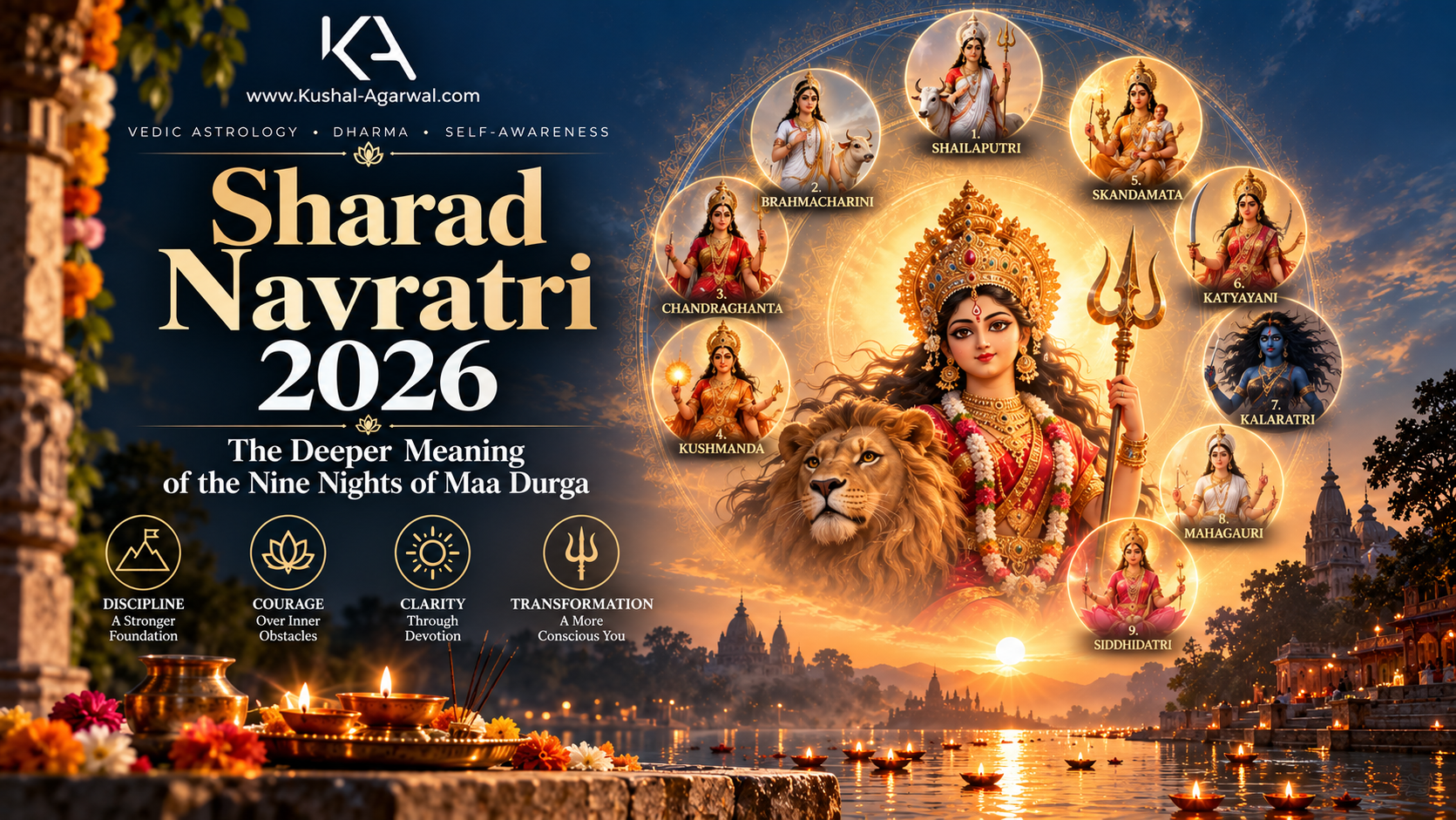
The nine forms of Durga, collectively known as the Navadurga, offer devotees different ways to contemplate the power, compassion, courage and wisdom associated with the Goddess. Read devotionally, they can also serve as a framework for reflecting on one's own inner life.
Why Is Navratri Celebrated for Nine Nights?
The word Navratri combines nava, meaning nine, and ratri, meaning night. The festival is observed in different forms across India, with Sharad Navratri falling during the Hindu lunar month of Ashwin.
The central narrative associated with Durga worship is the Goddess's battle against Mahishasura, a powerful asura whose defeat restores cosmic order. The story is told in the Devi Mahatmya, a foundational text within the Markandeya Purana and an important source for Shakta traditions.
The battle is not merely a story of physical strength. The Goddess represents a power capable of confronting forces that appear overwhelming. Mahishasura's defeat therefore becomes an enduring symbol of the restoration of dharma and the triumph of divine power over destructive forces.
Different traditions explain the nine nights and their rituals in different ways. One useful interpretive approach is to see the festival as a sustained period of devotion: rather than expecting transformation from a single prayer or dramatic moment, the devotee returns to the discipline of worship over successive days.
The Nine Forms of Maa Durga and Their Significance
The Navadurga tradition recognises nine forms of the Goddess. The sequence is widely used during Navratri, although regional customs, ritual procedures and interpretations may differ.
1. Shailaputri: Establishing the Foundation
Shailaputri, the daughter of the mountains, is worshipped on the first day of Navratri. Her association with the mountain evokes steadiness, rootedness and strength.
For a devotee, this is a reminder that spiritual practice needs a foundation. Intention matters, but so do consistency, humility and the willingness to begin again.
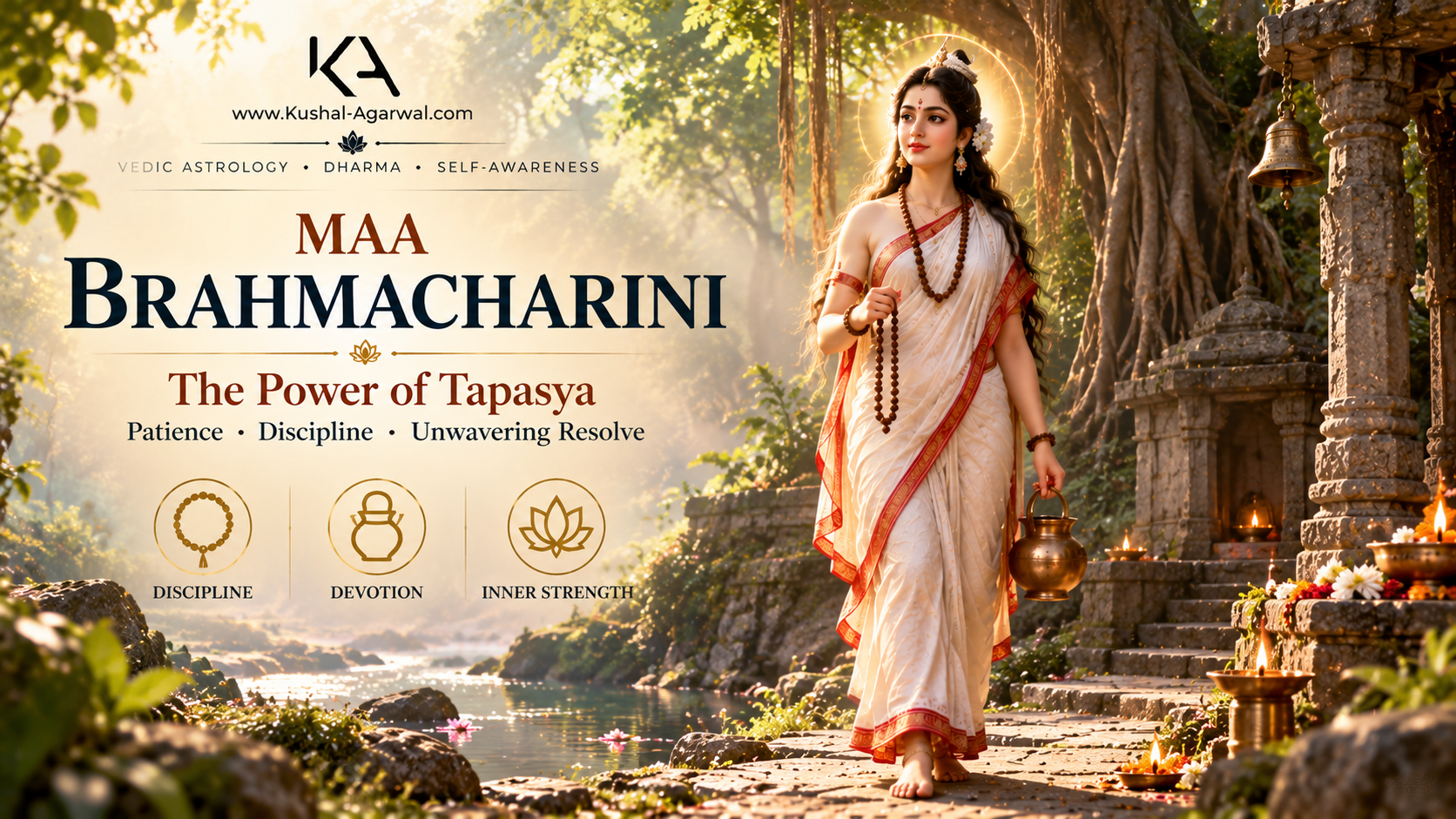
2. Brahmacharini: The Discipline of the Path
Brahmacharini represents austerity, devotion and sustained spiritual effort. Her form is associated with tapasya—the discipline through which a seeker commits to a chosen path.
The lesson is straightforward: enthusiasm can initiate a journey, but discipline sustains it. Whether the objective is spiritual study, ethical living or mastery of a difficult skill, repeated effort is indispensable.
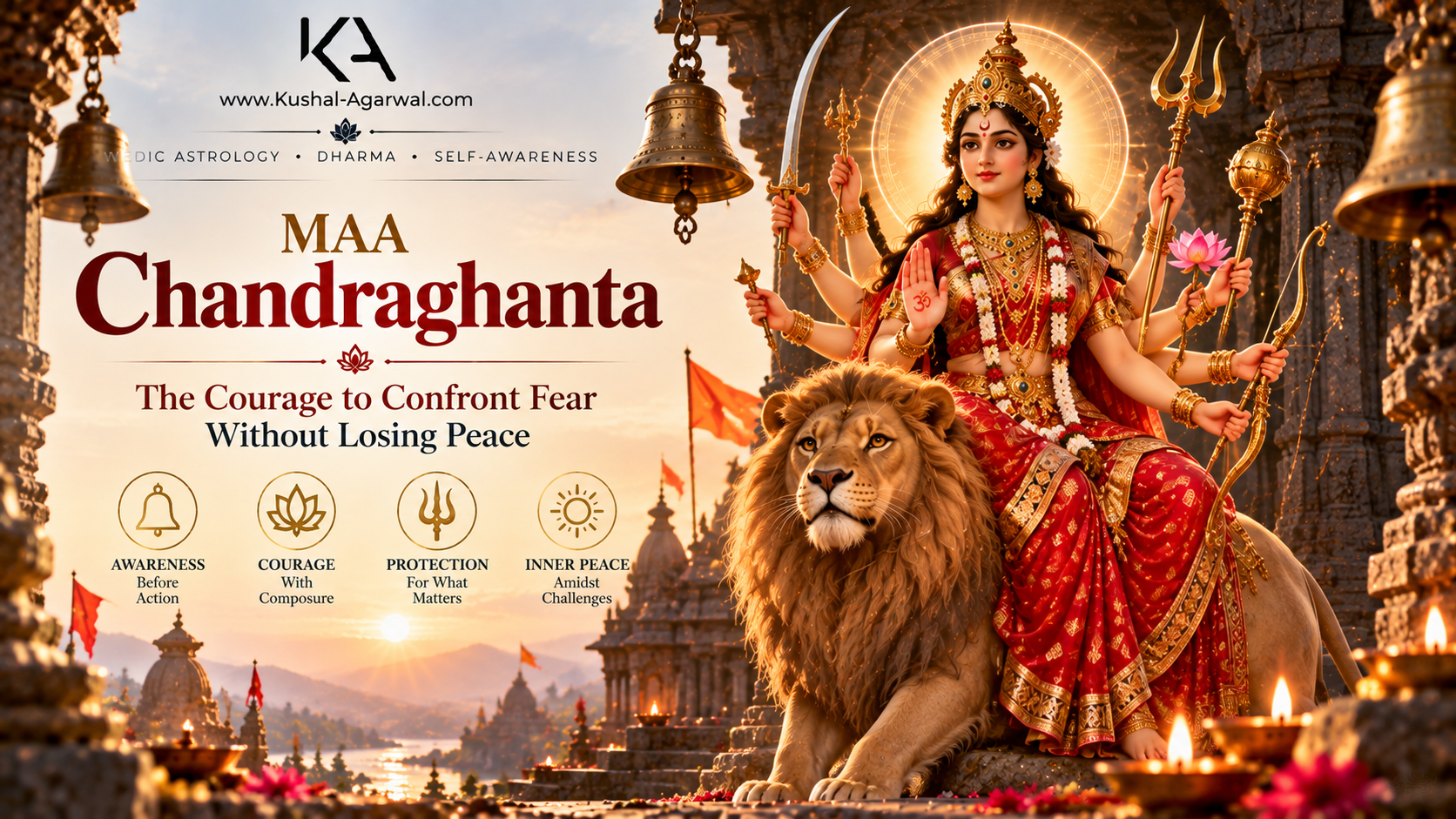
3. Chandraghanta: Courage in the Face of Conflict
Chandraghanta is associated with courage, vigilance and readiness to confront adversity. Her iconography communicates a Goddess prepared to defend dharma.
This form invites reflection on the difference between courage and aggression. Courage is not the absence of fear; it is the capacity to respond appropriately when fear, uncertainty or conflict arises.
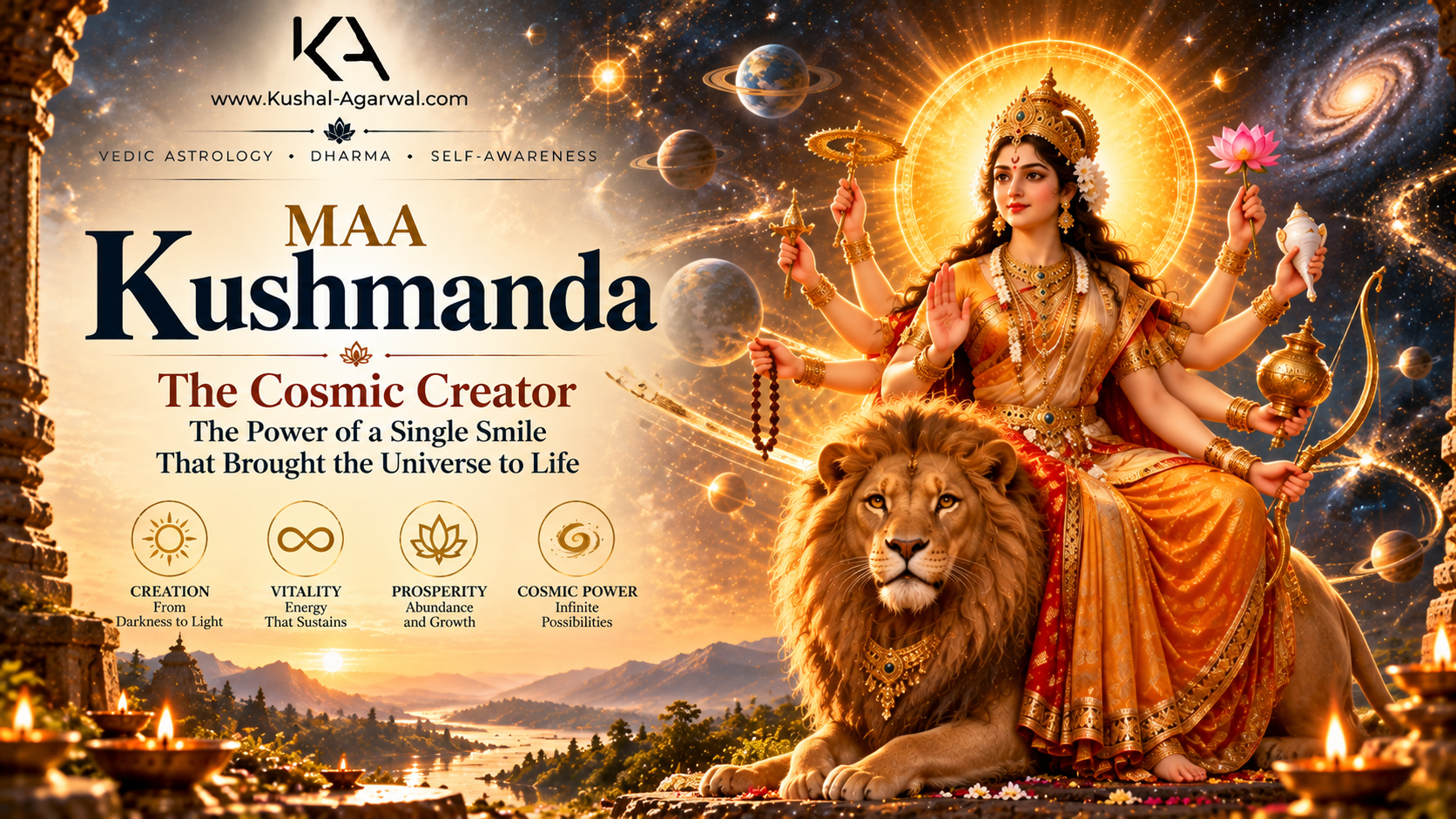
4. Kushmanda: The Creative Power
Kushmanda is traditionally associated with the cosmic creative energy of the Goddess. Her name and symbolism are interpreted in different ways within devotional traditions.
At a personal level, this form can prompt us to consider what we are creating through our thoughts, choices and actions. Life is not shaped only by the circumstances we inherit. It is also shaped by the things we repeatedly choose to build.
5. Skandamata: Care and Responsibility
Skandamata, the mother of Skanda, expresses the maternal aspect of the Goddess. Her form evokes care, protection and responsibility.
Spiritual strength need not always appear as confrontation. It may also be expressed through nurturing others, fulfilling obligations and protecting what is vulnerable.
6. Katyayani: The Power to Act
Katyayani is associated with the fierce and protective power of Durga. Her worship is often connected with courage and the removal of obstacles.
Her symbolism raises a practical question: when we recognise that something is wrong, are we prepared to act? Awareness without action can leave a problem untouched. The challenge is to act with conviction while remaining guided by dharma.
7. Kalaratri: Confronting the Difficult and Uncomfortable
Kalaratri is among the most formidable forms of the Goddess. Her fierce appearance is associated with the destruction of fear and the overcoming of darkness.
This symbolism should not be reduced to the claim that every difficult event is a divine punishment or that suffering is automatically spiritually beneficial. A more careful reflection is that genuine growth sometimes requires confronting realities we would rather avoid: destructive habits, denial, arrogance or unresolved responsibilities.
Darkness is not overcome by pretending it does not exist.
8. Mahagauri: Purification and Renewal
Mahagauri is associated with purity, serenity and renewal. Following the intensity associated with Kalaratri, her form invites contemplation of peace and clarity.
Purification, in this reflective sense, is not about presenting oneself as flawless. It is about examining one's conduct honestly, correcting mistakes and reducing the gap between one's values and one's actions.
9. Siddhidatri: Fulfilment and Spiritual Accomplishment
Siddhidatri is associated with siddhi, or accomplishment and spiritual attainment. Her worship completes the commonly followed Navadurga sequence.
The concluding form points towards the purpose of sustained practice: not merely accumulating rituals, but cultivating wisdom, steadiness and a more mature relationship with life.
These nine reflections are an interpretive framework, not a claim that every Hindu tradition prescribes the same psychological stages or that every devotee must experience them in a fixed order.
What Does the Story of Mahishasura Teach Us?
The battle between Durga and Mahishasura is central to the festival's religious imagination. In the Devi Mahatmya, the Goddess emerges as the power capable of defeating a formidable adversary and restoring order.
At a symbolic level, Mahishasura can be read as representing the forces that resist restraint and undermine dharma. Such a reading does not replace the traditional narrative; it draws a personal lesson from it.
The most difficult adversary is not always external. Arrogance can distort judgement. Anger can overpower reason. Attachment can prevent us from recognising when a situation has changed. Repeated self-justification can make harmful conduct appear acceptable.
The Goddess's victory invites the devotee to ask a demanding question: what must be confronted before order can be restored?
This is not an invitation to treat every disagreement as a battle between good and evil. It is a call to recognise destructive tendencies without losing discernment, compassion or responsibility.
Navratri, Shakti and the Place of the Divine Feminine
In Shakta traditions, Shakti is understood as divine power. The Goddess is not merely a decorative symbol or a passive recipient of devotion; she occupies a central place in the understanding of cosmic power and divine agency.
The many forms of Durga express different dimensions of that power. Some emphasise protection and courage, others compassion, nourishment, austerity or spiritual attainment.
This diversity is important. Strength is not one-dimensional. A person may need courage in one situation, restraint in another, compassion in a third and the discipline to walk away from something destructive in a fourth.
Navratri's many forms of the Goddess make room for this complexity. They offer devotees multiple ways to approach the Divine Feminine rather than confining divine power to a single image or quality.
Why Fasting and Rituals Matter
Fasting, mantra recitation, puja, meditation and other observances form part of Navratri for many devotees. The exact practices vary by family, region, sampradaya and personal circumstances.
Ritual can create structure for devotion. Fasting may encourage restraint; mantra repetition may support concentration; daily worship may provide a regular period for reflection. These are possible benefits of disciplined practice, not guarantees that a particular ritual will produce a specific worldly result.
It is equally important not to turn observance into a competition. The spiritual value of a practice cannot reliably be measured by how elaborate it appears or how many restrictions a person follows.
Devotion should be approached with sincerity and appropriate regard for one's health and circumstances. Those who cannot fast can still participate through prayer, service, study or remembrance.
What Should an Astrologer Understand About Navratri?
For students and practitioners of Jyotish, Navratri provides an opportunity to distinguish religious observance from astrological claims.
The festival follows the Hindu lunar calendar, and its observance is determined through tithi and traditional calendrical rules. The practical date of rituals such as Ghatasthapana depends on the relevant local Panchang and the observance convention being followed.
A festival's religious significance, however, should not be confused with a universal astrological prediction. Navratri alone does not establish that every person's career, marriage, health or finances will improve during these nine days. Such claims require appropriate evidence and should not be presented as established Jyotish principles without a defensible basis.
Astrologers can explain the festival's calendrical context, its place in Hindu tradition and the devotional significance of the Goddess while being transparent about the limits of predictive claims.
That distinction matters. Respect for tradition does not require exaggeration, and serious spiritual writing is stronger when it separates scriptural symbolism, regional custom and astrological interpretation.
A Practical Reflection for the Nine Nights
If you wish to use Navratri as a period of personal reflection, consider one question each day:
- Shailaputri: What foundation in my life needs strengthening?
- Brahmacharini: Which worthwhile commitment have I failed to sustain?
- Chandraghanta: Where do I need courage without aggression?
- Kushmanda: What am I creating through my repeated choices?
- Skandamata: What responsibilities or relationships require more care?
- Katyayani: Which necessary action am I postponing?
- Kalaratri: What uncomfortable truth must I stop avoiding?
- Mahagauri: What can I correct, simplify or release?
- Siddhidatri: What would genuine fulfilment look like beyond external achievement?
These questions are modern reflective prompts inspired by the symbolism of the Navadurga, not traditional ritual prescriptions. They can accompany worship, study or quiet contemplation.
The Deeper Message of Sharad Navratri
Navratri brings together devotion, mythology, ritual and the worship of Shakti. Its enduring appeal lies partly in the range of meanings it offers: protection, courage, discipline, compassion, renewal and the restoration of dharma.
The nine forms of Durga remind us that strength takes many forms. Sometimes it means confronting an adversary. Sometimes it means restraining an impulse, accepting responsibility, protecting another person or beginning again after failure.
The victory of Maa Durga over Mahishasura remains the festival's central religious narrative. Its personal significance emerges when devotion is accompanied by honest reflection and conduct consistent with the values one professes.
As Sharad Navratri begins on October 11, the invitation is not simply to count nine nights. It is to consider what we worship, what we are willing to change and what kind of strength we seek to cultivate.
May the worship of Maa Durga bring clarity, courage and a deeper commitment to dharma.
SOURCES:
- Drik Panchang — Shardiya Navratri 2026 calendar: https://www.drikpanchang.com/navratri/ashwin-shardiya-navratri-dates.html
- Government of West Bengal — Sahaj Puja Permission Portal, 2026 festival dates: https://sahaj.wb.gov.in/SiteController
- The Times of India — Navratri 2026 dates and Ghatasthapana timing context: https://timesofindia.indiatimes.com/religion/festivals/navratri-2026-start-end-date-is-ghatasthapana-on-october-10-or-11-check-the-full-tithi-schedule/articleshow/134767429.cms
- Markandeya Purana, Devi Mahatmya — traditional narrative of the Goddess and Mahishasura.
SUGGESTED INTERNAL LINKS:
- Mahalaya 2026: The Call of the Ancestors and the Arrival of Maa Durga
- Saturn and Karma in Vedic Astrology
- Saturn Retrograde in Pisces: The Karmic Audit Has Begun
- An introductory guide to Vedic Astrology
Explore more articles on Vedic Astrology, Jyotish, spiritual traditions and occult practice at https://kushal-agarwal.com/.
Want this read for your own chart?
Every session blends Vedic astrology, numerology and counselling psychology — your chart read as architecture, not prophecy. Bring the decision you are actually sitting with, and leave with timing, language and a next step.